Conformity - 16 Mark Essay
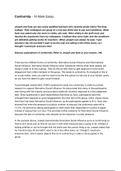
Joseph and Kate are two newly qualified teachers who recently joined Christ The King
College. Their colleagues are going on a one-day strike due to pay and conditions. When
Kate was asked why she went on strike, she said, ‘After sitting in the staff room and
hearing the arguments from my colleagues, I realised they were right, and the conditions
are definitely getting worse for teachers’. When Joseph was asked, he said, ‘I just
fancied a day off and didn’t want to be the only one sitting in the office alone, so I
thought I would join everyone else’.
Discuss explanations of conformity. Refer to Joseph and Kate in your answer. (16)
There are two different forms of conformity; Normative Social Influence and Informational
Social Influence. Normative Social Influence when somebody follows what other people are
doing in order to fit into a group. They do this as they want to gain approval or even avoid
disapproval from other members of the group. This leads to conformity. An example of this is
on social media, when you feel the need to be the first person to like one of your friends' posts,
as you have the desire to gain social rewards.
A psychologist named Asch (1956) conducted a study into conformity in order to provide
research to support Normative Social Influence. He discovered that many of the participants
went along with the majority and provided a distinctly incorrect response to a line judgement
task. When questioned in post-experimental interviews by Asch, participants said they
changed their response to avoid disagreement from the rest of the group, which clearly shows
that there had been Normative Social Influence, as the participants agreed to fit in. Asch also
showed that when the pressure to publicly conform is reduced, the conformity rates fell to
12.5%. He did this by asking participants to write down their responses on a piece of paper
instead of saying them out loud. This provides further evidence for Normative Social Influence,
because the rate of conformity was reduced by the reduction in public pressure.
In the scenario above, Joseph demonstrates Normative Social Influence as he is conforming so
that he isn’t alone and so that he can join in with what everyone else is going to do. Instead of
stating whether or not he thought that the strike was the correct thing to do, Joseph stated that
he ‘fancied a day off and didn’t want to be in the office alone, so I thought I would join
everyone else’, which clearly depicts that he is conforming in order to be accepted in the
group.
Joseph and Kate are two newly qualified teachers who recently joined Christ The King
College. Their colleagues are going on a one-day strike due to pay and conditions. When
Kate was asked why she went on strike, she said, ‘After sitting in the staff room and
hearing the arguments from my colleagues, I realised they were right, and the conditions
are definitely getting worse for teachers’. When Joseph was asked, he said, ‘I just
fancied a day off and didn’t want to be the only one sitting in the office alone, so I
thought I would join everyone else’.
Discuss explanations of conformity. Refer to Joseph and Kate in your answer. (16)
There are two different forms of conformity; Normative Social Influence and Informational
Social Influence. Normative Social Influence when somebody follows what other people are
doing in order to fit into a group. They do this as they want to gain approval or even avoid
disapproval from other members of the group. This leads to conformity. An example of this is
on social media, when you feel the need to be the first person to like one of your friends' posts,
as you have the desire to gain social rewards.
A psychologist named Asch (1956) conducted a study into conformity in order to provide
research to support Normative Social Influence. He discovered that many of the participants
went along with the majority and provided a distinctly incorrect response to a line judgement
task. When questioned in post-experimental interviews by Asch, participants said they
changed their response to avoid disagreement from the rest of the group, which clearly shows
that there had been Normative Social Influence, as the participants agreed to fit in. Asch also
showed that when the pressure to publicly conform is reduced, the conformity rates fell to
12.5%. He did this by asking participants to write down their responses on a piece of paper
instead of saying them out loud. This provides further evidence for Normative Social Influence,
because the rate of conformity was reduced by the reduction in public pressure.
In the scenario above, Joseph demonstrates Normative Social Influence as he is conforming so
that he isn’t alone and so that he can join in with what everyone else is going to do. Instead of
stating whether or not he thought that the strike was the correct thing to do, Joseph stated that
he ‘fancied a day off and didn’t want to be in the office alone, so I thought I would join
everyone else’, which clearly depicts that he is conforming in order to be accepted in the
group.