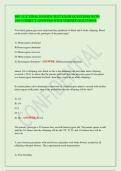
BIO 311C FINAL HANSEN TEST EXAM QUESTIONS WITH
100- CORRECT ANSWERS WITH VERIFIED SOLUTIONS
Two black guinea pigs were mated and they produced 14 black and 6 white offspring. Based
on the results what are the genotypes of the parent pigs?
A) Homozygous dominant
B)Heterozygous dominant
C) Homozygous recessive
D) Heterozygous recessive
E) Hemizygous dominant - ANSWER: B)Heterozygous dominant
almost 3/4 of offspring were black so this is the dominant trait and since white offspring
occurred (~25%) we know that the parents must both have the recessive gene (if one parent
was homozygous dominant for black, then there would be no white offspring)
In certain plants, tall is dominant to short trait. If a heterozygous plant is crossed with another
heterozygous (tall) plant, what is the probability that the offspring will be short?
A) 1/2
B) 1/4
C) 0
D) 1
E) 1/6 - ANSWER: B) 1/4
The parents' genotype is Tt because they are both heterozygous tall. The punnet square would
indicate 3/4 chance that the offspring will be tall (TT, Tt, Tt) and 1/4 chance they will be
short (tt)
A cross between pea plants with red flowers and plants with white flowers resulted in all
offspring with pink flowers. This experimental result demonstrates
A) True-breeding.
,B) Blending model of genetics.
C) Dominance.
D)Incomplete dominance
E) Epistasis - ANSWER: D)Incomplete dominance
This is correct. The heterozygotes show an intermediate phenotype between the parent,
homozygotes.
A couple without any cystic fibrosis symptoms have their first child showing symptoms of
cystic fibrosis.
What is the probability that their next child will be a carrier for cystic fibrosis ?
A) 0%
B)50%
C) 25%
D) 100%
E) 75% - ANSWER: B)50%
CF is recessive, so in order to have it, the child must be homozygous for the gene. When you
do a test cross, you can see that 50% will be a carrier (heterozygous - Aa) while 25% will be
homozygous dominant (non-carrier - AA) and 25% will have CF (homozygous recessive -
aa)
In crossing a homozygous recessive with a heterozygote, what is the chance of getting an
offspring with the homozygous dominant?
A)0%
B) 75%
C) 25%
D) 100%
E) 50% - ANSWER: A)0%
, This is correct. Each parent donates one copy of the allele, so if one parent is homozygous
recessive, they do not have the dominant allele so cannot pass it along.
Black fur in mice (B) is dominant to brown fur (b). Short tails (T) are dominant to long tails
(t).
What fraction of the progeny of the cross BbTt × BBtt will have black fur and long tails?
A) 1/16
B) 3/16
C) 3/8
D)1/2
E) 9/16 - ANSWER: D)1/2
Since one parent is homozygous for black fur (BB) you know all offspring will have black
fur. now just look at the percent that will have long tails when you do the cross.
Which of the following experimental treatments proved the "transforming principle" (later
identified as DNA) is the genetic material?
A) Infection of mice with pathogenic strain resulting in no disease.
B) Infection of mice with E. coli strain showing it can cause death.
C)Infection of live pathogenic strain mixed with dead non-pathogenic strain, causing disease.
D)Infection of dead pathogenic strain mixed with live non-pathogenic strain, causing disease.
E) Infection of dead pathogenic strain mixed with dead E.coli strain, causing disease. -
ANSWER: D)Infection of dead pathogenic strain mixed with live non-pathogenic strain,
causing disease.
Review this experiment. rough (non-pathogenic) bacteria was mixed with dead, smooth
(pathogenic) bacteria, and this caused disease. This does not necessarily show that DNA is
the genetic material, but shows that "something" from the dead strain was passed to the live,
non-pathogenic strain.
100- CORRECT ANSWERS WITH VERIFIED SOLUTIONS
Two black guinea pigs were mated and they produced 14 black and 6 white offspring. Based
on the results what are the genotypes of the parent pigs?
A) Homozygous dominant
B)Heterozygous dominant
C) Homozygous recessive
D) Heterozygous recessive
E) Hemizygous dominant - ANSWER: B)Heterozygous dominant
almost 3/4 of offspring were black so this is the dominant trait and since white offspring
occurred (~25%) we know that the parents must both have the recessive gene (if one parent
was homozygous dominant for black, then there would be no white offspring)
In certain plants, tall is dominant to short trait. If a heterozygous plant is crossed with another
heterozygous (tall) plant, what is the probability that the offspring will be short?
A) 1/2
B) 1/4
C) 0
D) 1
E) 1/6 - ANSWER: B) 1/4
The parents' genotype is Tt because they are both heterozygous tall. The punnet square would
indicate 3/4 chance that the offspring will be tall (TT, Tt, Tt) and 1/4 chance they will be
short (tt)
A cross between pea plants with red flowers and plants with white flowers resulted in all
offspring with pink flowers. This experimental result demonstrates
A) True-breeding.
,B) Blending model of genetics.
C) Dominance.
D)Incomplete dominance
E) Epistasis - ANSWER: D)Incomplete dominance
This is correct. The heterozygotes show an intermediate phenotype between the parent,
homozygotes.
A couple without any cystic fibrosis symptoms have their first child showing symptoms of
cystic fibrosis.
What is the probability that their next child will be a carrier for cystic fibrosis ?
A) 0%
B)50%
C) 25%
D) 100%
E) 75% - ANSWER: B)50%
CF is recessive, so in order to have it, the child must be homozygous for the gene. When you
do a test cross, you can see that 50% will be a carrier (heterozygous - Aa) while 25% will be
homozygous dominant (non-carrier - AA) and 25% will have CF (homozygous recessive -
aa)
In crossing a homozygous recessive with a heterozygote, what is the chance of getting an
offspring with the homozygous dominant?
A)0%
B) 75%
C) 25%
D) 100%
E) 50% - ANSWER: A)0%
, This is correct. Each parent donates one copy of the allele, so if one parent is homozygous
recessive, they do not have the dominant allele so cannot pass it along.
Black fur in mice (B) is dominant to brown fur (b). Short tails (T) are dominant to long tails
(t).
What fraction of the progeny of the cross BbTt × BBtt will have black fur and long tails?
A) 1/16
B) 3/16
C) 3/8
D)1/2
E) 9/16 - ANSWER: D)1/2
Since one parent is homozygous for black fur (BB) you know all offspring will have black
fur. now just look at the percent that will have long tails when you do the cross.
Which of the following experimental treatments proved the "transforming principle" (later
identified as DNA) is the genetic material?
A) Infection of mice with pathogenic strain resulting in no disease.
B) Infection of mice with E. coli strain showing it can cause death.
C)Infection of live pathogenic strain mixed with dead non-pathogenic strain, causing disease.
D)Infection of dead pathogenic strain mixed with live non-pathogenic strain, causing disease.
E) Infection of dead pathogenic strain mixed with dead E.coli strain, causing disease. -
ANSWER: D)Infection of dead pathogenic strain mixed with live non-pathogenic strain,
causing disease.
Review this experiment. rough (non-pathogenic) bacteria was mixed with dead, smooth
(pathogenic) bacteria, and this caused disease. This does not necessarily show that DNA is
the genetic material, but shows that "something" from the dead strain was passed to the live,
non-pathogenic strain.