Applied Sport & Exercise Psychology- Lecture 8- Interviews
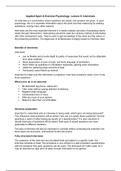
An interview is a conversation where questions are asked, and answers are given. In sport
psychology, this is to ascertain information about the client and their reasoning for seeking
assistance, among many other reasons.
Interviews are the most important element in a needs analysis (process of assessing clients
needs through intervention). Interviewing should be used as a primary method of information
with other assessment tools. They’re used to gain knowledge of the client and the nature of
the presenting problems. The diagnoses of professionals is largely based on interview data.
Benefits of interviews
Interviews:
can be flexible and provide depth & quality of responses that would not be attainable
from other methods.
Allow observation of tone of reply, and body language of participant.
Allow follow-up questions to unforeseen responses, gaining more information.
Useful for gathering large amounts of data
Particularly useful follow-up method
Important to make sure the interviewer is prepared- must have questions ready, even if only
loose questions.
What not to do in an interview
Be distracted (eg phone, laptop etc)
Take notes without paying attention & listening.
Negative body language.
Uninterested tone of voice.
Offer too much of your opinion.
Make the client feel uncomfortable.
Interview preparation
Important to understand why an interview is being used- what topics are being discussed?
This influences what questions will be asked. How can you justify these questions? Are the
questions a result of other testing eg results on a questionnaire? It is also important to
decide what type of questions will be asked. Both open & closed questions are more
applicable to different situations.
The type of interview will also be important to consider before conducting the interview- the
three types are structured, unstructured & semi-structured.
Fully structured interviews
The questions of this interview are pre-determined and asked in a specific order- the
interview schedule is fixed. The procedure is very similar to a self-completion questionnaire,
with the exception that open questions can be used. This technique isn’t often used, as it
may be deemed too rigid and not allow enough information to be gained.
An interview is a conversation where questions are asked, and answers are given. In sport
psychology, this is to ascertain information about the client and their reasoning for seeking
assistance, among many other reasons.
Interviews are the most important element in a needs analysis (process of assessing clients
needs through intervention). Interviewing should be used as a primary method of information
with other assessment tools. They’re used to gain knowledge of the client and the nature of
the presenting problems. The diagnoses of professionals is largely based on interview data.
Benefits of interviews
Interviews:
can be flexible and provide depth & quality of responses that would not be attainable
from other methods.
Allow observation of tone of reply, and body language of participant.
Allow follow-up questions to unforeseen responses, gaining more information.
Useful for gathering large amounts of data
Particularly useful follow-up method
Important to make sure the interviewer is prepared- must have questions ready, even if only
loose questions.
What not to do in an interview
Be distracted (eg phone, laptop etc)
Take notes without paying attention & listening.
Negative body language.
Uninterested tone of voice.
Offer too much of your opinion.
Make the client feel uncomfortable.
Interview preparation
Important to understand why an interview is being used- what topics are being discussed?
This influences what questions will be asked. How can you justify these questions? Are the
questions a result of other testing eg results on a questionnaire? It is also important to
decide what type of questions will be asked. Both open & closed questions are more
applicable to different situations.
The type of interview will also be important to consider before conducting the interview- the
three types are structured, unstructured & semi-structured.
Fully structured interviews
The questions of this interview are pre-determined and asked in a specific order- the
interview schedule is fixed. The procedure is very similar to a self-completion questionnaire,
with the exception that open questions can be used. This technique isn’t often used, as it
may be deemed too rigid and not allow enough information to be gained.