DECA Marketing Performance Indicators|
QUESTIONS AND ANSWERS | 2025/2026
UPDATE | WITH COMPLETE SOLUTION!!!
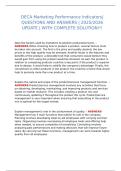
Describe factors used by marketers to position products/services. -
ANSWERS-When choosing how to present a product, several factors must
be taken into account. The first is the price and quality desired; the low
prices or the high quality may be stressed. Another factor is the features and
benefits of the product; a desirable trait that consumers would believe they
would gain from using the product would be stressed. As well, the product in
relation to competing products could be a key point; if the product is superior
due to design, it would help to solidify the company's advantage. Finally, the
connections to other products in the product line could be a factor that would
help to promote more than one product at a time.
Explain the nature and scope of the product/services management function. -
ANSWERS-Product/service management involves any activities that focus
on obtaining, developing, maintaining, and improving products and services
based on market research. This includes creating a product mix and
continuously updating it throughout the product life cycle. Product/service
management is very important when ensuring that everything in the product
mix is optimal for the target market.
Explain management's role in the achievement of quality. - ANSWERS-
Management has 3 main functions that outline its role in the company.
Planning involves developing steps to aid employees with carrying out their
tasks. Organizing involves overseeing all employee tasks and offering help
when needed, to ensure completion of everything. Controlling involves
analyzing past performances and making decisions that will improve future
tasks. By carrying out these functions, management can work towards higher
quality from all employees.
,Explain the concept of marketing strategies. - ANSWERS-Marketing
strategies are plans that identify target markets and coordinate marketing
mix activities in order to effectively sell the product/service. The product
positioning and key points of difference must be taken into account when
developing these strategies.
Identify communication channels used in sales promotions. - ANSWERS-
Sales promotions can be communicated to consumers in a variety of ways.
Word-of-mouth, standard media, and online websites are all popular choices
for sales promotions, as well as more subtle places such as product
placement and point-of-purchase displays.
Explain the concept of market and market identification. - ANSWERS-A
market is a group of consumers who have a common interest, need or want
of a given good or service. This group of consumers also must be able to
purchase the product. Identifying a market is an important activity in
marketing as products will not appeal to everyone. Marketers identify
markets' common interests by classifying consumer's demographic,
geographic and psychographic information. Examples of this information
include age, income, education, zip code, buying behavior, and leisure
activities.
Identify the elements of the promotional mix. - ANSWERS-There are five
main elements of the promotional mix, which can be remembered using the
acronym PPADS. Personal selling is when sales representatives sell products
by communicating directly with the consumer. Public relations involve
managing the company's perceived image through non-paid advertising and
different media channels. Advertising is any paid, non-personal activity that
serves to promote the product. Direct marketing is advertising that is
targeted at groups of potential consumers, using market segmentation. Sales
promotion involves limited time offers that are used to promote sales. The
elements of the promotion mix are personal selling, advertising, public
relations, and sales promotion. Personal selling is direct contact between a
salesperson and customer. Advertising is a form of nonpersonal promotion.
Public relations is the development of a favorable image for a company, its
products or its policies. Sales promotion includes activities that are used to
create purchases and sales not related to the other types of promotion.
, Coordinate activities in the promotional mix. - ANSWERS-For our company,
I'd like to propose the following promotional plan. For personal selling, we will
have employees stationed in every department of our store. For public
relations, we will release updates regarding our product lines in the form of
press releases every 6 months. For advertising, we will utilize traditional
media (e.g. TV and radio ads, newspaper, etc.) as well as social media via
our Facebook page and Twitter feed. For direct marketing, we will promote a
30% discount for seniors during the Monday-Friday 9am-4pm period. Finally,
for sales promotion, we will hold a 3-week contest for a Caribbean cruise, for
customers with purchases over $50. By releasing these promotions over a
time period of approximately 4 months, we can regulate the flow of
customers and steadily draw in potential customers for the business.
Explain the types of promotion. - ANSWERS-There are 2 main types of
promotion. The first type is trade promotion, which is focused on building
support from intermediaries in the distribution channels. An example would
be setting up a booth at a trade show. The second type is consumer
promotion, which is focused on getting the final consumer to buy the
product. An example would be giving out coupons. Both promotion types are
necessary in order to increase the number of distribution channels and the
size of the consumer base.
Explain key factors in building a clientele. - ANSWERS-When building a
clientele, there are 3 main factors that must be considered. The first factor is
making the sale, which includes all activities that sales representatives
perform when interacting with consumers during the selling process. The
second factor is after-sales activities, which includes order processing and
payment, the customer's departure from the store, follow-up after the
purchase, customer service and tracking, and evaluation of employee
performance. The third factor is customer relationship management, which
involves seeking out customers and keeping them satisfied with the use of
technology and customer loyalty techniques.
Explain the role of customer services as a component of selling relationships.
- ANSWERS-Customer service is the direct link between the business and
QUESTIONS AND ANSWERS | 2025/2026
UPDATE | WITH COMPLETE SOLUTION!!!
Describe factors used by marketers to position products/services. -
ANSWERS-When choosing how to present a product, several factors must
be taken into account. The first is the price and quality desired; the low
prices or the high quality may be stressed. Another factor is the features and
benefits of the product; a desirable trait that consumers would believe they
would gain from using the product would be stressed. As well, the product in
relation to competing products could be a key point; if the product is superior
due to design, it would help to solidify the company's advantage. Finally, the
connections to other products in the product line could be a factor that would
help to promote more than one product at a time.
Explain the nature and scope of the product/services management function. -
ANSWERS-Product/service management involves any activities that focus
on obtaining, developing, maintaining, and improving products and services
based on market research. This includes creating a product mix and
continuously updating it throughout the product life cycle. Product/service
management is very important when ensuring that everything in the product
mix is optimal for the target market.
Explain management's role in the achievement of quality. - ANSWERS-
Management has 3 main functions that outline its role in the company.
Planning involves developing steps to aid employees with carrying out their
tasks. Organizing involves overseeing all employee tasks and offering help
when needed, to ensure completion of everything. Controlling involves
analyzing past performances and making decisions that will improve future
tasks. By carrying out these functions, management can work towards higher
quality from all employees.
,Explain the concept of marketing strategies. - ANSWERS-Marketing
strategies are plans that identify target markets and coordinate marketing
mix activities in order to effectively sell the product/service. The product
positioning and key points of difference must be taken into account when
developing these strategies.
Identify communication channels used in sales promotions. - ANSWERS-
Sales promotions can be communicated to consumers in a variety of ways.
Word-of-mouth, standard media, and online websites are all popular choices
for sales promotions, as well as more subtle places such as product
placement and point-of-purchase displays.
Explain the concept of market and market identification. - ANSWERS-A
market is a group of consumers who have a common interest, need or want
of a given good or service. This group of consumers also must be able to
purchase the product. Identifying a market is an important activity in
marketing as products will not appeal to everyone. Marketers identify
markets' common interests by classifying consumer's demographic,
geographic and psychographic information. Examples of this information
include age, income, education, zip code, buying behavior, and leisure
activities.
Identify the elements of the promotional mix. - ANSWERS-There are five
main elements of the promotional mix, which can be remembered using the
acronym PPADS. Personal selling is when sales representatives sell products
by communicating directly with the consumer. Public relations involve
managing the company's perceived image through non-paid advertising and
different media channels. Advertising is any paid, non-personal activity that
serves to promote the product. Direct marketing is advertising that is
targeted at groups of potential consumers, using market segmentation. Sales
promotion involves limited time offers that are used to promote sales. The
elements of the promotion mix are personal selling, advertising, public
relations, and sales promotion. Personal selling is direct contact between a
salesperson and customer. Advertising is a form of nonpersonal promotion.
Public relations is the development of a favorable image for a company, its
products or its policies. Sales promotion includes activities that are used to
create purchases and sales not related to the other types of promotion.
, Coordinate activities in the promotional mix. - ANSWERS-For our company,
I'd like to propose the following promotional plan. For personal selling, we will
have employees stationed in every department of our store. For public
relations, we will release updates regarding our product lines in the form of
press releases every 6 months. For advertising, we will utilize traditional
media (e.g. TV and radio ads, newspaper, etc.) as well as social media via
our Facebook page and Twitter feed. For direct marketing, we will promote a
30% discount for seniors during the Monday-Friday 9am-4pm period. Finally,
for sales promotion, we will hold a 3-week contest for a Caribbean cruise, for
customers with purchases over $50. By releasing these promotions over a
time period of approximately 4 months, we can regulate the flow of
customers and steadily draw in potential customers for the business.
Explain the types of promotion. - ANSWERS-There are 2 main types of
promotion. The first type is trade promotion, which is focused on building
support from intermediaries in the distribution channels. An example would
be setting up a booth at a trade show. The second type is consumer
promotion, which is focused on getting the final consumer to buy the
product. An example would be giving out coupons. Both promotion types are
necessary in order to increase the number of distribution channels and the
size of the consumer base.
Explain key factors in building a clientele. - ANSWERS-When building a
clientele, there are 3 main factors that must be considered. The first factor is
making the sale, which includes all activities that sales representatives
perform when interacting with consumers during the selling process. The
second factor is after-sales activities, which includes order processing and
payment, the customer's departure from the store, follow-up after the
purchase, customer service and tracking, and evaluation of employee
performance. The third factor is customer relationship management, which
involves seeking out customers and keeping them satisfied with the use of
technology and customer loyalty techniques.
Explain the role of customer services as a component of selling relationships.
- ANSWERS-Customer service is the direct link between the business and