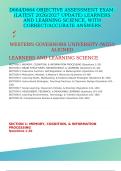
D664/D664 OBJECTIVE ASSESSMENT EXAM:
(LATEST 2026/2027 UPDATE) LEARNERS
AND LEARNING SCIENCE, WITH
CORRECT/ACCURATE ANSWERS
WESTERN GOVERNORS UNIVERSITY (WGU)
ALIGNED
LEARNERS AND LEARNING SCIENCE
SECTION 1: MEMORY, COGNITION, & INFORMATION PROCESSING (Questions 1–20)
SECTION 2: BRAIN STRUCTURES, NEUROSCIENCE, & LEARNING (Questions 21–40)
SECTION 3: Executive Function, Self-Regulation, & Metacognition (Questions 41–60)
SECTION 4: Motivation, Mindset, & Maslow’s Hierarchy (Questions 61–80)
SECTION 5: Learning Myths, Multitasking, & Evidence-Based Strategies (Questions 81–100)
SECTION 6: Instructional Strategies, Teaching Practices, & Classroom Design (Questions 101–
120)
SECTION 7: Social Learning, Classroom Climate, & Diversity (Questions 121–140)
SECTION 8: ASSESSMENT, FEEDBACK, & MEASURING LEARNING Questions 141–160
SECTION 9: Learning Environments, Technology, & Transfer (Questions 161–180)
SECTION 10: Comprehensive Review & Application (Questions 181–200)
SECTION 1: MEMORY, COGNITION, & INFORMATION
PROCESSING
Questions 1–20
,Question 1
What characterizes retrieval in the context of memory?
a) The process of remembering information over time
b) The process of bringing stored information into conscious awareness
c) The process of forgetting information due to lack of use
d) The process of initially placing information into memory
Correct Answer: b) The process of bringing stored information into conscious
awareness
Rationale:
Retrieval refers specifically to accessing information that has already been encoded
and stored in memory. It is an active cognitive process that brings stored knowledge
into conscious awareness for use. Unlike encoding or storage, retrieval determines
whether learned information can be applied when needed. Effective learning
strategies often focus on strengthening retrieval through practice.
Question 2
Which stage of memory involves the initial processing and organization of
information?
a) Retrieval
b) Storage
c) Encoding
d) Consolidation
Correct Answer: c) Encoding
Rationale:
Encoding is the first stage of memory formation and involves transforming sensory
input into a format that can be stored in the brain. This stage determines how well
information will later be remembered. Strategies such as elaboration, visualization,
and organization improve encoding quality. Weak encoding leads to poor recall even if
storage systems are intact.
,Question 3
Which type of memory is responsible for holding information briefly while it is actively
being used?
a) Long-term memory
b) Sensory memory
c) Working memory
d) Episodic memory
Correct Answer: c) Working memory
Rationale:
Working memory temporarily holds and manipulates information during cognitive
tasks such as problem-solving or reading. It has limited capacity and duration, making
it easily overloaded. Instructional strategies should reduce cognitive load to support
working memory function. When overloaded, learning efficiency decreases
significantly.
Question 4
Why is working memory considered a bottleneck in learning?
a) It stores information permanently
b) It has limited capacity and duration
c) It operates unconsciously
d) It processes emotional responses
Correct Answer: b) It has limited capacity and duration
Rationale:
Working memory can only hold a small amount of information at one time, typically 4–
7 items. This limitation constrains how much new information learners can process
simultaneously. Instruction that overloads working memory reduces comprehension
and retention. Effective teaching scaffolds information to avoid overload.
, Question 5
Which instructional strategy best supports long-term memory retention?
a) Re-reading content repeatedly
b) Massed practice
c) Retrieval practice
d) Passive listening
Correct Answer: c) Retrieval practice
Rationale:
Retrieval practice strengthens memory by requiring learners to actively recall
information. This process reinforces neural pathways and improves long-term
retention more effectively than passive review. Testing and self-quizzing are examples
of retrieval practice. Research consistently shows retrieval practice enhances durable
learning.
Question 6
What is the primary function of sensory memory?
a) Long-term storage of knowledge
b) Emotional regulation
c) Brief retention of sensory input
d) Complex problem-solving
Correct Answer: c) Brief retention of sensory input
Rationale:
Sensory memory holds incoming sensory information for a very brief period, usually
less than a few seconds. It allows the brain to determine which stimuli deserve further
attention. Without sensory memory, information would not reach working memory. It
acts as the gateway to further cognitive processing.
(LATEST 2026/2027 UPDATE) LEARNERS
AND LEARNING SCIENCE, WITH
CORRECT/ACCURATE ANSWERS
WESTERN GOVERNORS UNIVERSITY (WGU)
ALIGNED
LEARNERS AND LEARNING SCIENCE
SECTION 1: MEMORY, COGNITION, & INFORMATION PROCESSING (Questions 1–20)
SECTION 2: BRAIN STRUCTURES, NEUROSCIENCE, & LEARNING (Questions 21–40)
SECTION 3: Executive Function, Self-Regulation, & Metacognition (Questions 41–60)
SECTION 4: Motivation, Mindset, & Maslow’s Hierarchy (Questions 61–80)
SECTION 5: Learning Myths, Multitasking, & Evidence-Based Strategies (Questions 81–100)
SECTION 6: Instructional Strategies, Teaching Practices, & Classroom Design (Questions 101–
120)
SECTION 7: Social Learning, Classroom Climate, & Diversity (Questions 121–140)
SECTION 8: ASSESSMENT, FEEDBACK, & MEASURING LEARNING Questions 141–160
SECTION 9: Learning Environments, Technology, & Transfer (Questions 161–180)
SECTION 10: Comprehensive Review & Application (Questions 181–200)
SECTION 1: MEMORY, COGNITION, & INFORMATION
PROCESSING
Questions 1–20
,Question 1
What characterizes retrieval in the context of memory?
a) The process of remembering information over time
b) The process of bringing stored information into conscious awareness
c) The process of forgetting information due to lack of use
d) The process of initially placing information into memory
Correct Answer: b) The process of bringing stored information into conscious
awareness
Rationale:
Retrieval refers specifically to accessing information that has already been encoded
and stored in memory. It is an active cognitive process that brings stored knowledge
into conscious awareness for use. Unlike encoding or storage, retrieval determines
whether learned information can be applied when needed. Effective learning
strategies often focus on strengthening retrieval through practice.
Question 2
Which stage of memory involves the initial processing and organization of
information?
a) Retrieval
b) Storage
c) Encoding
d) Consolidation
Correct Answer: c) Encoding
Rationale:
Encoding is the first stage of memory formation and involves transforming sensory
input into a format that can be stored in the brain. This stage determines how well
information will later be remembered. Strategies such as elaboration, visualization,
and organization improve encoding quality. Weak encoding leads to poor recall even if
storage systems are intact.
,Question 3
Which type of memory is responsible for holding information briefly while it is actively
being used?
a) Long-term memory
b) Sensory memory
c) Working memory
d) Episodic memory
Correct Answer: c) Working memory
Rationale:
Working memory temporarily holds and manipulates information during cognitive
tasks such as problem-solving or reading. It has limited capacity and duration, making
it easily overloaded. Instructional strategies should reduce cognitive load to support
working memory function. When overloaded, learning efficiency decreases
significantly.
Question 4
Why is working memory considered a bottleneck in learning?
a) It stores information permanently
b) It has limited capacity and duration
c) It operates unconsciously
d) It processes emotional responses
Correct Answer: b) It has limited capacity and duration
Rationale:
Working memory can only hold a small amount of information at one time, typically 4–
7 items. This limitation constrains how much new information learners can process
simultaneously. Instruction that overloads working memory reduces comprehension
and retention. Effective teaching scaffolds information to avoid overload.
, Question 5
Which instructional strategy best supports long-term memory retention?
a) Re-reading content repeatedly
b) Massed practice
c) Retrieval practice
d) Passive listening
Correct Answer: c) Retrieval practice
Rationale:
Retrieval practice strengthens memory by requiring learners to actively recall
information. This process reinforces neural pathways and improves long-term
retention more effectively than passive review. Testing and self-quizzing are examples
of retrieval practice. Research consistently shows retrieval practice enhances durable
learning.
Question 6
What is the primary function of sensory memory?
a) Long-term storage of knowledge
b) Emotional regulation
c) Brief retention of sensory input
d) Complex problem-solving
Correct Answer: c) Brief retention of sensory input
Rationale:
Sensory memory holds incoming sensory information for a very brief period, usually
less than a few seconds. It allows the brain to determine which stimuli deserve further
attention. Without sensory memory, information would not reach working memory. It
acts as the gateway to further cognitive processing.