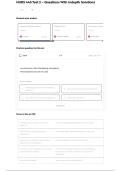
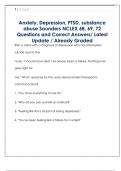
NURS 445 Test 2 – Questions With Indepth Solutions
Save
Students also studied
Sherpath: Diabetes Mellitus Chapter 21 Test Case Study 4 (Short
30 terms 24 terms 22 terms
jesssbee Preview kenanderson2017 Preview Brittany182
Practice questions for this set
Learn 1 /7 Study using Learn
-can become a life-threatening emergency.
-Phenobarbital should be used.
Choose an answer
What are 2 factors that are important in
1 2 2 key points of acute alcohol withdrawal
health hx?
3 key points of the renal/urinary system (2) 4 What is the Katz Index?
Don't know?
Terms in this set (78)
What are 2 factors that are important in current meds/dietary supplements and functional hx.
health hx?
What 2 tools are used for a cognitive mini-mental state examination (MMSE) and mini-cog.
assessment?
What 2 tools are used for a psychological geriatric depression scale (GDS) and PSQ 9.
assessment/dx for depression?
What tool is used to identify risk factors and SPICES (sleep disorders, problems w/ eating/feeding,
complications for older pts incontinence, confusion, evidence of falls, and skin
breakdown).
What is the Katz Index? basic framework for measuring ADLs.
, What are IADLs (instrumental ADLs) activities that are more complex and look at how the older
adult interacts to environment and community (cooking,
driving, shopping, and yard work).
What are AADLs (advanced ADLs) societal, family, and community roles as well as occupational
and recreational activities (hobbies and working).
what is FIFE and what is it used for? frailty index for elders; assesses for frailty in older adults.
2 key points about frailty in elders hallmark is a progressive decrease in fx and it's hard to revere
frailty decline.
key points of the CV system (7) -diastolic murmurs are never normal.
-decline in cardiac reserve.
-mild systolic murmurs.
-arterial stiffness.
-reduced CO.
-increased left atrium/left ventricle wall thickness.
-increased HR, dyspnea, and muscle fatigue.
key points of the peripheral vascular system -arteries: reduced elasticity and narrowing (most significant).
(4) -blood flow remains normal.
-veins/valves: stretched and less efficient.
-pooling of blood = increased venous pressure and edema.
key points of the respiratory system (5) -alveolar surface area decreases (air trapping).
-loss of elastic recoil (decreased respiratory muscle strength).
-chest wall stiffness (decreased pulmonary blood exchange).
-lowered efficacy of gas exchange/decreased ability to
handle secretions (increased AP diameter and decreased
action of cilia).
-increased respiratory disease at age 50.
key points of the renal/urinary system (2) -loss of nephrons, kidney mass, and ability to concentrate
urine.
-urinary incontinence is not a normal part of aging.
explain transient urinary incontinence (4) -sudden onset and acute.
-caused by treatable factors.
-hospitalized older adults.
-meds: diuretics, anticholinergics, and CCB's cause UI.
explain established urinary incontinence (6) -sudden/gradual onset.
-stress: increased abd pressure (cough/sneeze).
-urge: overactive bladder.
-overflow: hesitancy; BPH.
-functional: environmental factors are the problem.
-mixed: combo of 2 (usually stress and urge).
key points of the musculoskeletal system (4) -none are life-threatening.
-vertebral disks become thinner as result of gravity and
dehydration.
-deterioration in cartilage.
-less fluid movement and dry joints may cause pain.
what is sarcopenia the bulk and strength of skeletal muscle decline each yr after
the age of 50.
Save
Students also studied
Sherpath: Diabetes Mellitus Chapter 21 Test Case Study 4 (Short
30 terms 24 terms 22 terms
jesssbee Preview kenanderson2017 Preview Brittany182
Practice questions for this set
Learn 1 /7 Study using Learn
-can become a life-threatening emergency.
-Phenobarbital should be used.
Choose an answer
What are 2 factors that are important in
1 2 2 key points of acute alcohol withdrawal
health hx?
3 key points of the renal/urinary system (2) 4 What is the Katz Index?
Don't know?
Terms in this set (78)
What are 2 factors that are important in current meds/dietary supplements and functional hx.
health hx?
What 2 tools are used for a cognitive mini-mental state examination (MMSE) and mini-cog.
assessment?
What 2 tools are used for a psychological geriatric depression scale (GDS) and PSQ 9.
assessment/dx for depression?
What tool is used to identify risk factors and SPICES (sleep disorders, problems w/ eating/feeding,
complications for older pts incontinence, confusion, evidence of falls, and skin
breakdown).
What is the Katz Index? basic framework for measuring ADLs.
, What are IADLs (instrumental ADLs) activities that are more complex and look at how the older
adult interacts to environment and community (cooking,
driving, shopping, and yard work).
What are AADLs (advanced ADLs) societal, family, and community roles as well as occupational
and recreational activities (hobbies and working).
what is FIFE and what is it used for? frailty index for elders; assesses for frailty in older adults.
2 key points about frailty in elders hallmark is a progressive decrease in fx and it's hard to revere
frailty decline.
key points of the CV system (7) -diastolic murmurs are never normal.
-decline in cardiac reserve.
-mild systolic murmurs.
-arterial stiffness.
-reduced CO.
-increased left atrium/left ventricle wall thickness.
-increased HR, dyspnea, and muscle fatigue.
key points of the peripheral vascular system -arteries: reduced elasticity and narrowing (most significant).
(4) -blood flow remains normal.
-veins/valves: stretched and less efficient.
-pooling of blood = increased venous pressure and edema.
key points of the respiratory system (5) -alveolar surface area decreases (air trapping).
-loss of elastic recoil (decreased respiratory muscle strength).
-chest wall stiffness (decreased pulmonary blood exchange).
-lowered efficacy of gas exchange/decreased ability to
handle secretions (increased AP diameter and decreased
action of cilia).
-increased respiratory disease at age 50.
key points of the renal/urinary system (2) -loss of nephrons, kidney mass, and ability to concentrate
urine.
-urinary incontinence is not a normal part of aging.
explain transient urinary incontinence (4) -sudden onset and acute.
-caused by treatable factors.
-hospitalized older adults.
-meds: diuretics, anticholinergics, and CCB's cause UI.
explain established urinary incontinence (6) -sudden/gradual onset.
-stress: increased abd pressure (cough/sneeze).
-urge: overactive bladder.
-overflow: hesitancy; BPH.
-functional: environmental factors are the problem.
-mixed: combo of 2 (usually stress and urge).
key points of the musculoskeletal system (4) -none are life-threatening.
-vertebral disks become thinner as result of gravity and
dehydration.
-deterioration in cartilage.
-less fluid movement and dry joints may cause pain.
what is sarcopenia the bulk and strength of skeletal muscle decline each yr after
the age of 50.