Unit 6 - international trade and globalisation
National specialisation
Specialisation at a national level
Two factors in the basis for specialisation at the national level:
● Superior resource allocation - resources are distributed unevenly around the world, this can be
seen as superior factor endowments, this will enable some countries to be more efficient in
producing a good than others. Countries will have comparative advantages such as favourable
climate, fertile soil,...
Factor endowments: the quantity and quality of land, labour, capital and enterprise that a country
possesses and can use in the production process
● Cheaper product methods - Because the country is producing the product that they are most
suited to producing, there is less waste and production can be as efficient as possible. This
lessens the cost of production.
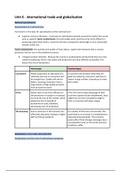
Advantages Disadvantages
Consumers Allows production to take place at a If countries only produce what they are
relatively low cost so consumers will good at producing, consumers will have to
be charged less. Quality will also be import a large number of products to meet
better, meaning consumers have a their needs
large variety of high-quality products
from around the world
Firms Allows them to be more efficient so If the firms fail to take advantage of their
the production of output is increased. countries superior factor endowments, they
Increase the size of the market, which might lose out their competitive edge to
allows the firm to benefit of firms in countries with lower wages
economies of scale, therefore,
decreasing costs of production
The Economy Scarce resources in the economy are If a number of firms are unsuccessful, this
effectively allocated, leading to higher could lead to an increase in unemployment,
GDP and living standards reducing living standards. The economy
could suffer if their foreign exchange rate is
uncompetitive and/ or the world economic
conditions suffer
Globalisation, free trade and protection
Globalisation and the role of multinational companies
, Globalisation: free movement of goods, services, capital, labour and technology which are produced
and sold all around the world. Leads to…
● Greater competition
● Greater efficiency
● Improved quality
● Lower prices
Globalisation can lead to an increasing world market in goods and services and therefore an increase in
multilateral trade. This would make improved living standards more likely.
Multinational companies (MNCs)
A company that produces and sells products in a number of countries. They have a headquarters in one
country, but many production units in other countries. They have costs and benefits to their host and
home countries
Host country: the country where a multinational company decides to locate and establish a
manufacturing plant
Home country: the country where a multinational company is based and has headquarters
Goals of multinationals -
● Profit maximisation - increasing value for shareholders
● Growth through maximization of revenue - increase size of the country to take advantage of
economies of scale
● Brand awareness
● Increasing market share
●
Benefits of MNCs to host Costs of MNCs to host countries
Provides jobs to local people and brings down the Wages paid to local workers may be low, and
rate of unemployment senior management positions may be reserved
for people from the MNCs home country
Brings new products to the country The products may be too expensive for people in
the host country
Introduce new technologies and therefore May employ local workers in relatively low skilled
improve the skills of its workers jobs, and they will learn nothing. Weak
employment laws as well as low health and safety
standards
May help speed up economic growth in the May cause pollution and environmental damage,
country don’t pay for negative externalities and exploit
the raw materials by demanding cheap costs
National specialisation
Specialisation at a national level
Two factors in the basis for specialisation at the national level:
● Superior resource allocation - resources are distributed unevenly around the world, this can be
seen as superior factor endowments, this will enable some countries to be more efficient in
producing a good than others. Countries will have comparative advantages such as favourable
climate, fertile soil,...
Factor endowments: the quantity and quality of land, labour, capital and enterprise that a country
possesses and can use in the production process
● Cheaper product methods - Because the country is producing the product that they are most
suited to producing, there is less waste and production can be as efficient as possible. This
lessens the cost of production.
Advantages Disadvantages
Consumers Allows production to take place at a If countries only produce what they are
relatively low cost so consumers will good at producing, consumers will have to
be charged less. Quality will also be import a large number of products to meet
better, meaning consumers have a their needs
large variety of high-quality products
from around the world
Firms Allows them to be more efficient so If the firms fail to take advantage of their
the production of output is increased. countries superior factor endowments, they
Increase the size of the market, which might lose out their competitive edge to
allows the firm to benefit of firms in countries with lower wages
economies of scale, therefore,
decreasing costs of production
The Economy Scarce resources in the economy are If a number of firms are unsuccessful, this
effectively allocated, leading to higher could lead to an increase in unemployment,
GDP and living standards reducing living standards. The economy
could suffer if their foreign exchange rate is
uncompetitive and/ or the world economic
conditions suffer
Globalisation, free trade and protection
Globalisation and the role of multinational companies
, Globalisation: free movement of goods, services, capital, labour and technology which are produced
and sold all around the world. Leads to…
● Greater competition
● Greater efficiency
● Improved quality
● Lower prices
Globalisation can lead to an increasing world market in goods and services and therefore an increase in
multilateral trade. This would make improved living standards more likely.
Multinational companies (MNCs)
A company that produces and sells products in a number of countries. They have a headquarters in one
country, but many production units in other countries. They have costs and benefits to their host and
home countries
Host country: the country where a multinational company decides to locate and establish a
manufacturing plant
Home country: the country where a multinational company is based and has headquarters
Goals of multinationals -
● Profit maximisation - increasing value for shareholders
● Growth through maximization of revenue - increase size of the country to take advantage of
economies of scale
● Brand awareness
● Increasing market share
●
Benefits of MNCs to host Costs of MNCs to host countries
Provides jobs to local people and brings down the Wages paid to local workers may be low, and
rate of unemployment senior management positions may be reserved
for people from the MNCs home country
Brings new products to the country The products may be too expensive for people in
the host country
Introduce new technologies and therefore May employ local workers in relatively low skilled
improve the skills of its workers jobs, and they will learn nothing. Weak
employment laws as well as low health and safety
standards
May help speed up economic growth in the May cause pollution and environmental damage,
country don’t pay for negative externalities and exploit
the raw materials by demanding cheap costs