TEST BANK
All Chapters Included
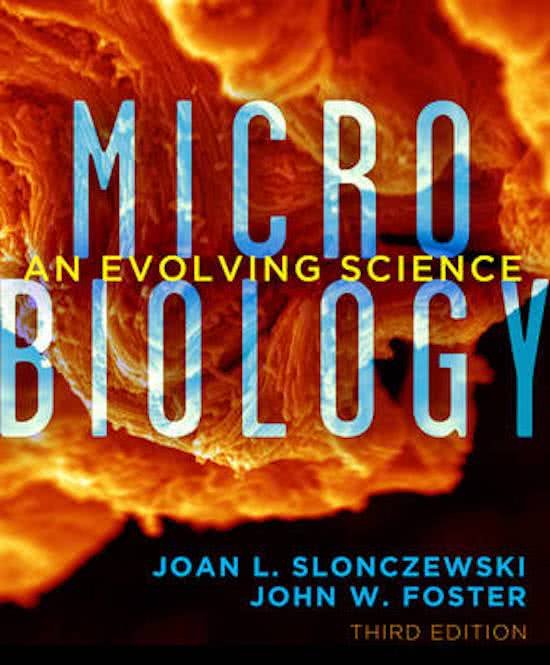
, microbiology an evolving science 3rd edition by joan L. slonczewski and john Foster All
Chapters 1-28 Covered
TABLE OF CONTENT
1. Microbial Life: Origin & Discovery
2. Observing the Microbial Cell
3. Cell Structure and Function
4. Bacterial Culture, Growth, and Development
5. Environmental Influences and Control of Microbial Growth
6. Viruses
7. Genomes and Chromosomes
8. Transcription, Translation, and Protein Processing
9. Genetic Change and Genome Evolution
10. Molecular Regulation
11. Viral Molecular Biology
12. Molecular Complexity and Synthetic Biology
13. Energetics and Catabolism
14. Electron Flow in Organotrophy, Lithotrophy, and Phototrophy
15. Biosynthesis
16. Food and Industrial Microbiology
17. Origins and Evolution
18. Bacterial Diversity
19. Archaeal Diversity
20. Eukaryotic Diversity
21. Microbial Ecology
22. Element Cycles and Environmental Microbiology
23. The Human Microbiome and Innate Immunity
24. The Adaptive Immune Response
25. Pathogenesis
26. Microbial Disease
27. Antimicrobial Therapy and Discovery
28. Clinical Microbiology and Epidemiology
,Microbiology An Evolving Science, 3rd Edition, John Foster & Joan Slonczewski
Chapter 1-28
CHAPTER 1: Microbial Life: Origin and Discovery
MULTIPLE CHOICE
1. Viruses are:
a. infectious agents that infect multi-cellular organisms
b. noncellular particles that take over the metabolism of a cell to generate
more virus particles
c. pathogens that replicate in complex growth media
d. cellular particles that belong to the archaea domain
e. microbes that consist of lipid membrane enclosed genomes
Answer: B DIF: Easy REF: 1.1 TOP: I.A | I.B
MSC: Remembering
2. Analysis of DNA sequences reveals:
a. the ancient convergence of two cell types, i.e., prokaryotes and
eukaryotes
b. prokaryotes and eukaryotes evolved from a common ancestral cell
c. that bacteria share common ancestor with archaea, but not with
eukarya
d. prokaryotes are cells with a nucleus
e. the genome of Haemophilus influenzae has about 2 billion base
pairs
Answer: B DIF: Easy REF: 1.1 TOP: I.A | I.B
MSC: Remembering
3. Which of these groups are considered to be microbes but NOT considered to be cells?
a. viruses d. protists
b. bacteria e. filamentous
fungi
c. archaea
Answer: A DIF: Easy REF: 1.1 TOP: I.A.i
MSC: Remembering
4. A microbe is commonly defined as:
a. a virus that requires a microscope to be seen
b. a bacterium that requires a microscope to be seen
c. a single-cellular prokaryote that requires a microscope to
, be seen
d. a multicellular eukaryote that requires a microscope to be
seen
e. a living organism that requires a microscope to be seen
Answer: E DIF: Easy REF: 1.1 TOP: I.A.i | I.A.ii
MSC: Remembering
5. Which one of the following statements regarding microbial cells is NOT true?
a. Microbial cells acquire food, gain energy to build themselves, and
respond to
environmental change.
b. Most single-celled organisms require a microscope to render them visible,
but some
bacterial cells are large enough to be seen with naked eyes.
c. Microbes function as individual entities.
d. Many microbes form complex multicellular assemblages.
e. Viruses are not considered as microbial cells.
Answer: C DIF: Easy REF: 1.1 TOP: I.A.i | I.A.ii
MSC: Remembering
6. Which of the following statements is FALSE?
a. A genome is the total genetic information contained in an organism’s
chromosomal DNA.
b. If a microbe’s genome includes genes for nitrogenase, that microbe probably can
fix nitrogen.
c. By comparing DNA sequences of different organisms, we can figure out how
closely
related they are.
d. Fred Sanger developed the first applicable DNA sequencing method.
e. Fred Sanger completed the sequences of Haemophilus influenzae.
Answer: E DIF: Easy REF: 1.1 TOP: I.B
MSC: Remembering
7. The first cellular genomes to be sequenced were those of:
a. humans d. prions
b. bacteria e. fungi
c. viruses
Answer: B DIF: Easy REF: 1.1 TOP: I.B.i
MSC: Remembering
8. The environment of early Earth may have contained all of the following EXCEPT:
a. ferrous iron d. oxygen
b. methane e. hydrogen
gas
c. ammonia
Answer: D DIF: Easy REF: Special Topic
1.1 TOP: II.D MSC: Remembering
9. The development of the theory of the ―RNA world‖ resulted from the discovery of:
a. archaea d. ribozymes
b. prions e. endosymbiont
All Chapters Included
, microbiology an evolving science 3rd edition by joan L. slonczewski and john Foster All
Chapters 1-28 Covered
TABLE OF CONTENT
1. Microbial Life: Origin & Discovery
2. Observing the Microbial Cell
3. Cell Structure and Function
4. Bacterial Culture, Growth, and Development
5. Environmental Influences and Control of Microbial Growth
6. Viruses
7. Genomes and Chromosomes
8. Transcription, Translation, and Protein Processing
9. Genetic Change and Genome Evolution
10. Molecular Regulation
11. Viral Molecular Biology
12. Molecular Complexity and Synthetic Biology
13. Energetics and Catabolism
14. Electron Flow in Organotrophy, Lithotrophy, and Phototrophy
15. Biosynthesis
16. Food and Industrial Microbiology
17. Origins and Evolution
18. Bacterial Diversity
19. Archaeal Diversity
20. Eukaryotic Diversity
21. Microbial Ecology
22. Element Cycles and Environmental Microbiology
23. The Human Microbiome and Innate Immunity
24. The Adaptive Immune Response
25. Pathogenesis
26. Microbial Disease
27. Antimicrobial Therapy and Discovery
28. Clinical Microbiology and Epidemiology
,Microbiology An Evolving Science, 3rd Edition, John Foster & Joan Slonczewski
Chapter 1-28
CHAPTER 1: Microbial Life: Origin and Discovery
MULTIPLE CHOICE
1. Viruses are:
a. infectious agents that infect multi-cellular organisms
b. noncellular particles that take over the metabolism of a cell to generate
more virus particles
c. pathogens that replicate in complex growth media
d. cellular particles that belong to the archaea domain
e. microbes that consist of lipid membrane enclosed genomes
Answer: B DIF: Easy REF: 1.1 TOP: I.A | I.B
MSC: Remembering
2. Analysis of DNA sequences reveals:
a. the ancient convergence of two cell types, i.e., prokaryotes and
eukaryotes
b. prokaryotes and eukaryotes evolved from a common ancestral cell
c. that bacteria share common ancestor with archaea, but not with
eukarya
d. prokaryotes are cells with a nucleus
e. the genome of Haemophilus influenzae has about 2 billion base
pairs
Answer: B DIF: Easy REF: 1.1 TOP: I.A | I.B
MSC: Remembering
3. Which of these groups are considered to be microbes but NOT considered to be cells?
a. viruses d. protists
b. bacteria e. filamentous
fungi
c. archaea
Answer: A DIF: Easy REF: 1.1 TOP: I.A.i
MSC: Remembering
4. A microbe is commonly defined as:
a. a virus that requires a microscope to be seen
b. a bacterium that requires a microscope to be seen
c. a single-cellular prokaryote that requires a microscope to
, be seen
d. a multicellular eukaryote that requires a microscope to be
seen
e. a living organism that requires a microscope to be seen
Answer: E DIF: Easy REF: 1.1 TOP: I.A.i | I.A.ii
MSC: Remembering
5. Which one of the following statements regarding microbial cells is NOT true?
a. Microbial cells acquire food, gain energy to build themselves, and
respond to
environmental change.
b. Most single-celled organisms require a microscope to render them visible,
but some
bacterial cells are large enough to be seen with naked eyes.
c. Microbes function as individual entities.
d. Many microbes form complex multicellular assemblages.
e. Viruses are not considered as microbial cells.
Answer: C DIF: Easy REF: 1.1 TOP: I.A.i | I.A.ii
MSC: Remembering
6. Which of the following statements is FALSE?
a. A genome is the total genetic information contained in an organism’s
chromosomal DNA.
b. If a microbe’s genome includes genes for nitrogenase, that microbe probably can
fix nitrogen.
c. By comparing DNA sequences of different organisms, we can figure out how
closely
related they are.
d. Fred Sanger developed the first applicable DNA sequencing method.
e. Fred Sanger completed the sequences of Haemophilus influenzae.
Answer: E DIF: Easy REF: 1.1 TOP: I.B
MSC: Remembering
7. The first cellular genomes to be sequenced were those of:
a. humans d. prions
b. bacteria e. fungi
c. viruses
Answer: B DIF: Easy REF: 1.1 TOP: I.B.i
MSC: Remembering
8. The environment of early Earth may have contained all of the following EXCEPT:
a. ferrous iron d. oxygen
b. methane e. hydrogen
gas
c. ammonia
Answer: D DIF: Easy REF: Special Topic
1.1 TOP: II.D MSC: Remembering
9. The development of the theory of the ―RNA world‖ resulted from the discovery of:
a. archaea d. ribozymes
b. prions e. endosymbiont