Cognitive Behavioral Interventions
Dinsdag 24-11-2020
College 3 – Experiential and Behavioral interventions in
Depression
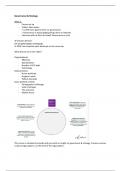
Today’s structure
Part 1: Behavioural treatment principles
o Behavioural activation
Part 2: Experiential treatment principles
o Positive psychology
o Mindfulness-based cognitive therapy (MBCT)
o Acceptance and commitment therapy (ACT)
Behavioural activation
The structured scheduling of specific activities for the client to complete in his or her
daily life, that functions to increase contact with positive reinforcement, consisting of
diverse, stable, and personally meaningful reinforcers.
When someone’s depressed, there’s of course the aspect of mood (mood swings, negative
feelings, melancholia). But another important aspect of depression pertains to behaviour; no
more engaging in activities previously viewed as pleasant, not going out anymore, not
engaging in productive behaviour etc. This forms the target of change, in Behavioural
activation.
Short history of the evolution of behavioral activation
Peter Lewinsohn (1970s)
Pleasant event scale: ± 300 items about different events, how often they were done and
how much pleasure was derived from them.
o Also made a unpleasant event scale, but this is less important since the
theoretical basis lays in the lack of pleasant events, not as much the abundance
of unpleasant events.
First base of theory: Early models highlighted the role of lack of response-contingent
reinforcement for nondepressed behavior. So, people are not getting enough positive
reinforcement for being non-depressed. It’s not really ‘learned’, it just happens.
Later refined model: Decrease in frequency/range of reinforcing stimuli or increase in
frequency of punishment lead to depression.
Aaron T. Beck (1979)
Wrote a book on cognitive therapy of depression, of which behavioural activation
became a part.
o Behavioural activation was included in CBT, but with a secondary status
theoretically. Namely because it got included, as means to change cognitions.
1
, Cognitive Behavioral Interventions
Dinsdag 24-11-2020
o So behavioural activity was reframed to facilitate cognitive rather than
behavioral change.
o Behavioural activation was used early on in treatment, especially for more
severely depressed patients.
Neil S. Jacobson (1996)
Jacobson performed a component analysis of CBT. The idea is that CBT consists of a
lot of different strategies and techniques, which can be distinguished in three different
categories;
o Techniques to change automatic thoughts.
o Techniques to change core beliefs.
o Techniques to change behavior (behavior activation).
Jacobson was interested in what would happen if you would separate the behavioral
strategies along with some general facilitative strategies (such as monitoring), from
the total package of CBT.
The results of the component analysis study found behavioural activation to be a
stand-alone therapy on its own. In other words, to change depression it’s not necessary
to focus on changing cognitions.
2
Dinsdag 24-11-2020
College 3 – Experiential and Behavioral interventions in
Depression
Today’s structure
Part 1: Behavioural treatment principles
o Behavioural activation
Part 2: Experiential treatment principles
o Positive psychology
o Mindfulness-based cognitive therapy (MBCT)
o Acceptance and commitment therapy (ACT)
Behavioural activation
The structured scheduling of specific activities for the client to complete in his or her
daily life, that functions to increase contact with positive reinforcement, consisting of
diverse, stable, and personally meaningful reinforcers.
When someone’s depressed, there’s of course the aspect of mood (mood swings, negative
feelings, melancholia). But another important aspect of depression pertains to behaviour; no
more engaging in activities previously viewed as pleasant, not going out anymore, not
engaging in productive behaviour etc. This forms the target of change, in Behavioural
activation.
Short history of the evolution of behavioral activation
Peter Lewinsohn (1970s)
Pleasant event scale: ± 300 items about different events, how often they were done and
how much pleasure was derived from them.
o Also made a unpleasant event scale, but this is less important since the
theoretical basis lays in the lack of pleasant events, not as much the abundance
of unpleasant events.
First base of theory: Early models highlighted the role of lack of response-contingent
reinforcement for nondepressed behavior. So, people are not getting enough positive
reinforcement for being non-depressed. It’s not really ‘learned’, it just happens.
Later refined model: Decrease in frequency/range of reinforcing stimuli or increase in
frequency of punishment lead to depression.
Aaron T. Beck (1979)
Wrote a book on cognitive therapy of depression, of which behavioural activation
became a part.
o Behavioural activation was included in CBT, but with a secondary status
theoretically. Namely because it got included, as means to change cognitions.
1
, Cognitive Behavioral Interventions
Dinsdag 24-11-2020
o So behavioural activity was reframed to facilitate cognitive rather than
behavioral change.
o Behavioural activation was used early on in treatment, especially for more
severely depressed patients.
Neil S. Jacobson (1996)
Jacobson performed a component analysis of CBT. The idea is that CBT consists of a
lot of different strategies and techniques, which can be distinguished in three different
categories;
o Techniques to change automatic thoughts.
o Techniques to change core beliefs.
o Techniques to change behavior (behavior activation).
Jacobson was interested in what would happen if you would separate the behavioral
strategies along with some general facilitative strategies (such as monitoring), from
the total package of CBT.
The results of the component analysis study found behavioural activation to be a
stand-alone therapy on its own. In other words, to change depression it’s not necessary
to focus on changing cognitions.
2