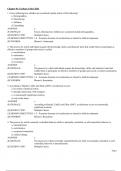
NSG233 KQC Wk 3 Questions and Verified
Answers
Save
Terms in this set (35)
Which of the following are Increased contractility
happening during the
compensatory stage? vasoconstriction
Select all that apply.
Decreased heart rate
Hypertension
Increased contractility of
the heart
Hypotension
Which of the following are Administering IV fluids
early interventions for identifying cause of shock
patients with shock? oxygen
Select all that apply.
Pulse pressure is False, Pulse pressure is calculated by subtracting the
calculated by subtracting diastolic measurement from the systolic
the diastolic measurement measurement; the difference is the pulse pressure.
from the systolic Normally, the pulse pressure is 30 to 40 mm Hg.
measurement; the
difference is the pulse
pressure. Normally, the
pulse pressure is 10 to 20
mm Hg.
, defined as a systolic BP of hypotension
less than 90 mm Hg or a
decrease in systolic BP of
40 mm Hg from baseline.
Which of the following are lack of blood supply
true regarding the second
stage of shock? Select all resp are rapid and shallow
that apply.
The second stage of False, The IRREVERSIBLE (or refractory) stage of
shock represents the point shock represents the point along the shock continuum
along the shock at which organ damage is so severe that the patient
continuum at which organ does not respond to treatment and cannot survive
damage is so severe that
the patient does not
respond to treatment and
cannot survive.
The fluids given may TRUE
include crystalloids
(electrolyte solutions that
move freely between
intravascular compartment
and interstitial spaces),
colloids (large-molecule
IV solutions), and blood
components (packed red
blood cells, fresh frozen
plasma, and platelets).
Which of the following Ascites
can cause hypovolemic Severe dehydration
shock? Select all that External fluid losses
apply.
Answers
Save
Terms in this set (35)
Which of the following are Increased contractility
happening during the
compensatory stage? vasoconstriction
Select all that apply.
Decreased heart rate
Hypertension
Increased contractility of
the heart
Hypotension
Which of the following are Administering IV fluids
early interventions for identifying cause of shock
patients with shock? oxygen
Select all that apply.
Pulse pressure is False, Pulse pressure is calculated by subtracting the
calculated by subtracting diastolic measurement from the systolic
the diastolic measurement measurement; the difference is the pulse pressure.
from the systolic Normally, the pulse pressure is 30 to 40 mm Hg.
measurement; the
difference is the pulse
pressure. Normally, the
pulse pressure is 10 to 20
mm Hg.
, defined as a systolic BP of hypotension
less than 90 mm Hg or a
decrease in systolic BP of
40 mm Hg from baseline.
Which of the following are lack of blood supply
true regarding the second
stage of shock? Select all resp are rapid and shallow
that apply.
The second stage of False, The IRREVERSIBLE (or refractory) stage of
shock represents the point shock represents the point along the shock continuum
along the shock at which organ damage is so severe that the patient
continuum at which organ does not respond to treatment and cannot survive
damage is so severe that
the patient does not
respond to treatment and
cannot survive.
The fluids given may TRUE
include crystalloids
(electrolyte solutions that
move freely between
intravascular compartment
and interstitial spaces),
colloids (large-molecule
IV solutions), and blood
components (packed red
blood cells, fresh frozen
plasma, and platelets).
Which of the following Ascites
can cause hypovolemic Severe dehydration
shock? Select all that External fluid losses
apply.