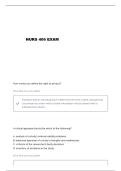
How would you define the right to privacy?
Give this one a try later!
Freedom that an individual has to determine the time, extent, and general
circumstances under which private information will be shared with or
withheld from others.
A critical appraisal should be which of the following?
A. analysis of a study's internal validity problems.
B. balanced appraisal of a study's strengths and weaknesses.
C. criticism of the researcher's faulty decisions.
D. inventory of problems in the study.
Give this one a try later!
, B.
Rationale: An intellectual critical appraisal involves careful examination of
all aspects of at study to judge the strengths, weakness, meaning, and
significance of a study.
quantitative research: quasi-experimental (partially controlled)
Give this one a try later!
Determines effectiveness of interventions in predicting and controlling
patient outcomes.
Variables; no control group or randomization to groups.
-DOES examine cause and effect relationships; researcher can't control
everything in study; samples are not randomly selected.
Accessible population
Give this one a try later!
Those available to researcher.
How do we collect data?
Give this one a try later!
, Observation, interviews, questionnaires, or scales.
What is data collection?
Give this one a try later!
Precise, systematic gathering of info. for study.
What is the ultimate goal of nursing research?
Give this one a try later!
Develop an empirical body of knowledge for nursing discipline.
Essential to develop and refine knowledge that nurses can implement to
improve clinical practice & promote quality outcomes.
Reasoning
Give this one a try later!
Processing and organizing of ideas to reach a conclusion; has many types.
Intervention
Give this one a try later!
, give details about info. for someone who might never have heard about it.
Don't use abbreviations and think of other terms (ex: pressure ulcers can
also be pressure sores or tissue injury).
Agency for Healthcare Policy and Research (AHRQ)
Give this one a try later!
Est. 1989; facilitates conduct of outcomes research.
Purposive sampling in qualitative research
Give this one a try later!
"participants" rather than "subjects"
Researcher selects participants based on their
experience/perspective/beliefs about phenomenon being studied.
Usually seeks out individuals that are different from other participants in
some way to get diverse, varied perspectives.
Snowball sampling common.
What should a PICOT question be?
Give this one a try later!
Give this one a try later!
Freedom that an individual has to determine the time, extent, and general
circumstances under which private information will be shared with or
withheld from others.
A critical appraisal should be which of the following?
A. analysis of a study's internal validity problems.
B. balanced appraisal of a study's strengths and weaknesses.
C. criticism of the researcher's faulty decisions.
D. inventory of problems in the study.
Give this one a try later!
, B.
Rationale: An intellectual critical appraisal involves careful examination of
all aspects of at study to judge the strengths, weakness, meaning, and
significance of a study.
quantitative research: quasi-experimental (partially controlled)
Give this one a try later!
Determines effectiveness of interventions in predicting and controlling
patient outcomes.
Variables; no control group or randomization to groups.
-DOES examine cause and effect relationships; researcher can't control
everything in study; samples are not randomly selected.
Accessible population
Give this one a try later!
Those available to researcher.
How do we collect data?
Give this one a try later!
, Observation, interviews, questionnaires, or scales.
What is data collection?
Give this one a try later!
Precise, systematic gathering of info. for study.
What is the ultimate goal of nursing research?
Give this one a try later!
Develop an empirical body of knowledge for nursing discipline.
Essential to develop and refine knowledge that nurses can implement to
improve clinical practice & promote quality outcomes.
Reasoning
Give this one a try later!
Processing and organizing of ideas to reach a conclusion; has many types.
Intervention
Give this one a try later!
, give details about info. for someone who might never have heard about it.
Don't use abbreviations and think of other terms (ex: pressure ulcers can
also be pressure sores or tissue injury).
Agency for Healthcare Policy and Research (AHRQ)
Give this one a try later!
Est. 1989; facilitates conduct of outcomes research.
Purposive sampling in qualitative research
Give this one a try later!
"participants" rather than "subjects"
Researcher selects participants based on their
experience/perspective/beliefs about phenomenon being studied.
Usually seeks out individuals that are different from other participants in
some way to get diverse, varied perspectives.
Snowball sampling common.
What should a PICOT question be?
Give this one a try later!