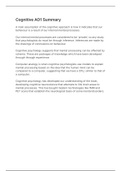
Cognitive AO1 Summary
A main assumption of the cognitive approach is how it indicates that our
behaviour is a result of our internal mental processes.
Our internal mental processes are considered to be ‘private’, so any study
that psychologists do must be through inference. Inferences are made by
the drawings of conclusions on behaviour.
Cognitive psychology suggests that mental processing can be affected by
schema. These are packages of knowledge which have been developed
through through experience.
Computer analogy is when cognitive psychologists use models to explain
mental processing based on the idea that the human mind can be
compared to a computer, suggesting that we have a CPU, similar to that of
a computer.
Cognitive psychology has developed our understanding of the brain,
developing cognitive neuroscience that attempts to link brain areas to
mental processes. This has bought modern technologies like fMRI and
PET scans that establish the neurological basis of some mental disorders.
A main assumption of the cognitive approach is how it indicates that our
behaviour is a result of our internal mental processes.
Our internal mental processes are considered to be ‘private’, so any study
that psychologists do must be through inference. Inferences are made by
the drawings of conclusions on behaviour.
Cognitive psychology suggests that mental processing can be affected by
schema. These are packages of knowledge which have been developed
through through experience.
Computer analogy is when cognitive psychologists use models to explain
mental processing based on the idea that the human mind can be
compared to a computer, suggesting that we have a CPU, similar to that of
a computer.
Cognitive psychology has developed our understanding of the brain,
developing cognitive neuroscience that attempts to link brain areas to
mental processes. This has bought modern technologies like fMRI and
PET scans that establish the neurological basis of some mental disorders.