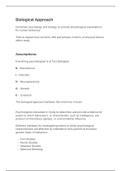
Biological Approach
Combines psychology and biology to provide physiological explanations
for human behaviour.
Tries to explain how we think, feel and behave in terms of physical factors
within body.
Assumptions:
Everything psychological is at first biological
B - Biochemical
I - Infection
N - Neuroanaotomy
G - Genetic
E - Evolution
The biological approach believes the mind lives in brain
Psychologists interested in trying to determine and provide evidence for
extent to which behaviours, or characteristic such as intelligence, are
product of inheritance (genes), or environmental influence.
Different methods for investigating extent to which psychological
characteristics are affected by inheritance from parents & evolution
genetic basis of behaviour:
– Twin Studies
– Family Studies
– Adoption Studies
– Selective Breeding
, Twin:
Interested in studying twins to investigate genetic basis of behaviour.
Identical Twins - Monozygotic (MZ) - One zygote, twins formed when a
fertilised cell splits into two and forms two separate embryos.
Non-Identical Twins - Dizygotic (DZ) - Two zygotes, twins formed when
two separate eggs both become fertilised by different sperm cells.
Concordance rates: agreement between
Family:
Any resemblance between family relatives could be a result of both genes
and shared environment.
Alcoholism suggests biological predisposition to the addiction.
Adoption:
Involve comparing trait or characteristic between adopted children and
their biological or adoptive parents.
Selective Breeding:
Artificially selecting male and female animals for particular trait.
Animals are then put together in order to breed and produce offspring.
Demonstrates how a number of behavioural characteristics may have a
genetic basis - e.g. ‘maze bright’ rats.
Genotype and Phenotype:
Basic units of inheritance called genes
Combines psychology and biology to provide physiological explanations
for human behaviour.
Tries to explain how we think, feel and behave in terms of physical factors
within body.
Assumptions:
Everything psychological is at first biological
B - Biochemical
I - Infection
N - Neuroanaotomy
G - Genetic
E - Evolution
The biological approach believes the mind lives in brain
Psychologists interested in trying to determine and provide evidence for
extent to which behaviours, or characteristic such as intelligence, are
product of inheritance (genes), or environmental influence.
Different methods for investigating extent to which psychological
characteristics are affected by inheritance from parents & evolution
genetic basis of behaviour:
– Twin Studies
– Family Studies
– Adoption Studies
– Selective Breeding
, Twin:
Interested in studying twins to investigate genetic basis of behaviour.
Identical Twins - Monozygotic (MZ) - One zygote, twins formed when a
fertilised cell splits into two and forms two separate embryos.
Non-Identical Twins - Dizygotic (DZ) - Two zygotes, twins formed when
two separate eggs both become fertilised by different sperm cells.
Concordance rates: agreement between
Family:
Any resemblance between family relatives could be a result of both genes
and shared environment.
Alcoholism suggests biological predisposition to the addiction.
Adoption:
Involve comparing trait or characteristic between adopted children and
their biological or adoptive parents.
Selective Breeding:
Artificially selecting male and female animals for particular trait.
Animals are then put together in order to breed and produce offspring.
Demonstrates how a number of behavioural characteristics may have a
genetic basis - e.g. ‘maze bright’ rats.
Genotype and Phenotype:
Basic units of inheritance called genes