Tort Law
Tuesday 21st
November
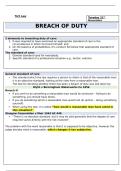
BREACH OF DUTY
2 elements to breaching duty of care:
1. D was required to have exercised an appropriate standard of care in the
circumstances in which he found himself; and
2. On the balance of probabilities, D’s conduct fell below that appropriate standard of
care.
The standard of care:
1. General standard used for everybody.
2. Specific standard of a professional situation e.g., doctor, solicitor.
General standard of care
• The standard which the law requires a person to attain is that of the reasonable man:
it is an objective standard, looking at the view from a reasonable man.
The test for deciding whether there has been a breach of duty was laid down by:
Blyth v Birmingham Waterworks Co 1856
Breach if:
If you omit to do something a reasonable man would do (omission – failing to do
something, you should have done).
If you do something which a reasonable man would not do (action – doing something
yourself).
When using this test, it is asked “how would a reasonable man have acted in
this situation?”.
Glasgow Corporation v Muir 1943 AC 448
“There is no absolute standard, but it may be said generally that the degree of care
required varies directly with the risk involved’’.
The problem with the word reasonable is that it is supposed to be objective, however the
judge decides what is reasonable, which changes it too subjective.
, Guiding factors to determine reasonable:
Foreseeability of harm
Particular danger could not reasonably have been anticipated; D has not acted
negligently due to a reasonable man would not take precautions against
unforeseeable consequences. Measured by reference to knowledge at the time of
the event.
Demonstrated in Roe v Minister of Health 1954 2 QB 66.
Williams v University of Birmingham (2011) – hindsight – don’t look at what
happened in 1974 through the 2009 or 2011 spectacles – times have changed –
risks may have not been anticipated back then however they are now.
Magnitude of the risk of harm
The greater the risk of harm, the more precautions should be taken. The magnitude of
the risk is the product of two factors:
Likelihood of the risk happening and:
The potential severity of the damage if it happened.
Paris v Stepney Borough Council 1951 AC 367
The Practicability of Taking Precautions
Some risks can be avoided, some cannot. The question that the law will ask is: at what
point the cost of precautions would justify a reasonable man in not taking them.
Latimer v AEC Ltd 1953 AC 643
If the risk is enough to justify the consequences.
In every case of foreseeable risk, it is a matter of balancing the risk against the
measures necessary to eliminate it’’ per Lord Denning
The Utility or Social Value of D’s Actions
A reasonable man would have taken those risks, because it is a useful risk.
Impact on society – e.g., lowering speeds for driving cars or trains.
Watt Hertfordshire County Council 1954 – risk is justified by the risk of death
outweighing the injury.
Common Practice
• Where the D has acted in accordance with the common or general practice of
others in a similar situation this will be strong evidence that he has not been
negligent.
• What is the norm within that industry.
• Does not always work – Brown v Rolls Royce 1960 1 WLR – no breach because
supplying a remedy was not justified.
Tuesday 21st
November
BREACH OF DUTY
2 elements to breaching duty of care:
1. D was required to have exercised an appropriate standard of care in the
circumstances in which he found himself; and
2. On the balance of probabilities, D’s conduct fell below that appropriate standard of
care.
The standard of care:
1. General standard used for everybody.
2. Specific standard of a professional situation e.g., doctor, solicitor.
General standard of care
• The standard which the law requires a person to attain is that of the reasonable man:
it is an objective standard, looking at the view from a reasonable man.
The test for deciding whether there has been a breach of duty was laid down by:
Blyth v Birmingham Waterworks Co 1856
Breach if:
If you omit to do something a reasonable man would do (omission – failing to do
something, you should have done).
If you do something which a reasonable man would not do (action – doing something
yourself).
When using this test, it is asked “how would a reasonable man have acted in
this situation?”.
Glasgow Corporation v Muir 1943 AC 448
“There is no absolute standard, but it may be said generally that the degree of care
required varies directly with the risk involved’’.
The problem with the word reasonable is that it is supposed to be objective, however the
judge decides what is reasonable, which changes it too subjective.
, Guiding factors to determine reasonable:
Foreseeability of harm
Particular danger could not reasonably have been anticipated; D has not acted
negligently due to a reasonable man would not take precautions against
unforeseeable consequences. Measured by reference to knowledge at the time of
the event.
Demonstrated in Roe v Minister of Health 1954 2 QB 66.
Williams v University of Birmingham (2011) – hindsight – don’t look at what
happened in 1974 through the 2009 or 2011 spectacles – times have changed –
risks may have not been anticipated back then however they are now.
Magnitude of the risk of harm
The greater the risk of harm, the more precautions should be taken. The magnitude of
the risk is the product of two factors:
Likelihood of the risk happening and:
The potential severity of the damage if it happened.
Paris v Stepney Borough Council 1951 AC 367
The Practicability of Taking Precautions
Some risks can be avoided, some cannot. The question that the law will ask is: at what
point the cost of precautions would justify a reasonable man in not taking them.
Latimer v AEC Ltd 1953 AC 643
If the risk is enough to justify the consequences.
In every case of foreseeable risk, it is a matter of balancing the risk against the
measures necessary to eliminate it’’ per Lord Denning
The Utility or Social Value of D’s Actions
A reasonable man would have taken those risks, because it is a useful risk.
Impact on society – e.g., lowering speeds for driving cars or trains.
Watt Hertfordshire County Council 1954 – risk is justified by the risk of death
outweighing the injury.
Common Practice
• Where the D has acted in accordance with the common or general practice of
others in a similar situation this will be strong evidence that he has not been
negligent.
• What is the norm within that industry.
• Does not always work – Brown v Rolls Royce 1960 1 WLR – no breach because
supplying a remedy was not justified.