Tort Law
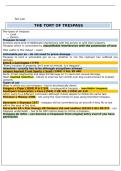
THE TORT OF TRESPASS
Two types of trespass:
Land.
Person.
Trespass to land
Involves some kind of deliberate interference with the person or with their property.
Trespass which is constituted by unjustifiable interference with the possession of land.
How useful is this today? – exam.
Actionable per se – do not need to prove damage
Trespass to land is actionable per se i.e., whether or not the claimant has suffered any
damage.
Entick v Carrington (1765)
"Every invasion of property, be it ever so minute, is a trespass".
Intention – usually has to be although exceptions allowed
League Against Cruel Sports v Scott (1985) 2 ALL ER 480
Facts; D had staghounds and dogs did damage on C’s land and caused damage.
Held; implied intention – failure to exercise full control over dog could amount to implied
consent.
Types of act
Ways in which you can trespass – has to be physically direct:
Gregory v Piper (1820) B & C 591- consequential trespass – inevitable trespass.
Southport Corporation v Esso [1954] 2 QB 182, [1956] AC 218
which came to a different conclusion although it does appear to follow the same test.
Hickman v Maisey 1900 – not using the road merely to pass along therefore trespass.
Bernstein v Skyways 1977 – trespass will be committed by an aircraft if they fly so low
within the area of the land.
Borocardo SA v Star Energy UK Onshore Ltd and another [2010] 3 ALL ER 975 – can
trespass underneath – has to be 300 metres deep to not be a trespass.
Trespass ab initio – can become a trespasser from original entry even if you have
permission.
THE TORT OF TRESPASS
Two types of trespass:
Land.
Person.
Trespass to land
Involves some kind of deliberate interference with the person or with their property.
Trespass which is constituted by unjustifiable interference with the possession of land.
How useful is this today? – exam.
Actionable per se – do not need to prove damage
Trespass to land is actionable per se i.e., whether or not the claimant has suffered any
damage.
Entick v Carrington (1765)
"Every invasion of property, be it ever so minute, is a trespass".
Intention – usually has to be although exceptions allowed
League Against Cruel Sports v Scott (1985) 2 ALL ER 480
Facts; D had staghounds and dogs did damage on C’s land and caused damage.
Held; implied intention – failure to exercise full control over dog could amount to implied
consent.
Types of act
Ways in which you can trespass – has to be physically direct:
Gregory v Piper (1820) B & C 591- consequential trespass – inevitable trespass.
Southport Corporation v Esso [1954] 2 QB 182, [1956] AC 218
which came to a different conclusion although it does appear to follow the same test.
Hickman v Maisey 1900 – not using the road merely to pass along therefore trespass.
Bernstein v Skyways 1977 – trespass will be committed by an aircraft if they fly so low
within the area of the land.
Borocardo SA v Star Energy UK Onshore Ltd and another [2010] 3 ALL ER 975 – can
trespass underneath – has to be 300 metres deep to not be a trespass.
Trespass ab initio – can become a trespasser from original entry even if you have
permission.