

Tuesday 20th February
Tort Law 2024
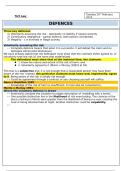
DEFENCES
Three key defences:
1) Voluntarily assuming the risk – absolutely no liability if raised correctly.
2) Contributory negligence – partial defence, both parties contributed.
3) Illegality – c is involved in illegal activity.
Voluntarily assuming the risk
Complete defence means that when it is successful, it will defeat the claim and no
damages will be paid whatsoever.
We have already stated that the defendant must show that the claimant either agreed to, or
voluntarily took the risk of, the harm that materialized.
The defendant must show that at the material time, the claimant:
1. Knew the nature and extent of the risk of harm; and
2. Voluntarily agreed to it (Morris v Murray [1991] at 18).
This test is a subjective one; it is not enough that a reasonable person may have been
aware of the risk. Instead, the particular claimant must know and, importantly, agree
to it. Being aware of the risk is simply not enough.
Could be agreement through a contract or you choosing yourself will suffice.
Dann v Hamilton 1939
Knowledge of the risk of harm is insufficient. It must also be consented to.
Morris v Murray 1991
Where the voluntary defence is drawn
Essentially compare the situation to judges description of ‘meddling with a bomb’.
One possible distinction lies in the likelihood of risk eventuating. The chances of the
place crashing in Morris were greater than the likelihood of being run over crossing the
road or being attacked late at night. Another distinction could be culpability.
, Illegality – complete defence
No benefit when they themselves were committing a crime at the time they were
injured.
Not necessarily – If the illegal act is trivial (such as parking on double yellow lines
and someone negligently damages your car at that time) then it is unlikely to bar the
claim.
Also, participants jointly engaged in criminal activity are not necessarily prevented
from recovering from each other. To use Lord Asquith’s example in National Coal
Board v England [1954].
Contributory Negligence
This is a partial defence. It reduces the amount of damages the defendant must pay
if the claimant has failed to take responsible steps to ensure their own safety.
For the defence to be raised, three questions need to be addressed:
Did the claimant fail to exercise reasonable care for their own safety?
Did this failure contribute to the claimant’s damage? And
By what extent should the claimant’s damages be reduced?
(1)Did the claimant fail to exercise reasonable care for their own safety?
Jones v Livox Quarries [1952]:
“a person is guilty of contributory negligence if he ought reasonably to have foreseen
that, if he did not act as a reasonable prudent man, he might hurt himself” (Denning
LJ at 615)
(2) Did this failure contribute to the claimant’s damage?
The claimant’s own carelessness will only provide a defence to the defendant’s
negligence when it makes some contribution to the injuries they have suffered.
(3) By what extent should the claimant’s damages be reduced?
The Law Reform (Contributory Negligence) Act 1945 section 1(1) states that a court
can reduce the claimant’s damages by whatever amount seems just according to
their share in responsibility for the damage.
When deciding by how much to reduce the award of damages to the claimant, the
courts look to the comparative blameworthiness of the parties. If the parties are
equally to blame the damages will be reduced by 50% (consider Nettleship v Weston);
if the defendant is twice as blameworthy as the claimant, they will be reduced by 33%
and so on.
Froom v Butcher 1976
Tort Law 2024
DEFENCES
Three key defences:
1) Voluntarily assuming the risk – absolutely no liability if raised correctly.
2) Contributory negligence – partial defence, both parties contributed.
3) Illegality – c is involved in illegal activity.
Voluntarily assuming the risk
Complete defence means that when it is successful, it will defeat the claim and no
damages will be paid whatsoever.
We have already stated that the defendant must show that the claimant either agreed to, or
voluntarily took the risk of, the harm that materialized.
The defendant must show that at the material time, the claimant:
1. Knew the nature and extent of the risk of harm; and
2. Voluntarily agreed to it (Morris v Murray [1991] at 18).
This test is a subjective one; it is not enough that a reasonable person may have been
aware of the risk. Instead, the particular claimant must know and, importantly, agree
to it. Being aware of the risk is simply not enough.
Could be agreement through a contract or you choosing yourself will suffice.
Dann v Hamilton 1939
Knowledge of the risk of harm is insufficient. It must also be consented to.
Morris v Murray 1991
Where the voluntary defence is drawn
Essentially compare the situation to judges description of ‘meddling with a bomb’.
One possible distinction lies in the likelihood of risk eventuating. The chances of the
place crashing in Morris were greater than the likelihood of being run over crossing the
road or being attacked late at night. Another distinction could be culpability.
, Illegality – complete defence
No benefit when they themselves were committing a crime at the time they were
injured.
Not necessarily – If the illegal act is trivial (such as parking on double yellow lines
and someone negligently damages your car at that time) then it is unlikely to bar the
claim.
Also, participants jointly engaged in criminal activity are not necessarily prevented
from recovering from each other. To use Lord Asquith’s example in National Coal
Board v England [1954].
Contributory Negligence
This is a partial defence. It reduces the amount of damages the defendant must pay
if the claimant has failed to take responsible steps to ensure their own safety.
For the defence to be raised, three questions need to be addressed:
Did the claimant fail to exercise reasonable care for their own safety?
Did this failure contribute to the claimant’s damage? And
By what extent should the claimant’s damages be reduced?
(1)Did the claimant fail to exercise reasonable care for their own safety?
Jones v Livox Quarries [1952]:
“a person is guilty of contributory negligence if he ought reasonably to have foreseen
that, if he did not act as a reasonable prudent man, he might hurt himself” (Denning
LJ at 615)
(2) Did this failure contribute to the claimant’s damage?
The claimant’s own carelessness will only provide a defence to the defendant’s
negligence when it makes some contribution to the injuries they have suffered.
(3) By what extent should the claimant’s damages be reduced?
The Law Reform (Contributory Negligence) Act 1945 section 1(1) states that a court
can reduce the claimant’s damages by whatever amount seems just according to
their share in responsibility for the damage.
When deciding by how much to reduce the award of damages to the claimant, the
courts look to the comparative blameworthiness of the parties. If the parties are
equally to blame the damages will be reduced by 50% (consider Nettleship v Weston);
if the defendant is twice as blameworthy as the claimant, they will be reduced by 33%
and so on.
Froom v Butcher 1976


