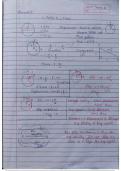
Centripetal for
for objects it will
moving in a circle have the
following properties
·
Time period o
Angular displacement
frequency
·
Angular Velocity
·
When objects more in a
straight line at a constant speed the motion
cy the object can be described
velocity with acceleration the object will also neutons1st law
moving at a constant zero
,
obey
it will
of
motion stating if an object is
moving at a constant
velocity continue
moving at this velocity
unless acted by resultant However the
abject also
obeys newtors 2nd law
on a
fore
. by
motion States
Which When an
object is moving at a constant
belouty the object is not
accelerating
there is resultant abject
fore acting
no on the .
When an object is moving in circular motion the
face acting on the objects acts at an
angle as
90 to the
the
velocity
, as a result
magnitude
by the
Velocity remains constant however the direction
by
the
velocity change Which would mean the object is
accelerating so there must be o
fore / Resultant force acting object
not on the
required to
-
OF
Y I the net
force
keep the object moving in
circle is directed
always
a
towards the the circle
Centre
by
I the net
force the
causes
Centripetal acceleration
This net
force is the
centripetal
P gove
ravel ↑
direction by
defined
-
is
The Centripetal force ,
F, as the
Resultant gove
towards the centre
of the
in uniform
af
direction O velocity .
Circle required to keep an
object
-
circular motion . It is always directed towards
the centre of the bodies .
rotation
↳ centripetalforce the
same direction due to
n
we C
againe w
fore
Gene
second law
·m,
newtons
*
the F
-
direction of = ma
velocity is at a
tangent
to the Circle .
for objects it will
moving in a circle have the
following properties
·
Time period o
Angular displacement
frequency
·
Angular Velocity
·
When objects more in a
straight line at a constant speed the motion
cy the object can be described
velocity with acceleration the object will also neutons1st law
moving at a constant zero
,
obey
it will
of
motion stating if an object is
moving at a constant
velocity continue
moving at this velocity
unless acted by resultant However the
abject also
obeys newtors 2nd law
on a
fore
. by
motion States
Which When an
object is moving at a constant
belouty the object is not
accelerating
there is resultant abject
fore acting
no on the .
When an object is moving in circular motion the
face acting on the objects acts at an
angle as
90 to the
the
velocity
, as a result
magnitude
by the
Velocity remains constant however the direction
by
the
velocity change Which would mean the object is
accelerating so there must be o
fore / Resultant force acting object
not on the
required to
-
OF
Y I the net
force
keep the object moving in
circle is directed
always
a
towards the the circle
Centre
by
I the net
force the
causes
Centripetal acceleration
This net
force is the
centripetal
P gove
ravel ↑
direction by
defined
-
is
The Centripetal force ,
F, as the
Resultant gove
towards the centre
of the
in uniform
af
direction O velocity .
Circle required to keep an
object
-
circular motion . It is always directed towards
the centre of the bodies .
rotation
↳ centripetalforce the
same direction due to
n
we C
againe w
fore
Gene
second law
·m,
newtons
*
the F
-
direction of = ma
velocity is at a
tangent
to the Circle .