Social Influence
Types of conformity and explanations for
conformity
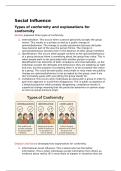
Kelman proposed three types of conformity:
1. Internalisation: This occurs when a person genuinely accepts the group
norms. This results in a private as well as a public change of
opinion/behaviour. The change is usually permanent because attitudes
have become part of the way the person thinks. The change in
opinions/behaviour persists even in the absence of other group members
2. Identification: this occurs when people conform to the opinions/behaviour
of a group because there is something about the group they value. This is
when people want to be associated with another person or group.
Identification has elements of both compliance and internalisation, as the
individual accepts the attitudes and behaviours they are adopting as right
and true, but the purpose of accepting them is to be accepted/ feel closer
to a group. This could be both public and private or may mean we publicly
change our opinions/behaviour to be accepted by the group, even if we
don’t privately agree with everything the group stands for.
3. Compliance: this occurs when individuals go along with a group in order to
gain their approval or avoid their disapproval. This is public acceptance of
a behaviour/opinion while privately disagreeing. compliance results in
superficial change meaning that the particular behaviour or opinion stops
as soon as group pressure stops
Deutsch and Gerard developed two explanations for conformity:
1. Informational social influence: This is about who has the better
information. This is when individuals accept information from others as
evidence about reality. ISI is most likely to happen in situations that are
, new to a person (so you don’t know what is right) or where there is some
ambiguity (so it isn’t clear what is right). It also occurs in crisis situations
where decisions have to be made quickly and we assume that the group is
more likely to be right.
2. Normative social influence: NSI is an emotional rather than a cognitive
process. It leads to a temporary change in opinions/behaviour. NSI is likely
to occur in situations with strangers where a person may feel concerned
about rejection. It may also occur with friends because the main concern is
their social approval. It may be more pronounced in stressful situations
than non-stressful situations where people have a greater need for social
support
EVAUATION
One strength of NSI is that evidence supports it as an explanation of conformity.
When Asch interviewed his participants, some said they conformed because they
were self-conscious about giving the correct answer, and they were afraid of
disapproval. When participants wrote their answers down, conformity fell to
12.5%. this is because giving answers privately meant there was no normative
group pressure
One strength of ISI is the evidence in support of it. Lucas et al. found that
participants conformed more often to incorrect answers they were given when
the maths problems were difficult. This is because when the problems were easy,
the participants knew their own minds, but when the problems were hard, the
situation became ambiguous (unclear). The participants did not want to be
wrong, so they relied on the answers they were given. This shows that ISI is a
valid explanation of conformity because the results are what ISI would predict.
One limitation is the difficulties in distinguishing between internalisation and
compliance. Definitions and measurements of public compliance and private
acceptance complicate this difference. It is assumed that a person who publicly
agrees with the majority yet disagrees with them in private must be
demonstrating compliance, however, it is also possible that acceptance has
occurred in public yet dissipates later when in private because information
gotten from the group has been forgotten or new information has been acquired.
It is also assumed that a person who agrees with a group in public and private
must have internalised the views of the group, however, it is also possible that
the individual may have complied in public, and as a result of self-perception,
accepted the position as their own
One limitation of NSI and ISI is that it is often unclear whether it is NSI or ISI at
work in research studies. Asch found that conformity is reduced when there is
one other dissenting participant. The dissenter may reduce the power of NSI
because they provide social support or they may reduce the power of ISI because
they provide an alternative source of social information. Both interpretations are
possible therefore, it is hard to separate ISI and NSI and both processes probably
operate together in most real-world conformity situations
, Variables affecting conformity
Baseline study
Asch devised a procedure to assess to what extent people will conform to the
opinions of others, even in a situation where the answer is certain
(unambiguous)
Asch asked student volunteers to take part in a visual discrimination task. All but
one participant were confederates.
The purpose of the study was to see how the real participant would react to the
behaviour of the confederates
123 American men were tested, each one in a group with other participants saw
two large white cards on each trial
The line X is the standard line. The lines A, B and C are the three comparison
lines. One of the comparison lines is always clearly the same length as X, the
other two are substantially different.
On each trial, participants had to say out loud which of the comparison lines was
the same length as the standard line X
The participants were tested in groups of 6 to 8. Only one was not a confederate.
The Confederates all gave the same scripted answers each time. The genuine
participant was always seated either last or next to last in the group and did not
know the others were confederates
On 12 of the 18 trials the confederates were instructed to give the same
incorrect answer. On hose 12 trials, the average conformity rate was 33% (about
one third of the time)
There were individual differences as:
25% of the participants never conformed on any of the critical trials
Half conformed on 6 or more of the critical trials
1 in 20 of the participants conformed on all 12 of the critical trials
To confirm that the stimulus lines were indeed unambiguous, Asch conducted
control condition without the distraction of confederates giving wrong answers.
In this condition, he found that participants made mistakes about 1% of the time,
although this could not explain the relatively high levels of conformity in the
main study.
Types of conformity and explanations for
conformity
Kelman proposed three types of conformity:
1. Internalisation: This occurs when a person genuinely accepts the group
norms. This results in a private as well as a public change of
opinion/behaviour. The change is usually permanent because attitudes
have become part of the way the person thinks. The change in
opinions/behaviour persists even in the absence of other group members
2. Identification: this occurs when people conform to the opinions/behaviour
of a group because there is something about the group they value. This is
when people want to be associated with another person or group.
Identification has elements of both compliance and internalisation, as the
individual accepts the attitudes and behaviours they are adopting as right
and true, but the purpose of accepting them is to be accepted/ feel closer
to a group. This could be both public and private or may mean we publicly
change our opinions/behaviour to be accepted by the group, even if we
don’t privately agree with everything the group stands for.
3. Compliance: this occurs when individuals go along with a group in order to
gain their approval or avoid their disapproval. This is public acceptance of
a behaviour/opinion while privately disagreeing. compliance results in
superficial change meaning that the particular behaviour or opinion stops
as soon as group pressure stops
Deutsch and Gerard developed two explanations for conformity:
1. Informational social influence: This is about who has the better
information. This is when individuals accept information from others as
evidence about reality. ISI is most likely to happen in situations that are
, new to a person (so you don’t know what is right) or where there is some
ambiguity (so it isn’t clear what is right). It also occurs in crisis situations
where decisions have to be made quickly and we assume that the group is
more likely to be right.
2. Normative social influence: NSI is an emotional rather than a cognitive
process. It leads to a temporary change in opinions/behaviour. NSI is likely
to occur in situations with strangers where a person may feel concerned
about rejection. It may also occur with friends because the main concern is
their social approval. It may be more pronounced in stressful situations
than non-stressful situations where people have a greater need for social
support
EVAUATION
One strength of NSI is that evidence supports it as an explanation of conformity.
When Asch interviewed his participants, some said they conformed because they
were self-conscious about giving the correct answer, and they were afraid of
disapproval. When participants wrote their answers down, conformity fell to
12.5%. this is because giving answers privately meant there was no normative
group pressure
One strength of ISI is the evidence in support of it. Lucas et al. found that
participants conformed more often to incorrect answers they were given when
the maths problems were difficult. This is because when the problems were easy,
the participants knew their own minds, but when the problems were hard, the
situation became ambiguous (unclear). The participants did not want to be
wrong, so they relied on the answers they were given. This shows that ISI is a
valid explanation of conformity because the results are what ISI would predict.
One limitation is the difficulties in distinguishing between internalisation and
compliance. Definitions and measurements of public compliance and private
acceptance complicate this difference. It is assumed that a person who publicly
agrees with the majority yet disagrees with them in private must be
demonstrating compliance, however, it is also possible that acceptance has
occurred in public yet dissipates later when in private because information
gotten from the group has been forgotten or new information has been acquired.
It is also assumed that a person who agrees with a group in public and private
must have internalised the views of the group, however, it is also possible that
the individual may have complied in public, and as a result of self-perception,
accepted the position as their own
One limitation of NSI and ISI is that it is often unclear whether it is NSI or ISI at
work in research studies. Asch found that conformity is reduced when there is
one other dissenting participant. The dissenter may reduce the power of NSI
because they provide social support or they may reduce the power of ISI because
they provide an alternative source of social information. Both interpretations are
possible therefore, it is hard to separate ISI and NSI and both processes probably
operate together in most real-world conformity situations
, Variables affecting conformity
Baseline study
Asch devised a procedure to assess to what extent people will conform to the
opinions of others, even in a situation where the answer is certain
(unambiguous)
Asch asked student volunteers to take part in a visual discrimination task. All but
one participant were confederates.
The purpose of the study was to see how the real participant would react to the
behaviour of the confederates
123 American men were tested, each one in a group with other participants saw
two large white cards on each trial
The line X is the standard line. The lines A, B and C are the three comparison
lines. One of the comparison lines is always clearly the same length as X, the
other two are substantially different.
On each trial, participants had to say out loud which of the comparison lines was
the same length as the standard line X
The participants were tested in groups of 6 to 8. Only one was not a confederate.
The Confederates all gave the same scripted answers each time. The genuine
participant was always seated either last or next to last in the group and did not
know the others were confederates
On 12 of the 18 trials the confederates were instructed to give the same
incorrect answer. On hose 12 trials, the average conformity rate was 33% (about
one third of the time)
There were individual differences as:
25% of the participants never conformed on any of the critical trials
Half conformed on 6 or more of the critical trials
1 in 20 of the participants conformed on all 12 of the critical trials
To confirm that the stimulus lines were indeed unambiguous, Asch conducted
control condition without the distraction of confederates giving wrong answers.
In this condition, he found that participants made mistakes about 1% of the time,
although this could not explain the relatively high levels of conformity in the
main study.