Psychopathology
Definitions of abnormality
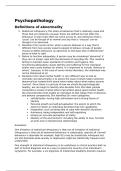
1. Statistical infrequency: this looks at behaviour that is relatively usual and
those that are relatively unusual, these are defined by how often the
behaviour is seen (how often we come across it). Any behaviour that is
‘usual’ can be though of as normal and any that is ‘unusual’ can be
thought of as abnormal.
2. Deviation from social norms: when a person behaves in a way that is
different from how society expects people to behave. Groups of people
choose to define behaviour as abnormal on the basis that it offends their
sense of what is right
3. Failure to function adequately: A person may be considered ‘abnormal’ if
they can no longer cope with the demands of everyday life. This could be
failing to maintain basic standards of nutrition and hygiene. Not
functioning adequately causes distress and suffering for the individual
and/or may cause distress for others. It is important to include ‘distress to
others’, because, in the case of some mental disorders, the individual may
not be distressed at all
4. Deviation from ideal mental health: A very different way to look at
normality and abnormality is to ignore the issue of what makes someone
abnormal but instead think about what makes about what makes anyone
‘normal’. Once there is a picture of how we should be psychologically
healthy, we can begin to identify who deviates from this ideal. Jahoda
conducted a review of what others had written about good mental health,
the characteristics that enable an individual to feel happy (free of distress)
and behave competently. She identified Six main categories:
self-attitudes: having high self-esteem and a strong Sense of
identity
Personal growth and self-actualisation: the extent to which the
extent to which an individual develops their full capabilities
Integration: such as being able to cope with stressful situations
Autonomy: being independent and self-regulating
Having an accurate perception of reality
Mastery of the environment: including the ability to love, function
at work and in interpersonal relationships
Evaluation
One limitation of statistical infrequency is that not all limitation of statistical
infrequency is that not all abnormal behaviour is undesirable, and not all ‘normal’
behaviour is desirable for example, high IQ’s may be statistically infrequent but
are still desirable while anxiety or depression might be statistically frequent and
undesirable
One strength of statistical infrequency is its usefulness in clinical practice both as
part of formal diagnosis and as a way to assess the severity of an individual’s
symptoms. For example, a sis diagnosis of intellectual disability disorder requires
Definitions of abnormality
1. Statistical infrequency: this looks at behaviour that is relatively usual and
those that are relatively unusual, these are defined by how often the
behaviour is seen (how often we come across it). Any behaviour that is
‘usual’ can be though of as normal and any that is ‘unusual’ can be
thought of as abnormal.
2. Deviation from social norms: when a person behaves in a way that is
different from how society expects people to behave. Groups of people
choose to define behaviour as abnormal on the basis that it offends their
sense of what is right
3. Failure to function adequately: A person may be considered ‘abnormal’ if
they can no longer cope with the demands of everyday life. This could be
failing to maintain basic standards of nutrition and hygiene. Not
functioning adequately causes distress and suffering for the individual
and/or may cause distress for others. It is important to include ‘distress to
others’, because, in the case of some mental disorders, the individual may
not be distressed at all
4. Deviation from ideal mental health: A very different way to look at
normality and abnormality is to ignore the issue of what makes someone
abnormal but instead think about what makes about what makes anyone
‘normal’. Once there is a picture of how we should be psychologically
healthy, we can begin to identify who deviates from this ideal. Jahoda
conducted a review of what others had written about good mental health,
the characteristics that enable an individual to feel happy (free of distress)
and behave competently. She identified Six main categories:
self-attitudes: having high self-esteem and a strong Sense of
identity
Personal growth and self-actualisation: the extent to which the
extent to which an individual develops their full capabilities
Integration: such as being able to cope with stressful situations
Autonomy: being independent and self-regulating
Having an accurate perception of reality
Mastery of the environment: including the ability to love, function
at work and in interpersonal relationships
Evaluation
One limitation of statistical infrequency is that not all limitation of statistical
infrequency is that not all abnormal behaviour is undesirable, and not all ‘normal’
behaviour is desirable for example, high IQ’s may be statistically infrequent but
are still desirable while anxiety or depression might be statistically frequent and
undesirable
One strength of statistical infrequency is its usefulness in clinical practice both as
part of formal diagnosis and as a way to assess the severity of an individual’s
symptoms. For example, a sis diagnosis of intellectual disability disorder requires