Test Bank Chapter 18- Disorders of Blood Flow and Blood Pressure NURS 3365
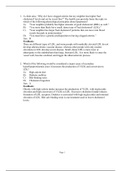
1. A client asks, “Why do I have clogged arteries but my neighbor has higher 'bad cholesterol' levels and yet he is just fine?” The health care provider bases the reply on which of the following physiological principles about lipoprotein? A) “Your neighbor probably has higher amounts of good cholesterol (HDL) as well.” B) “You more than likely have small, dense type of 'bad cholesterol' (LDL).” C) “Your neighbor has larger 'bad cholesterol' particles that can move into blood vessels but park in joints/tendons.” D) “You must have a genetic predisposition to having clogged arteries.” Ans: B Feedback: There are different types of LDL, and some people with markedly elevated LDL do not develop atherosclerotic vascular disease, whereas other people with only modest elevations in LDL develop severe disease. Small, dense LDL is more toxic or atherogenic to the endothelium than large, buoyant LDL. It is more likely to enter the vessel wall, become oxidized, and trigger the atherosclerotic process. 2. Which of the following would be considered a major cause of secondary hyperlipoproteinemia since it increases the production of VLDL and conversion to LDL? A) High-calorie diet B) Diabetes mellitus C) Bile-binding resin D) Cholesterol ingestion Ans: A Feedback: Obesity with high-calorie intake increases the production of VLDL, with triglyceride elevation and high conversion of VLDL to LDL. Excessive cholesterol intake reduces formation of LDL receptors. Diabetes is associated with high triglycerides and minimal elevation of LDL. Bile salt–binding resin is one treatment used to lower cholesterol levels. 3. Which elevated serum marker for systemic inflammation is now considered a major risk factor for atherosclerosis and vascular disease? A) Leukocytosis B) Homocysteine C) Serum lipoprotein D) C-reactive protein Ans: D Feedback: CRP is an acute-phase reactant synthesized in the liver that is a marker for systemic inflammation. A number of population-based studies have demonstrated that baseline CRP levels can predict future cardiovascular events among apparently healthy individuals. High-sensitivity CRP (hs-CRP) may be a better predictor of cardiovascular risk than lipid measurement alone. Homocysteine and serum lipoprotein are also serum markers, but they do not identify inflammation. Leukocytosis is an indicator of infection rather than inflammation alone. 4. The most important complication of atherosclerosis that may cause occlusion of small heart vessels is: A) Ulceration B) Thrombosis C) Fatty streaks D) Fibrous plaque Ans: B Feedback: Thrombus formations on complicated atherosclerotic lesions are the result of sluggish blood flow and turbulence in the ulcerated plaque region. Fatty streaks are preatherosclerotic plaque changes in vessels. Fibrous plaque is part of the atherosclerosis formation, not a complication of it.
Written for
Document information
- Uploaded on
- February 18, 2021
- Number of pages
- 12
- Written in
- 2020/2021
- Type
- Exam (elaborations)
- Contains
- Questions & answers
Subjects
-
1 a client asks
-
“why do i have clogged arteries but my neighbor has higher bad cholesterol levels and yet he is just fine” the health care provider bases the reply on which of the following

Also available in package deal