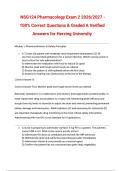
NSG124 Pharmacology Exam 2 2026/2027 - 100%
Correct Questions & A Grade Verified Answers for
Herzing University
Module 1: Pharmacokinetics & Safety Principles
1. A 78-year-old patient with moderate renal impairment (estimated CrCl 35
mL/min) is prescribed metformin for Type 2 Diabetes. The nurse’s priority
assessment before administration should focus on:
A) Monitoring for symptoms of hypoglycemia.
B) Obtaining a baseline serum creatinine and BUN.
C) Assessing for symptoms of lactic acidosis.
D) Evaluating the patient’s understanding of the medication.
Correct Answer: C
Correct Answer Text: Assessing for symptoms of lactic acidosis.
Rationale: Metformin is contraindicated in renal impairment due to the
significantly increased risk of lactic acidosis, a rare but life-threatening adverse
effect. While baseline renal function (B) is important, the patient’s existing
impairment makes vigilant assessment for early symptoms (e.g., malaise,
myalgia, respiratory distress) the immediate nursing priority before administering
the first dose. Hypoglycemia (A) is less common with metformin. Education (D)
is essential but secondary to safety screening.
2. A nurse is preparing to administer furosemide 40 mg IV push to a patient with
heart failure. Which action is most essential for safe administration?
A) Administer the medication over 1–2 minutes.
B) Assess the patient’s potassium level prior to administration.
C) Instruct the patient to report any hearing changes.
D) Monitor the patient’s blood pressure every 15 minutes during infusion.
Correct Answer: A
Correct Answer Text: Administer the medication over 1–2 minutes.
Rationale: Furosemide must be given IV push slowly (over 1–2 minutes per
2026/2027 IV compatibility guidelines) to prevent ototoxicity. Rapid injection is a
high-alert medication error. While checking potassium (B) is clinically useful, it is
, not required immediately before each dose. Hearing changes (C) are patient
education points. BP monitoring (D) occurs post-administration.
3. A 55-kg adolescent is prescribed vancomycin 500 mg IV every 8 hours for MRSA
sepsis. Which pre-administration nursing action is unique to vancomycin and
prevents a serious adverse reaction?
A) Obtain a trough level 30 minutes before the fourth dose.
B) Infuse each dose over at least 60 minutes.
C) Monitor blood urea nitrogen and serum creatinine twice weekly.
D) Verify the dose with a second nurse.
Correct Answer: B
Correct Answer Text: Infuse each dose over at least 60 minutes.
Rationale: Vancomycin must be infused slowly to minimize
histamine-release–mediated “red-man” syndrome (flushing, pruritus,
hypotension). Although trough levels (A) and nephrotoxicity monitoring (C) are
important, rate control is the immediate safety step. Double verification (D)
applies to all high-alert drugs but is not vancomycin-specific.
Module 2: Drug Classes & Clinical Application
4. A patient with hypertension is started on lisinopril. The nurse should include
which instruction in the discharge teaching?
A) “Report a persistent dry cough to your provider.”
B) “Take this medication with food to avoid stomach upset.”
C) “Avoid foods high in potassium, like bananas and oranges.”
D) “Rise slowly from sitting or lying down to prevent dizziness.”
Correct Answer: A
Correct Answer Text: “Report a persistent dry cough to your provider.”
Rationale: A dry, non-productive cough is a hallmark ACE-inhibitor side effect
caused by increased bradykinin. Patients must report it because a switch to an
ARB may be needed. Taking with food (B) is unnecessary. While potassium
monitoring (C) is valid, the cough is the distinctive teaching point. Orthostatic
precautions (D) are more relevant to alpha-blockers or diuretics.
5. A patient with atrial fibrillation is receiving a heparin infusion at 18 units/kg/hr
after a bolus. The 2026/2027 protocol requires which laboratory monitoring
before increasing the rate?
A) Activated partial thromboplastin time (aPTT)
B) Prothrombin time (PT/INR)
C) Anti-Xa level
Correct Questions & A Grade Verified Answers for
Herzing University
Module 1: Pharmacokinetics & Safety Principles
1. A 78-year-old patient with moderate renal impairment (estimated CrCl 35
mL/min) is prescribed metformin for Type 2 Diabetes. The nurse’s priority
assessment before administration should focus on:
A) Monitoring for symptoms of hypoglycemia.
B) Obtaining a baseline serum creatinine and BUN.
C) Assessing for symptoms of lactic acidosis.
D) Evaluating the patient’s understanding of the medication.
Correct Answer: C
Correct Answer Text: Assessing for symptoms of lactic acidosis.
Rationale: Metformin is contraindicated in renal impairment due to the
significantly increased risk of lactic acidosis, a rare but life-threatening adverse
effect. While baseline renal function (B) is important, the patient’s existing
impairment makes vigilant assessment for early symptoms (e.g., malaise,
myalgia, respiratory distress) the immediate nursing priority before administering
the first dose. Hypoglycemia (A) is less common with metformin. Education (D)
is essential but secondary to safety screening.
2. A nurse is preparing to administer furosemide 40 mg IV push to a patient with
heart failure. Which action is most essential for safe administration?
A) Administer the medication over 1–2 minutes.
B) Assess the patient’s potassium level prior to administration.
C) Instruct the patient to report any hearing changes.
D) Monitor the patient’s blood pressure every 15 minutes during infusion.
Correct Answer: A
Correct Answer Text: Administer the medication over 1–2 minutes.
Rationale: Furosemide must be given IV push slowly (over 1–2 minutes per
2026/2027 IV compatibility guidelines) to prevent ototoxicity. Rapid injection is a
high-alert medication error. While checking potassium (B) is clinically useful, it is
, not required immediately before each dose. Hearing changes (C) are patient
education points. BP monitoring (D) occurs post-administration.
3. A 55-kg adolescent is prescribed vancomycin 500 mg IV every 8 hours for MRSA
sepsis. Which pre-administration nursing action is unique to vancomycin and
prevents a serious adverse reaction?
A) Obtain a trough level 30 minutes before the fourth dose.
B) Infuse each dose over at least 60 minutes.
C) Monitor blood urea nitrogen and serum creatinine twice weekly.
D) Verify the dose with a second nurse.
Correct Answer: B
Correct Answer Text: Infuse each dose over at least 60 minutes.
Rationale: Vancomycin must be infused slowly to minimize
histamine-release–mediated “red-man” syndrome (flushing, pruritus,
hypotension). Although trough levels (A) and nephrotoxicity monitoring (C) are
important, rate control is the immediate safety step. Double verification (D)
applies to all high-alert drugs but is not vancomycin-specific.
Module 2: Drug Classes & Clinical Application
4. A patient with hypertension is started on lisinopril. The nurse should include
which instruction in the discharge teaching?
A) “Report a persistent dry cough to your provider.”
B) “Take this medication with food to avoid stomach upset.”
C) “Avoid foods high in potassium, like bananas and oranges.”
D) “Rise slowly from sitting or lying down to prevent dizziness.”
Correct Answer: A
Correct Answer Text: “Report a persistent dry cough to your provider.”
Rationale: A dry, non-productive cough is a hallmark ACE-inhibitor side effect
caused by increased bradykinin. Patients must report it because a switch to an
ARB may be needed. Taking with food (B) is unnecessary. While potassium
monitoring (C) is valid, the cough is the distinctive teaching point. Orthostatic
precautions (D) are more relevant to alpha-blockers or diuretics.
5. A patient with atrial fibrillation is receiving a heparin infusion at 18 units/kg/hr
after a bolus. The 2026/2027 protocol requires which laboratory monitoring
before increasing the rate?
A) Activated partial thromboplastin time (aPTT)
B) Prothrombin time (PT/INR)
C) Anti-Xa level