
NR226 Fundamentals CJE
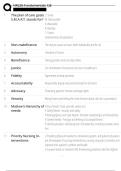
1. The plan of care goals S: Smart
S.M.A.R.T. stands for? M: Measurable
A: Attainable
R: Realistic
T: Timed
(Interventions & Evaluation)
2. Non-maleficence The duty to cause no harm, both individually and for all
3. Autonomy Freedom of choice
4. Beneficence Taking positive action to help others
5. Justice Fair distribution of resources (Access to healthcare)
6. Fidelity Agreement to keep promises
7. Accountability Responsible legally and professionally for decisions
8. Advocacy Protecting patients' human and legal rights
9. Veracity Being honest and telling the truth (Honest about risks for a procedure)
10. Maslow's Hierarchy of § Basic Needs- food, warmth, water, rest
needs: § Safety Needs- Security and safety
§ Belongingness and Love Needs- Intimate relationships and friendships
§ Esteem Needs- Prestige and feeling of accomplishment
§ Self-Actualization- Achieving one's full potential, including creative activi-
ties
11. Priority Nursing In- o Providing physical treatments, emotional support, and patient education
terventions are all examples of nursing interventions; nursing care plan to monitor and
improve their patient's comfort and health
o Survival needs or imminent life-threatening problems take the highest
, NR226 Fundamentals CJE
priority
o What is the nurse's priority? Which client should the nurse see first? If you
can only choose one option...? What should the nurse do next?
12. Prioritizing Patients o Consider age of patient, vital signs that are out of range, ABCs, pain and
safety
Priority 1: Treatable life-threatening illness or injury
Priority 2: Serious but not life-threatening illness or injury
Priority 3: Walking wounded
Priority 4 (sometimes called Priority 0): Dead or fatally injured
13. Delegations: o NEVER delegate clinical reasoning, judgment, education, and critical
UAP/CNA decision-making to UAP
o Right task, right circumstance, right person, right directions or commu-
nication, and right supervision or evaluation
14. Hospice o Focuses on care of terminally ill patients, usually those who have less than
6 months to live
o Non-curable
o No identifiable cause
o More suffering with pain
§ Goal is to manage pain, provide comfort, and ensure the quality of life
15. Palliative Care o Care designed not to treat an illness but to provide physical and emotional
comfort to the patient, and support and guidance to his or her family
o Curable
o Available for anyone, no age limitations
o Focuses on prevention, relief, and reduction of symptoms
§ Goal is to help achieve the best possible quality of life
16. Sleep Disorders o Bed wetting, sleep-onset anxiety, sleep apnea, delayed sleep phase
disorder, sleepwalking/talking, night terrors
, NR226 Fundamentals CJE
17. The RN is caring for Correct Answer: B. A 35-year-old male with tracheostomy and copious
four clients and is secretions.
preparing to do his The patient with an airway problem should be given the highest priority.
initial rounds. Which The ABCs identifies the airway, breathing and cardiovascular status of the
client should the patient as the highest of all priorities in that sequential order.
nurse assess first?
A. A client with di-
abetes is being dis-
charged today.
B. A 35-year-old
male with tracheosto-
my and copious se-
cretions.
C. A teenager is
scheduled for physi-
cal therapy this morn-
ing.
D. A 78-year-old fe-
male client with a
pressure ulcer needs
a dressing change.
18. The nurse is as- C. A client with chronic bronchitis on nasal oxygen.
signed to the car- A client with airway problems should be attended first.
diac unit caring for
four clients. He is
preparing to do initial
rounds. Which client
should the nurse as-
sess first?
1. The plan of care goals S: Smart
S.M.A.R.T. stands for? M: Measurable
A: Attainable
R: Realistic
T: Timed
(Interventions & Evaluation)
2. Non-maleficence The duty to cause no harm, both individually and for all
3. Autonomy Freedom of choice
4. Beneficence Taking positive action to help others
5. Justice Fair distribution of resources (Access to healthcare)
6. Fidelity Agreement to keep promises
7. Accountability Responsible legally and professionally for decisions
8. Advocacy Protecting patients' human and legal rights
9. Veracity Being honest and telling the truth (Honest about risks for a procedure)
10. Maslow's Hierarchy of § Basic Needs- food, warmth, water, rest
needs: § Safety Needs- Security and safety
§ Belongingness and Love Needs- Intimate relationships and friendships
§ Esteem Needs- Prestige and feeling of accomplishment
§ Self-Actualization- Achieving one's full potential, including creative activi-
ties
11. Priority Nursing In- o Providing physical treatments, emotional support, and patient education
terventions are all examples of nursing interventions; nursing care plan to monitor and
improve their patient's comfort and health
o Survival needs or imminent life-threatening problems take the highest
, NR226 Fundamentals CJE
priority
o What is the nurse's priority? Which client should the nurse see first? If you
can only choose one option...? What should the nurse do next?
12. Prioritizing Patients o Consider age of patient, vital signs that are out of range, ABCs, pain and
safety
Priority 1: Treatable life-threatening illness or injury
Priority 2: Serious but not life-threatening illness or injury
Priority 3: Walking wounded
Priority 4 (sometimes called Priority 0): Dead or fatally injured
13. Delegations: o NEVER delegate clinical reasoning, judgment, education, and critical
UAP/CNA decision-making to UAP
o Right task, right circumstance, right person, right directions or commu-
nication, and right supervision or evaluation
14. Hospice o Focuses on care of terminally ill patients, usually those who have less than
6 months to live
o Non-curable
o No identifiable cause
o More suffering with pain
§ Goal is to manage pain, provide comfort, and ensure the quality of life
15. Palliative Care o Care designed not to treat an illness but to provide physical and emotional
comfort to the patient, and support and guidance to his or her family
o Curable
o Available for anyone, no age limitations
o Focuses on prevention, relief, and reduction of symptoms
§ Goal is to help achieve the best possible quality of life
16. Sleep Disorders o Bed wetting, sleep-onset anxiety, sleep apnea, delayed sleep phase
disorder, sleepwalking/talking, night terrors
, NR226 Fundamentals CJE
17. The RN is caring for Correct Answer: B. A 35-year-old male with tracheostomy and copious
four clients and is secretions.
preparing to do his The patient with an airway problem should be given the highest priority.
initial rounds. Which The ABCs identifies the airway, breathing and cardiovascular status of the
client should the patient as the highest of all priorities in that sequential order.
nurse assess first?
A. A client with di-
abetes is being dis-
charged today.
B. A 35-year-old
male with tracheosto-
my and copious se-
cretions.
C. A teenager is
scheduled for physi-
cal therapy this morn-
ing.
D. A 78-year-old fe-
male client with a
pressure ulcer needs
a dressing change.
18. The nurse is as- C. A client with chronic bronchitis on nasal oxygen.
signed to the car- A client with airway problems should be attended first.
diac unit caring for
four clients. He is
preparing to do initial
rounds. Which client
should the nurse as-
sess first?


