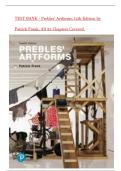
TEST BANK - Prebles' Artforms, 12th Edition by
Patrick Frank, All 25 Chapters Covered.
,TABLE OF CONTENTS
PART I: THE LANGUAGE OF VISUAL EXPERIENCE
1. The Nature of Art and Creativity
2. The Purposes and Functions of Art
3. The Visual Elements
4. The Principles of Design
5. Evaluating Art
PART II: THE MEDIA OF ART
6. Drawing
7. Painting
8. Printmaking
9. Photography
10. Cinema and Digital Arts
11. Design Disciplines
12. Sculpture
13. Craft Media in Useful Objects
14. Architecture
PART III: ART AS CULTURAL HERITAGE
15. From the Earliest Art to The Bronze Age
16. The Classical and Medieval West
17. Renaissance and Baroque Europe
18. Traditional Arts of Asia
19. The Islamic World
20. Africa, Oceania, and the Americas
PART IV: THE MODERN WORLD
21. Late Eighteenth and Nineteenth Centuries
22. Early Twentieth Century
23. Between World Wars
24. Postwar Modern Movements
PART V: THE POSTMODERN WORLD
25. Postmodernity and Global Art
,Test Bank for Prebles' Artforms, 12th Edition by Patrick L. Frank
Chapter 1: The Nature of Art and Creativity
Multiple-Choice Questions
1. In Her Secret Is Patience, Janet Echelman used a cactus flower formed by netting and colored
light to symbolize __________.
a. pure visual forms
b. the desert city of Phoenix
c. feelings and acts of love
d. daily life in the rural south
Answer: b
Learning Objective: 1.1 Describe art as a means of visual expression that uses various media and
forms.
Topic: Introduction
Difficulty Level: Moderate
Skill Level: Understand the Concepts
2. The visual expression of an idea or experience through the use of a medium is known as
__________.
a. creativity
b. a subject
c. iconography
d. a work of art
Answer: d
Learning Objective: 1.1 Describe art as a means of visual expression that uses various media and
forms.
Topic: What is Art?
Difficulty Level: Easy
Skill Level: Remember the Facts
3. A material and its accompanying technique is called a __________.
a. work of art
b. craft
c. medium
d. style
Answer: c
Learning Objective: 1.1 Describe art as a means of visual expression that uses various media and
forms.
Topic: What is Art?
Difficulty Level: Easy
Skill Level: Remember the Facts
, 4. Which attribute has the potential to influence future thoughts, actions, and human endeavors?
a. creativity
b. form
c. training
d. medium
Answer: a
Learning Objective: 1.1 Describe art as a means of visual expression that uses various media and
forms.
Topic: What is Creativity?
Difficulty Level: Easy
Skill Level: Remember the Facts
5. Daily life in the rural South influenced the work of __________.
a. Romare Bearden
b. Edward Weston
c. Janet Echelman
d. Georgia O’Keeffe
Answer: a
Learning Objective: 1.2 Explain what is meant by creativity.
Topic: What is Creativity?
Difficulty Level: Moderate
Skill Level: Understand the Concepts
6. Experimenting is a characteristic trait of __________.
a. iconography
b. creativity
c. media
d. abstraction
Answer: b
Learning Objective: 1.2 Explain what is meant by creativity.
Topic: What is Creativity?
Difficulty Level: Easy
Skill Level: Remember the Facts
7. The Philadelphia Wireman’s Untitled (Watch Face) is classified as outsider art because it is
created __________.
a. with nonrepresentational forms
b. with ordinary and discarded materials
c. with a combination of media
d. without an awareness of conventional styles
Answer: d
Learning Objective: 1.3 Discuss the role creativity plays in the work of trained and untrained
artists.
Topic: Trained and Untrained Artists
Difficulty Level: Moderate
Skill Level: Understand the Concepts
Patrick Frank, All 25 Chapters Covered.
,TABLE OF CONTENTS
PART I: THE LANGUAGE OF VISUAL EXPERIENCE
1. The Nature of Art and Creativity
2. The Purposes and Functions of Art
3. The Visual Elements
4. The Principles of Design
5. Evaluating Art
PART II: THE MEDIA OF ART
6. Drawing
7. Painting
8. Printmaking
9. Photography
10. Cinema and Digital Arts
11. Design Disciplines
12. Sculpture
13. Craft Media in Useful Objects
14. Architecture
PART III: ART AS CULTURAL HERITAGE
15. From the Earliest Art to The Bronze Age
16. The Classical and Medieval West
17. Renaissance and Baroque Europe
18. Traditional Arts of Asia
19. The Islamic World
20. Africa, Oceania, and the Americas
PART IV: THE MODERN WORLD
21. Late Eighteenth and Nineteenth Centuries
22. Early Twentieth Century
23. Between World Wars
24. Postwar Modern Movements
PART V: THE POSTMODERN WORLD
25. Postmodernity and Global Art
,Test Bank for Prebles' Artforms, 12th Edition by Patrick L. Frank
Chapter 1: The Nature of Art and Creativity
Multiple-Choice Questions
1. In Her Secret Is Patience, Janet Echelman used a cactus flower formed by netting and colored
light to symbolize __________.
a. pure visual forms
b. the desert city of Phoenix
c. feelings and acts of love
d. daily life in the rural south
Answer: b
Learning Objective: 1.1 Describe art as a means of visual expression that uses various media and
forms.
Topic: Introduction
Difficulty Level: Moderate
Skill Level: Understand the Concepts
2. The visual expression of an idea or experience through the use of a medium is known as
__________.
a. creativity
b. a subject
c. iconography
d. a work of art
Answer: d
Learning Objective: 1.1 Describe art as a means of visual expression that uses various media and
forms.
Topic: What is Art?
Difficulty Level: Easy
Skill Level: Remember the Facts
3. A material and its accompanying technique is called a __________.
a. work of art
b. craft
c. medium
d. style
Answer: c
Learning Objective: 1.1 Describe art as a means of visual expression that uses various media and
forms.
Topic: What is Art?
Difficulty Level: Easy
Skill Level: Remember the Facts
, 4. Which attribute has the potential to influence future thoughts, actions, and human endeavors?
a. creativity
b. form
c. training
d. medium
Answer: a
Learning Objective: 1.1 Describe art as a means of visual expression that uses various media and
forms.
Topic: What is Creativity?
Difficulty Level: Easy
Skill Level: Remember the Facts
5. Daily life in the rural South influenced the work of __________.
a. Romare Bearden
b. Edward Weston
c. Janet Echelman
d. Georgia O’Keeffe
Answer: a
Learning Objective: 1.2 Explain what is meant by creativity.
Topic: What is Creativity?
Difficulty Level: Moderate
Skill Level: Understand the Concepts
6. Experimenting is a characteristic trait of __________.
a. iconography
b. creativity
c. media
d. abstraction
Answer: b
Learning Objective: 1.2 Explain what is meant by creativity.
Topic: What is Creativity?
Difficulty Level: Easy
Skill Level: Remember the Facts
7. The Philadelphia Wireman’s Untitled (Watch Face) is classified as outsider art because it is
created __________.
a. with nonrepresentational forms
b. with ordinary and discarded materials
c. with a combination of media
d. without an awareness of conventional styles
Answer: d
Learning Objective: 1.3 Discuss the role creativity plays in the work of trained and untrained
artists.
Topic: Trained and Untrained Artists
Difficulty Level: Moderate
Skill Level: Understand the Concepts