1
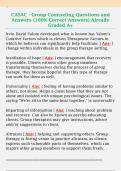
CASAC Counseling Domain Questions and
Answers (100% Correct Answers) Already
Graded A+
active listening [ Ans: ] This clinical skill involves
atttending skills and reflective listening. Through utilizing
this skill, the counselor will be able to connect with the
client and be able to reflect the client's emotions,
thoughts, and attitudes. By providing reflection to the
addict, the counselor can interject an observing
perspective that may be lacking.
empathy [ Ans: ] This clinical skill is the ability to
perceive another person's experience and communicate
that perception back to the person.
concreteness [ Ans: ] This clinical skill is a process by
which the counselor relates the vague aspects of the client
in direct expression of feelings and experiences in specific
concrete terms to assist the client to develop more
functional coping skills.
paraphrasing [ Ans: ] This clinical skill refers to a
counselor's verbal response that rephrases the essence of
the client's message. It allows the client to hear what he or
she just said, either in parroted form or with added
clarity. This interactive process can increase trust and can
reduce resistance. This skill includes the therapeutic
qualities of empathy and warmth.
, 2
reflecting [ Ans: ] This clinical skill occurs when the
counselor restates
content that had generated emotion from the client. It
captures and expresses to the client the core of what he or
she is feeling. It allows the client to be aware of his or her
own expressed emotions and how the counselor
understood his or her emotional emssage. The counselor
should be careful not to interpret the client's feelings. The
counselor remains neutral and non-judgmental by not
offering opinions, judgments, or advice during this
process.
simplifying [ Ans: ] This clinical skill involves the
reflection and
restatement of what the clent said. It removes confusion,
avoids intellectualizations and convoluted explanations,
and can help the client stay focused on concerns, feelings,
and problem in the here and now.
summarizing [ Ans: ] This clinical skill is the tying
together of the main points, themes and issues presented
by clients during part or all of a session.
attending [ Ans: ] This clinical skill refers to ways in which
the clinician demonstrates that she or he is listening to
the client through the use of cues.
probing [ Ans: ] This clinical skill involves asking open-
ended questions to clarify information and to help the
client toward a new understanding.
CASAC Counseling Domain Questions and
Answers (100% Correct Answers) Already
Graded A+
active listening [ Ans: ] This clinical skill involves
atttending skills and reflective listening. Through utilizing
this skill, the counselor will be able to connect with the
client and be able to reflect the client's emotions,
thoughts, and attitudes. By providing reflection to the
addict, the counselor can interject an observing
perspective that may be lacking.
empathy [ Ans: ] This clinical skill is the ability to
perceive another person's experience and communicate
that perception back to the person.
concreteness [ Ans: ] This clinical skill is a process by
which the counselor relates the vague aspects of the client
in direct expression of feelings and experiences in specific
concrete terms to assist the client to develop more
functional coping skills.
paraphrasing [ Ans: ] This clinical skill refers to a
counselor's verbal response that rephrases the essence of
the client's message. It allows the client to hear what he or
she just said, either in parroted form or with added
clarity. This interactive process can increase trust and can
reduce resistance. This skill includes the therapeutic
qualities of empathy and warmth.
, 2
reflecting [ Ans: ] This clinical skill occurs when the
counselor restates
content that had generated emotion from the client. It
captures and expresses to the client the core of what he or
she is feeling. It allows the client to be aware of his or her
own expressed emotions and how the counselor
understood his or her emotional emssage. The counselor
should be careful not to interpret the client's feelings. The
counselor remains neutral and non-judgmental by not
offering opinions, judgments, or advice during this
process.
simplifying [ Ans: ] This clinical skill involves the
reflection and
restatement of what the clent said. It removes confusion,
avoids intellectualizations and convoluted explanations,
and can help the client stay focused on concerns, feelings,
and problem in the here and now.
summarizing [ Ans: ] This clinical skill is the tying
together of the main points, themes and issues presented
by clients during part or all of a session.
attending [ Ans: ] This clinical skill refers to ways in which
the clinician demonstrates that she or he is listening to
the client through the use of cues.
probing [ Ans: ] This clinical skill involves asking open-
ended questions to clarify information and to help the
client toward a new understanding.