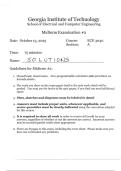
Georgia Institute of Technolory
school o"f Electrical and computer Engineering
Midterm Exam #1
Course: ECE 3o4o
Date: SePtember 10, 2o25
Section: B
Time: B:25 ANI - 1o:oo AM (r hour 35 minutes)
Name: 5ot-ur / o l\-l-S
Guidelines for Midterm Exam #t:
1. Closed book, closed notes, no formula sheets. Calculators are permitted'
I
z. The work you show on the exam paper itseH is the only w-ork which will h
graded. Yo, *ry use the backs of ine quiz pages, if you find you need
additional space.
3. Plots, sketches and diagrams must be labeled in detail.
4. Answers rnttst include proper units, toheneuer olpplico,ble, and
uector quantities nzaust be clearlg indicated as uectots.
S. It is required to show all work in order to receive full credit for your
answers, regardless of whether or not the answers are correct. Incorrect
answers may be awarded partial credit when appropriate.
6. There areT pages to this exam (including the cover sheet). Be sure yotr
have not overlookefun
, problem r: Provide the Best Answer or Answers (zo points)
a) 2 pts. True The energetic distribution of electrons is given by the Fermi-Dirac
distribution function f (E) = ;ir;/-, and the energetic distribution of holes is given by 1 -
f(E)-
b) 2 pts. True Fermi-Dirac distribution function can be approximated by the
Boltzmann tion function whenever the Fermi level lies within the bandgap and is at
least kI removed from either band edge.
c) 2 pts. According to Pierret, two of the three ofcarrier action are
) ri and )i r'ffi'. for
dA
electrons and holes both have a
d) g pts.True While the true densitY of states
significant on temperafure, the effective density ofstates for electrons and holes
both temperature dependence.
e) 2 pts. False: A region of n-tyPe semiconductor material exhibits an electron drift
of r A/cm". In spite of this, it is still possible for the sample to be in
0 JJtlTl,:n; crysta*izes in the ) )
^r.^o,....'.J
crystal structure with abasis of
g) 2
L sih c0 n
pts. Gallium arsenide
atoms.
(GaAs) crystallizes in the z\ xcbl e n) e crystaI
structure, with the 7C lattice type.
h) S pts. Polonium (atomic number 84) crystallizes with a simple cubic lattice and a basis of I
atom at each lattice point. Assume there are 124 neutrons in its nucleus. If the lattice constant
of polonium is 335.2 picometers, find the mass density. (The mass of protons and electrons are
L.673 . LO-27 and 9.1L . 10-31 kg, respectively. Neutrons share the same mass as protons.)
[,.as "t ,*o/^ : (f r, + t"t) .1.6t3. t0-'7+61 . 1,ll^ r0-B t
3.\ x lxro''s k
rY\o59 ) e"r ,ly f,x x 3.tt ?l . r!_29 3
1.Ab xto Y-V
(ga5.2xro-'")3 /^'
= q,7b f /.*>
i) 1 pt. Which of the following statements is true? Circle your answer. V
1) Electron mobility is proportional to both conductivity effective mass and the mean time
between collisions.
mobility is proportional to the mean time between collisions, but inversely
proportional to effective mass.
3) Electron mobility is proportional to the effective mass, but inversely proportional to the
mean time between collisions.
4) None of the above statements is true.
-2-
school o"f Electrical and computer Engineering
Midterm Exam #1
Course: ECE 3o4o
Date: SePtember 10, 2o25
Section: B
Time: B:25 ANI - 1o:oo AM (r hour 35 minutes)
Name: 5ot-ur / o l\-l-S
Guidelines for Midterm Exam #t:
1. Closed book, closed notes, no formula sheets. Calculators are permitted'
I
z. The work you show on the exam paper itseH is the only w-ork which will h
graded. Yo, *ry use the backs of ine quiz pages, if you find you need
additional space.
3. Plots, sketches and diagrams must be labeled in detail.
4. Answers rnttst include proper units, toheneuer olpplico,ble, and
uector quantities nzaust be clearlg indicated as uectots.
S. It is required to show all work in order to receive full credit for your
answers, regardless of whether or not the answers are correct. Incorrect
answers may be awarded partial credit when appropriate.
6. There areT pages to this exam (including the cover sheet). Be sure yotr
have not overlookefun
, problem r: Provide the Best Answer or Answers (zo points)
a) 2 pts. True The energetic distribution of electrons is given by the Fermi-Dirac
distribution function f (E) = ;ir;/-, and the energetic distribution of holes is given by 1 -
f(E)-
b) 2 pts. True Fermi-Dirac distribution function can be approximated by the
Boltzmann tion function whenever the Fermi level lies within the bandgap and is at
least kI removed from either band edge.
c) 2 pts. According to Pierret, two of the three ofcarrier action are
) ri and )i r'ffi'. for
dA
electrons and holes both have a
d) g pts.True While the true densitY of states
significant on temperafure, the effective density ofstates for electrons and holes
both temperature dependence.
e) 2 pts. False: A region of n-tyPe semiconductor material exhibits an electron drift
of r A/cm". In spite of this, it is still possible for the sample to be in
0 JJtlTl,:n; crysta*izes in the ) )
^r.^o,....'.J
crystal structure with abasis of
g) 2
L sih c0 n
pts. Gallium arsenide
atoms.
(GaAs) crystallizes in the z\ xcbl e n) e crystaI
structure, with the 7C lattice type.
h) S pts. Polonium (atomic number 84) crystallizes with a simple cubic lattice and a basis of I
atom at each lattice point. Assume there are 124 neutrons in its nucleus. If the lattice constant
of polonium is 335.2 picometers, find the mass density. (The mass of protons and electrons are
L.673 . LO-27 and 9.1L . 10-31 kg, respectively. Neutrons share the same mass as protons.)
[,.as "t ,*o/^ : (f r, + t"t) .1.6t3. t0-'7+61 . 1,ll^ r0-B t
3.\ x lxro''s k
rY\o59 ) e"r ,ly f,x x 3.tt ?l . r!_29 3
1.Ab xto Y-V
(ga5.2xro-'")3 /^'
= q,7b f /.*>
i) 1 pt. Which of the following statements is true? Circle your answer. V
1) Electron mobility is proportional to both conductivity effective mass and the mean time
between collisions.
mobility is proportional to the mean time between collisions, but inversely
proportional to effective mass.
3) Electron mobility is proportional to the effective mass, but inversely proportional to the
mean time between collisions.
4) None of the above statements is true.
-2-