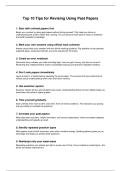
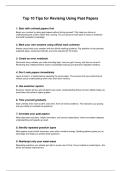
Top 10 Tips for Revising Using Past Papers
1. Start with untimed papers first
Begin your revision by doing past papers without timing yourself. This helps you focus on
understanding the content rather than rushing. You can pause to look back at notes or textbooks
and build foundation knowledge.
2. Mark your own answers using official mark schemes
Always cross-check your answers with the official marking guidance. Pay attention to key phrases,
expected steps, reasoning methods, and units required for full marks.
3. Create an error notebook
Document every mistake you make including topic, how you got it wrong, and how to correct it.
Reviewing this notebook before exams consolidates learning and prevents repeated mistakes.
4. Don’t redo papers immediately
Leave at least 1–2 weeks before repeating the same paper. This ensures that your performance
reflects actual understanding rather than short-term memory.
5. Use examiner reports
Examiner reports tell you why students lose marks. Understanding these common pitfalls helps you
avoid them and achieve higher grades.
6. Time yourself gradually
Start untimed, then move to 25% extra time, then full timed conditions. This improves your pacing
and your ability to complete all questions.
7. Annotate your past papers
Write alternative solutions, helpful reminders, and correct explanations. Active annotation deepens
understanding and speeds up recall.
8. Identify repeated question types
Most papers reuse similar structures, even when numbers change. Spotting patterns gives you an
advantage and helps you predict likely questions.
9. Reattempt only your weak areas
Repeating questions you already got right is a poor use of time. Focus instead on weak topics—this
drives the fastest improvement.
,10. Simulate real exam conditions
At least twice before the real exam, do a full paper under exam timing, printed format, no phone, no
notes. This builds confidence, stamina, and realistic readiness.
Final Advice
Past papers are the strongest revision tool available. The goal is not simply to finish papers, but to
learn from them. When used correctly—especially alongside mark schemes and examiner
reports—they help improve accuracy, forecast likely question trends, and build exam-day
confidence.
, Edexcel GCSE Mock papers
Edexcel GCSE May June 2025 papers
for more: tyrionpapers.com
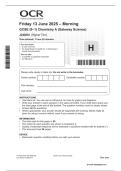
EDEXCEL GCSE TRIPLE SCIENCE CHEMISTRY MAY JUNE 2025 PAPER 2 HIGHER QUESTION PAPER FOR
MOCKS
, Please check the examination details below before entering your candidate information
Candidate surname Other names
Centre Number Candidate Number
Pearson Edexcel Level 1/Level 2 GCSE (9–1)
Friday 13 June 2025
Morning (Time: 1 hour 45 minutes) Paper
reference 1CH0/2H
Chemistry
PAPER 2
Higher Tier
You must have: Total Marks
Calculator, ruler, Periodic Table (enclosed)
Instructions
•• Use black ink or ball-point pen.
Fill in the boxes at the top of this page with your name,
centre number and candidate number.
•• Answer all questions.
Answer the questions in the spaces provided
– there may be more space than you need.
•• Calculators may be used.
Any diagrams may NOT be accurately drawn, unless otherwise indicated.
• You must show all your working out with your answer clearly identified at the
end of your solution.
Information
•• The total mark for this paper is 100.
The marks for each question are shown in brackets
– use this as a guide as to how much time to spend on each question.
• structure
In questions marked with an asterisk (*), marks will be awarded for your ability to
your answer logically, showing how the points that you make are related or
follow on from each other where appropriate.
Advice
•• Read each question carefully before you start to answer it.
Try to answer every question.
• Check your answers if you have time at the end.
Turn over
P75509RRRA
©2025 Pearson Education Ltd.
Y:1/1/1/1/1/1/1/1/1/1/1/1/1/1/1
*P75509RRRA0132* for more: tyrionpapers.com
1. Start with untimed papers first
Begin your revision by doing past papers without timing yourself. This helps you focus on
understanding the content rather than rushing. You can pause to look back at notes or textbooks
and build foundation knowledge.
2. Mark your own answers using official mark schemes
Always cross-check your answers with the official marking guidance. Pay attention to key phrases,
expected steps, reasoning methods, and units required for full marks.
3. Create an error notebook
Document every mistake you make including topic, how you got it wrong, and how to correct it.
Reviewing this notebook before exams consolidates learning and prevents repeated mistakes.
4. Don’t redo papers immediately
Leave at least 1–2 weeks before repeating the same paper. This ensures that your performance
reflects actual understanding rather than short-term memory.
5. Use examiner reports
Examiner reports tell you why students lose marks. Understanding these common pitfalls helps you
avoid them and achieve higher grades.
6. Time yourself gradually
Start untimed, then move to 25% extra time, then full timed conditions. This improves your pacing
and your ability to complete all questions.
7. Annotate your past papers
Write alternative solutions, helpful reminders, and correct explanations. Active annotation deepens
understanding and speeds up recall.
8. Identify repeated question types
Most papers reuse similar structures, even when numbers change. Spotting patterns gives you an
advantage and helps you predict likely questions.
9. Reattempt only your weak areas
Repeating questions you already got right is a poor use of time. Focus instead on weak topics—this
drives the fastest improvement.
,10. Simulate real exam conditions
At least twice before the real exam, do a full paper under exam timing, printed format, no phone, no
notes. This builds confidence, stamina, and realistic readiness.
Final Advice
Past papers are the strongest revision tool available. The goal is not simply to finish papers, but to
learn from them. When used correctly—especially alongside mark schemes and examiner
reports—they help improve accuracy, forecast likely question trends, and build exam-day
confidence.
, Edexcel GCSE Mock papers
Edexcel GCSE May June 2025 papers
for more: tyrionpapers.com
EDEXCEL GCSE TRIPLE SCIENCE CHEMISTRY MAY JUNE 2025 PAPER 2 HIGHER QUESTION PAPER FOR
MOCKS
, Please check the examination details below before entering your candidate information
Candidate surname Other names
Centre Number Candidate Number
Pearson Edexcel Level 1/Level 2 GCSE (9–1)
Friday 13 June 2025
Morning (Time: 1 hour 45 minutes) Paper
reference 1CH0/2H
Chemistry
PAPER 2
Higher Tier
You must have: Total Marks
Calculator, ruler, Periodic Table (enclosed)
Instructions
•• Use black ink or ball-point pen.
Fill in the boxes at the top of this page with your name,
centre number and candidate number.
•• Answer all questions.
Answer the questions in the spaces provided
– there may be more space than you need.
•• Calculators may be used.
Any diagrams may NOT be accurately drawn, unless otherwise indicated.
• You must show all your working out with your answer clearly identified at the
end of your solution.
Information
•• The total mark for this paper is 100.
The marks for each question are shown in brackets
– use this as a guide as to how much time to spend on each question.
• structure
In questions marked with an asterisk (*), marks will be awarded for your ability to
your answer logically, showing how the points that you make are related or
follow on from each other where appropriate.
Advice
•• Read each question carefully before you start to answer it.
Try to answer every question.
• Check your answers if you have time at the end.
Turn over
P75509RRRA
©2025 Pearson Education Ltd.
Y:1/1/1/1/1/1/1/1/1/1/1/1/1/1/1
*P75509RRRA0132* for more: tyrionpapers.com