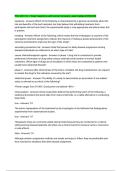
PHC 6001 Ch. 7 Exam Questions with Correct Answers Latest Update 2025/2026
equipoise - Answers Which of the following is characterized by a genuine uncertainty about the
risk and benefits of the test treatment, but truly believe that witholding treatmetn from
participants will not harm them? An experimental study is only appropriate and ethical when this
is present.
masking - Answers Which of the following, which means that the investigator is unaware of the
partcipants treatment assignment, reduces the chances of making a biased assessment of the
outcome and therefore improves the rigor of the study?
secondary prevention trial - Answers trials that prevent or delay disease progression among
diseased individuals are refferred to as which type of trials?
cancer chemotherapeutic agents - Answers A phase 1 drug trial is conducted to provide
preliminary information on drug safety using a relatively small number of normal, health
volunteers. Which type of drugs are an exception in which trials are conducted in patients who
usually have advanced disease?
phase 3 - Answers After which phase of the trial is complete, the drug manufacturer can request
to market the drug for the indication covered by the trial?
statistical power - Answers The ability of a study to demonstrate an association if one indeed
exists is referred to as which of the following?
*Power ranges from 0-100%. Good power considered >80%.*
meta-analysis - Answers Some researchers believe that performing which of the following, a
statistical procedure that pools data from many small tirals, is a viable alternative to conducting
large trials.
true - Answers T/F
The active manipulation of the treatment by the investigator is the hallmark that distinguishes
experimental from observational studies.
true - Answers T/F
Therapeutic trials are commonly called clinical trials because they are conducted in a clinical
setting among diseased patients and often use a clinical outcome measure sucha s recurrence
or side effects.
false - Answers T/F
Although random assignment methods are simple and easy to follow, they are predictable and
thus may lead to situations that allow biased assignment.
, experimental studies - Answers investigator assigns study participants to two groups; one
group receives the exposure of interest and the other group does not. Then the investigator
follows the groups over time fo incidence of disease.
AKA
a) Intervention studies
b) Clinical Trials
c) Randomized Clinical Trials (RCTs)
*not all experimental studies are randomized*
assigns exposure - Answers the defining feature of experimental studies is that the investigator
_____________ _________________ to study subjects.
controlled laboratory experiements - Answers experimental studies emulate controlled this
1. investigator regulates all important aspects of experimental conditions (i.e. genetically similar
animals, same physical environment, same diet, same schedule, same route of administration
of test chemical. Only difference is the dissimilar test chemical.
2. Experimental studies among free living humans never achieve same degree of control, but
many aspects of human experimental research emulate the principles of this
Experimental vs observational - Answers Experimental studies: investigator intervenes
Research question involves prevention or treatment. Feasible and ethical. *Small effect
expected*
vs.
Observational studies: (cohort and case control): investigator watches
Research question involves prevention, treatment or *causal factor* Experimental study not
feasible or ethical. *moderate/large effect expected*
prevention tiral - Answers agent given to healthy or high risk individuals to prevent disease
occurrence
therapeutic (clinical) trial - Answers agent given to diseased individuals to treat or cure disease
individual trial - Answers treatment is allocated to individual
community trial - Answers treatment allocated to entire community
inclusion exclusion criteria - Answers aka eligibility criteria; based on scientific, safety and
equipoise - Answers Which of the following is characterized by a genuine uncertainty about the
risk and benefits of the test treatment, but truly believe that witholding treatmetn from
participants will not harm them? An experimental study is only appropriate and ethical when this
is present.
masking - Answers Which of the following, which means that the investigator is unaware of the
partcipants treatment assignment, reduces the chances of making a biased assessment of the
outcome and therefore improves the rigor of the study?
secondary prevention trial - Answers trials that prevent or delay disease progression among
diseased individuals are refferred to as which type of trials?
cancer chemotherapeutic agents - Answers A phase 1 drug trial is conducted to provide
preliminary information on drug safety using a relatively small number of normal, health
volunteers. Which type of drugs are an exception in which trials are conducted in patients who
usually have advanced disease?
phase 3 - Answers After which phase of the trial is complete, the drug manufacturer can request
to market the drug for the indication covered by the trial?
statistical power - Answers The ability of a study to demonstrate an association if one indeed
exists is referred to as which of the following?
*Power ranges from 0-100%. Good power considered >80%.*
meta-analysis - Answers Some researchers believe that performing which of the following, a
statistical procedure that pools data from many small tirals, is a viable alternative to conducting
large trials.
true - Answers T/F
The active manipulation of the treatment by the investigator is the hallmark that distinguishes
experimental from observational studies.
true - Answers T/F
Therapeutic trials are commonly called clinical trials because they are conducted in a clinical
setting among diseased patients and often use a clinical outcome measure sucha s recurrence
or side effects.
false - Answers T/F
Although random assignment methods are simple and easy to follow, they are predictable and
thus may lead to situations that allow biased assignment.
, experimental studies - Answers investigator assigns study participants to two groups; one
group receives the exposure of interest and the other group does not. Then the investigator
follows the groups over time fo incidence of disease.
AKA
a) Intervention studies
b) Clinical Trials
c) Randomized Clinical Trials (RCTs)
*not all experimental studies are randomized*
assigns exposure - Answers the defining feature of experimental studies is that the investigator
_____________ _________________ to study subjects.
controlled laboratory experiements - Answers experimental studies emulate controlled this
1. investigator regulates all important aspects of experimental conditions (i.e. genetically similar
animals, same physical environment, same diet, same schedule, same route of administration
of test chemical. Only difference is the dissimilar test chemical.
2. Experimental studies among free living humans never achieve same degree of control, but
many aspects of human experimental research emulate the principles of this
Experimental vs observational - Answers Experimental studies: investigator intervenes
Research question involves prevention or treatment. Feasible and ethical. *Small effect
expected*
vs.
Observational studies: (cohort and case control): investigator watches
Research question involves prevention, treatment or *causal factor* Experimental study not
feasible or ethical. *moderate/large effect expected*
prevention tiral - Answers agent given to healthy or high risk individuals to prevent disease
occurrence
therapeutic (clinical) trial - Answers agent given to diseased individuals to treat or cure disease
individual trial - Answers treatment is allocated to individual
community trial - Answers treatment allocated to entire community
inclusion exclusion criteria - Answers aka eligibility criteria; based on scientific, safety and