Functions and Limits
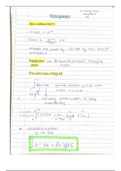
Split functions
= The function is defined by different rules over different parts of the domain
Example: x iff x ≥ 0
lxl =
-x iff x < 0
x - 1 if x < 0
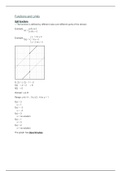
Example:
f(x) = 1 if x = 0
x + 2 id x > 0
f(- 2) = (- 2) – 1 = -3
f(4) = 4 + 2 = 6
f(0) = 0
Domain: x ∈ R
Range: y ∈ (-∞ ; 1) ∪ (2 ; ∞) ∪ y = 1
f(x) = 3
. x=1
f(x) = - 3
. x=-2
f(x) = 0
. x = no solution
f(x) = 1
. x=0
f(x) = 2
. x = no solution
The graph has discontinuities.
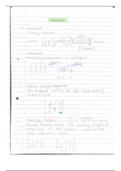
,Composite functions
The composite function (f o g)(x) also called (“f circle g” or “ f of g”) is defined by
(f o g )(x) = f (g(x) )
Example: h(x) = 2x + 5 can be seen as a combination of 2 functions,
1. f(x) = 2x and g(x) = x + 5
1. g(f(x)) = g(2x) = 2x + 5
or
2. f(x) = x + 5 and g(x) = 2x
2. f(g(x)) = f(2x) = 2x + 5
Note: g(f(x)) = g(x + 5) = 2(x + 5) = 2x + 10, so f(g(x)) ≠ g (f(x))
Note: We are not limited to only 2 functions e.g. f(g(h(x)))
Domain of f o g :
- {x : x ∈ domaing and g(x) ∈ domainf }
- g(x) must be defined and must be such that f(x) can be applied to it
Example:
Determine f o g and g o f and find their domains if:
f o g = f(2x + 1)
. = (2x + 1)2 + 1
. = 4x2 + 4x + 1 + 1
. = 4x2 + 4x + 2
g o f = g(x2 + 1)
. = 2(x2 + 1) + 1
. = 2x2 + 2 + 1
. = 2x2 + 3
x∈R
f o g = f(x - 2)
. = √(x - 2)
g o f = g(√x)
. = √x - 2)
x≥0
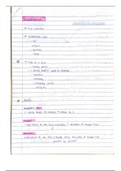
, Limits
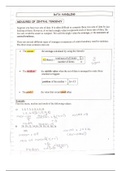
1 1 1 1
e.g. 2
+ 4 + 8 + … + 2𝑛
As the denominator gets bigger, the faction gets smaller.
The sum will never equal 1, but it will keep approaching 1.
It is therefore logical to assume that there must be a limit to the sum.
This can be written as:
Sn→1 as n→∞
. lim can never stand alone. One always finds the limit of something.
. x→a
e.g. 6x = 30 if x=5
. lim 6x
x →5
= 30
x is approaching 5, then 6x is approaching 30.
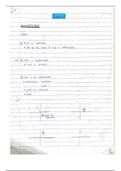
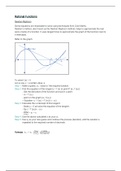
Example:
c
c
y=x
As x→c- then y = c
so lim f(x) = c = f(c)
. x→c-
As x→c+ then y = c
so lim f(x) = c = f(c)
. x→c+
so lim f(x) = lim f(x)
. x→c- x→c+
and it can be said that, lim f(x) = lim x = c = f(c)
. x→c x→c
If the limit of a function as x approaches from the left is the same as the limit of the function as x
approaches from the right, the limit exists and equals the function value for that particular x,
even if the function value is not part of the range of the function.
This leads us to the concept of discontinuity.
Split functions
= The function is defined by different rules over different parts of the domain
Example: x iff x ≥ 0
lxl =
-x iff x < 0
x - 1 if x < 0
Example:
f(x) = 1 if x = 0
x + 2 id x > 0
f(- 2) = (- 2) – 1 = -3
f(4) = 4 + 2 = 6
f(0) = 0
Domain: x ∈ R
Range: y ∈ (-∞ ; 1) ∪ (2 ; ∞) ∪ y = 1
f(x) = 3
. x=1
f(x) = - 3
. x=-2
f(x) = 0
. x = no solution
f(x) = 1
. x=0
f(x) = 2
. x = no solution
The graph has discontinuities.
,Composite functions
The composite function (f o g)(x) also called (“f circle g” or “ f of g”) is defined by
(f o g )(x) = f (g(x) )
Example: h(x) = 2x + 5 can be seen as a combination of 2 functions,
1. f(x) = 2x and g(x) = x + 5
1. g(f(x)) = g(2x) = 2x + 5
or
2. f(x) = x + 5 and g(x) = 2x
2. f(g(x)) = f(2x) = 2x + 5
Note: g(f(x)) = g(x + 5) = 2(x + 5) = 2x + 10, so f(g(x)) ≠ g (f(x))
Note: We are not limited to only 2 functions e.g. f(g(h(x)))
Domain of f o g :
- {x : x ∈ domaing and g(x) ∈ domainf }
- g(x) must be defined and must be such that f(x) can be applied to it
Example:
Determine f o g and g o f and find their domains if:
f o g = f(2x + 1)
. = (2x + 1)2 + 1
. = 4x2 + 4x + 1 + 1
. = 4x2 + 4x + 2
g o f = g(x2 + 1)
. = 2(x2 + 1) + 1
. = 2x2 + 2 + 1
. = 2x2 + 3
x∈R
f o g = f(x - 2)
. = √(x - 2)
g o f = g(√x)
. = √x - 2)
x≥0
, Limits
1 1 1 1
e.g. 2
+ 4 + 8 + … + 2𝑛
As the denominator gets bigger, the faction gets smaller.
The sum will never equal 1, but it will keep approaching 1.
It is therefore logical to assume that there must be a limit to the sum.
This can be written as:
Sn→1 as n→∞
. lim can never stand alone. One always finds the limit of something.
. x→a
e.g. 6x = 30 if x=5
. lim 6x
x →5
= 30
x is approaching 5, then 6x is approaching 30.
Example:
c
c
y=x
As x→c- then y = c
so lim f(x) = c = f(c)
. x→c-
As x→c+ then y = c
so lim f(x) = c = f(c)
. x→c+
so lim f(x) = lim f(x)
. x→c- x→c+
and it can be said that, lim f(x) = lim x = c = f(c)
. x→c x→c
If the limit of a function as x approaches from the left is the same as the limit of the function as x
approaches from the right, the limit exists and equals the function value for that particular x,
even if the function value is not part of the range of the function.
This leads us to the concept of discontinuity.