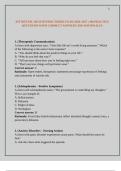
ATI Care of Patients with Problems of the Biliary System
and Pancreas, Nurse Questions and Answers 100% correct
The client with obstructive jaundice asks the nurse why his skin is so itchy. Which
is the nurse's best response?
a.
"Bile salts accumulate in the skin and cause the itching."
b.
"Toxins released from an inflamed gallbladder lead to itching."
c.
"Itching is caused by the release of calcium into the skin."
d.
"Itching is caused by a hypersensitivity reaction." Correct answerANS: A
In obstructive jaundice, the normal flow of bile into the duodenum is blocked,
allowing excess bile salts to accumulate on the skin. This leads to itching, or
pruritus. The other statements are not accurate.
,The nurse is caring for a client with cholecystitis. Which assessment finding
indicates to the nurse that the condition is chronic rather than acute?
a.
Abdomen that is hyperresonant to percussion
b.
Hyperactive bowel sounds and diarrhea
c.
,Clay-colored stools and dark amber urine
d.
Rebound tenderness in the right upper quadrant Correct answerANS: C
In chronic cholecystitis, bile duct obstruction results in the absence of urobilinogen
to color the stool. Excess circulating bilirubin turns the urine dark and foamy. The
other assessment findings do not correlate with chronic cholecystitis.
A client is admitted for suspected cholecystitis. On reviewing laboratory results,
the nurse notes that the client's amylase is elevated. Which action by the nurse
is best?
a.
Document the finding in the chart.
b.
Ask the client about drinking habits.
c.
Notify the health care provider.
d.
Place the client on clear liquids Correct answerANS: B
Serum and urine amylase levels are elevated when the pancreas becomes inflamed.
One cause of pancreatitis is gallbladder disease; another causative factor is alcohol
intake. The nurse should tactfully explore this subject with the client before
documenting the findings and notifying the provider. The client may need to be
, NPO or on clear liquids, but the nurse does not have enough information yet to
determine this.
The nurse is providing discharge teaching for a client who has just undergone
laparoscopic cholecystectomy surgery. Which statement by the client indicates
understanding of the instructions?
a.
"I will drink at least 2 liters of fluid a day."
b.
"I need a diet without a lot of fatty foods."
c.
"I should drink fluids between meals rather than with meals."
d.
"I will avoid concentrated sweets and simple carbohydrates." Correct answerANS:
B
After cholecystectomy, clients need a nutritious diet without a lot of excess fat;
otherwise a special diet is not recommended for most clients. Good fluid intake is
healthy for all people but is not related to the surgery. Drinking fluids between
meals helps with dumping syndrome, which is not seen with this operation.
Restriction of sweets is not required.
The nurse is caring for a client who has just undergone traditional cholecystectomy
surgery and has a Jackson-Pratt (JP) drain in place. The nurse notes
serosanguineous drainage present in the drain. Which is the nurse's priority action?
and Pancreas, Nurse Questions and Answers 100% correct
The client with obstructive jaundice asks the nurse why his skin is so itchy. Which
is the nurse's best response?
a.
"Bile salts accumulate in the skin and cause the itching."
b.
"Toxins released from an inflamed gallbladder lead to itching."
c.
"Itching is caused by the release of calcium into the skin."
d.
"Itching is caused by a hypersensitivity reaction." Correct answerANS: A
In obstructive jaundice, the normal flow of bile into the duodenum is blocked,
allowing excess bile salts to accumulate on the skin. This leads to itching, or
pruritus. The other statements are not accurate.
,The nurse is caring for a client with cholecystitis. Which assessment finding
indicates to the nurse that the condition is chronic rather than acute?
a.
Abdomen that is hyperresonant to percussion
b.
Hyperactive bowel sounds and diarrhea
c.
,Clay-colored stools and dark amber urine
d.
Rebound tenderness in the right upper quadrant Correct answerANS: C
In chronic cholecystitis, bile duct obstruction results in the absence of urobilinogen
to color the stool. Excess circulating bilirubin turns the urine dark and foamy. The
other assessment findings do not correlate with chronic cholecystitis.
A client is admitted for suspected cholecystitis. On reviewing laboratory results,
the nurse notes that the client's amylase is elevated. Which action by the nurse
is best?
a.
Document the finding in the chart.
b.
Ask the client about drinking habits.
c.
Notify the health care provider.
d.
Place the client on clear liquids Correct answerANS: B
Serum and urine amylase levels are elevated when the pancreas becomes inflamed.
One cause of pancreatitis is gallbladder disease; another causative factor is alcohol
intake. The nurse should tactfully explore this subject with the client before
documenting the findings and notifying the provider. The client may need to be
, NPO or on clear liquids, but the nurse does not have enough information yet to
determine this.
The nurse is providing discharge teaching for a client who has just undergone
laparoscopic cholecystectomy surgery. Which statement by the client indicates
understanding of the instructions?
a.
"I will drink at least 2 liters of fluid a day."
b.
"I need a diet without a lot of fatty foods."
c.
"I should drink fluids between meals rather than with meals."
d.
"I will avoid concentrated sweets and simple carbohydrates." Correct answerANS:
B
After cholecystectomy, clients need a nutritious diet without a lot of excess fat;
otherwise a special diet is not recommended for most clients. Good fluid intake is
healthy for all people but is not related to the surgery. Drinking fluids between
meals helps with dumping syndrome, which is not seen with this operation.
Restriction of sweets is not required.
The nurse is caring for a client who has just undergone traditional cholecystectomy
surgery and has a Jackson-Pratt (JP) drain in place. The nurse notes
serosanguineous drainage present in the drain. Which is the nurse's priority action?