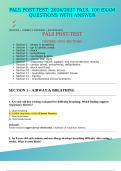
PALS POST-TEST: 2026/2027 PALS, 100 EXAM
QUESTIONS WITH ANSWER
CHOICES + CORRECT ANSWERS + RATIONALES
PALS POST-TEST
DEVIDED INTO SECTIONS
Section 1 – airway & breathing
Section 2 – cpr & cardiac arrest
Section 3 – shock
Section 4 – arrhythmias
Section 5 – neurologic & avpu
Section 6 – normal vital signs
Section 7 – respiratory failure, support, and clinical decision making
Section 8 – cardiac arrest, arrhythmias, defibrillation
Section 9 – shock and fluids
Section 10 – medications, doses, access
Section 11 – neurology, seizures, metabolic issues
Section 12 – trauma
Section 13 – miscellaneous clinical scenarios
SECTION 1 – AIRWAY & BREATHING
1. A 6-year-old boy is being evaluated for difficulty breathing. Which finding suggests
respiratory distress?
A. Quiet breathing
B. Audible inspiratory stridor (Correct Answer)
C. Slow respirations
D. Clear breath sounds
Rationale:
Stridor indicates upper airway obstruction, a hallmark of respiratory distress.
2. An 8-year-old with asthma and nut allergy develops breathing difficulty after eating a
cookie. What is most likely?
,A. Lower airway obstruction
B. Upper airway obstruction (Correct Answer)
C. Normal airway
D. Lung tissue disease
Rationale:
Allergic reactions cause upper airway swelling, leading to stridor and obstruction.
3. A 10-year-old with fever and cough has an oxygen saturation of 88% on 4L nasal
cannula. What does this indicate?
A. Normal oxygenation
B. Mild desaturation
C. Needs immediate intervention (Correct Answer)
D. No treatment needed
Rationale:
Saturations below 90% despite supplemental O₂ indicate impending respiratory failure.
4. A 1-year-old with decreased RR from 65 to 30, lethargy, and retractions is most likely
experiencing:
A. Normal improvement
B. Mild distress
C. Respiratory failure (Correct Answer)
D. Dehydration
Rationale:
A decreasing respiratory rate with increased work of breathing indicates fatigue → respiratory failure.
5. Which finding suggests lung tissue disease?
A. Stridor
B. Wheezing
C. Crackles (Correct Answer)
D. Snoring
Rationale:
Crackles indicate alveolar or interstitial disease such as pneumonia.
, 6. Which finding indicates an upper airway obstruction?
A. Wheezing
B. Rales
C. Inspiratory stridor (Correct Answer)
D. Grunting
Rationale:
Stridor = obstruction above the vocal cords.
7. A 3-year-old child has increased inspiratory effort with retractions. You suspect:
A. Lower airway obstruction
B. Upper airway obstruction (Correct Answer)
C. Lung tissue disease
D. Brainstem disorder
Rationale:
Increased inspiratory effort with retractions is classic for upper airway issues.
8. A 2-year-old is grunting and tachypneic. What does this indicate?
A. Mild distress
B. Normal variant
C. Needs immediate intervention (Correct Answer)
D. Hunger
Rationale:
Grunting is a compensatory mechanism to maintain airway pressure → sign of severe distress.
9. A 9-month-old with stridor and clear lungs most likely has:
A. Asthma
B. Pneumonia
C. Upper airway obstruction (Correct Answer)
D. Lung tissue disease
Rationale:
Stridor + clear lungs = obstruction above bronchi.
QUESTIONS WITH ANSWER
CHOICES + CORRECT ANSWERS + RATIONALES
PALS POST-TEST
DEVIDED INTO SECTIONS
Section 1 – airway & breathing
Section 2 – cpr & cardiac arrest
Section 3 – shock
Section 4 – arrhythmias
Section 5 – neurologic & avpu
Section 6 – normal vital signs
Section 7 – respiratory failure, support, and clinical decision making
Section 8 – cardiac arrest, arrhythmias, defibrillation
Section 9 – shock and fluids
Section 10 – medications, doses, access
Section 11 – neurology, seizures, metabolic issues
Section 12 – trauma
Section 13 – miscellaneous clinical scenarios
SECTION 1 – AIRWAY & BREATHING
1. A 6-year-old boy is being evaluated for difficulty breathing. Which finding suggests
respiratory distress?
A. Quiet breathing
B. Audible inspiratory stridor (Correct Answer)
C. Slow respirations
D. Clear breath sounds
Rationale:
Stridor indicates upper airway obstruction, a hallmark of respiratory distress.
2. An 8-year-old with asthma and nut allergy develops breathing difficulty after eating a
cookie. What is most likely?
,A. Lower airway obstruction
B. Upper airway obstruction (Correct Answer)
C. Normal airway
D. Lung tissue disease
Rationale:
Allergic reactions cause upper airway swelling, leading to stridor and obstruction.
3. A 10-year-old with fever and cough has an oxygen saturation of 88% on 4L nasal
cannula. What does this indicate?
A. Normal oxygenation
B. Mild desaturation
C. Needs immediate intervention (Correct Answer)
D. No treatment needed
Rationale:
Saturations below 90% despite supplemental O₂ indicate impending respiratory failure.
4. A 1-year-old with decreased RR from 65 to 30, lethargy, and retractions is most likely
experiencing:
A. Normal improvement
B. Mild distress
C. Respiratory failure (Correct Answer)
D. Dehydration
Rationale:
A decreasing respiratory rate with increased work of breathing indicates fatigue → respiratory failure.
5. Which finding suggests lung tissue disease?
A. Stridor
B. Wheezing
C. Crackles (Correct Answer)
D. Snoring
Rationale:
Crackles indicate alveolar or interstitial disease such as pneumonia.
, 6. Which finding indicates an upper airway obstruction?
A. Wheezing
B. Rales
C. Inspiratory stridor (Correct Answer)
D. Grunting
Rationale:
Stridor = obstruction above the vocal cords.
7. A 3-year-old child has increased inspiratory effort with retractions. You suspect:
A. Lower airway obstruction
B. Upper airway obstruction (Correct Answer)
C. Lung tissue disease
D. Brainstem disorder
Rationale:
Increased inspiratory effort with retractions is classic for upper airway issues.
8. A 2-year-old is grunting and tachypneic. What does this indicate?
A. Mild distress
B. Normal variant
C. Needs immediate intervention (Correct Answer)
D. Hunger
Rationale:
Grunting is a compensatory mechanism to maintain airway pressure → sign of severe distress.
9. A 9-month-old with stridor and clear lungs most likely has:
A. Asthma
B. Pneumonia
C. Upper airway obstruction (Correct Answer)
D. Lung tissue disease
Rationale:
Stridor + clear lungs = obstruction above bronchi.