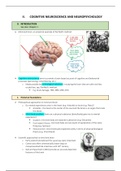
II. COGNITIVE NEUROSCIENCE AND NEUROPSYCHOLOGY
0. INTRODUCTION
See also: Chapter 1
➢ Mind and brain: an empirical example of Penfield’s method
➢ Cognitive neuroscience aims to provide a brain-based account of cognitive and behavoirial
processes (perceiving, remembering, etc.)
o Made possible by technological advances in studying the brain that are safer and less
crude than, say, Penfield’s method
▪ E.g. brain damage, TMS, MRI, MEG, EEG
1. Historical foundations
➢ Philosophical approaches to mind and brain
o Do mental experiences arise in the heart (e.g. Aristotle) or brain (e.g. Plato)?
▪ Aristotle – the heart is the center of the soul and the brain is an organ that cools
the blood
o Mind-body problem: how can a physical substance (brain/body) give rise to mental
experience?
▪ Dualism: mind and body are separate substances (e.g. Descartes)
▪ Dual-aspect theory: mind and body are two levels of explanation of the same
thing (e.g. Spinoza)
▪ Reductionism: mind eventually explained solely in terms of physical/biological
theory (e.g. Churchland)
➢ Scientific approached to mind and brain
o Early anatomists believed the ventricles were important
o Cortex was often schematically drawn (top) or
misrepresented like intestines until 18th century
o Gall and Spurzheim (1810) provide an accurate depiction of the
features of the brain
,➢ Phrenology
o Assumptions
▪ Different parts of cortex serve different
functions
▪ Differences in personality traits manifest in
differences in cortical size and bumps on skull
▪ Crude division of psychological traits (e.g. ‘love
of animals’) and not grounded in science
o Lobes & maps of the brain
o Although phrenology is discredited, the notion that different regions of the brain serve
different functions has stood the test of time
o Modern cognitive neuroscience uses empirical methods to ascertain different functions
o It does not assume that each region has one function, or that each function has a discrete
location (unlike phrenology), but does assume some degree of functional
specialization
➢ Functional specialization: Broca’s observations
o ‘Tan’s lesion’
➢ Functional specialization: after Broca
o Wernicke later observed a patient with poor speech comprehension, but
good production
o Suggests at least two language faculties in the brain (comprehension vs. production) that
can be independently affected by brain damage
o This inference can be made without necessarily knowing where in the brain they are
located
= Cognitive neuropsychology
➢ Minds without brains: the computer metaphor
o Much of the 20th-century psychology was concerned with observations of behavior,
rather than observations of the brain during behavior
o This led to models of cognition that do not make direct reference to the brain, e.g. the
information-processing models popular from the 1950’s onwards
o The models were inspired by thinking of the mind as a series of routines, like those found
in computers
o Connectionist models are mathematical (computational) in nature but don’t involve serial
processing and discrete routines
,➢ The return of the brain: cognitive neuroscience
o 1970’s: structural imaging methods (CT, MRI) enable precise images of the brain (and
brain lesions)
o 1980’s: PET adapted to models of cognition developed by psychologists
o 1985: TMS is first used (a non-invasive, safer equivalent of Penfield’s earlier studies)
o 1990: level of oxygen in blood used as a measure of cognitive function (the principle
behind fMRI)
2. Methods of cognitive neuroscience
Method Type Invasiveness Brain property used
EEG/ERP Recording Noninvasive Electrical
Single-cell/ multi-unit Recording Invasive Electrical
recordings
TMS Stimulation Noninvasive Electromagnetic
tES Stimulation Noninvasive Electric
MEG Recording Noninvasive Magnetic
PET Recording Invasive Hemodynamic
FMRI Recording Noninvasive Hemodynamic
fMIRS Recording Noninvasive Hemodynamic
, 1. THE LESIONED AND STIMULATED BRAIN
See also: Chapter 5
➢ Mind and the lesioned brain: an example
o See video of Alien hand syndrome
➢ Mind and the lesioned brain: classical cases
o Tan – language
o DF – object recognition
o Phineas Gage – personality
o HM – memory
➢ Reverse engineering
o Infer the function of a region (or cognitive mechanism) by removing it and measuring the
effect on the rest of the system
▪ E.g. if damage to a region disrupts reading, but not speaking or seeing, then one
might conclude that the region is specialized for some aspect of processing text
o Disruption of brain function comes about through natural damage (e.g. stroke, trauma),
elicited damage (e.g. animal models), or harmless temporary changes induced electro-
magnetically (e.g. TMS)
1. Brain manipulation methods
➢ Taxonomy of brain manipulation methods
o
➢ Natural damage
o Neurosurgery
o Cerebrovascular Accident (CVA)
▪ A CVA or a stroke is an accident in the arteries (vascular) of the brain (cerebro)
▪ CVA in Belgium: 25.000 new victims/year, 15% dies, 50% of the stroke survivors
has long-lasting impairments
, ▪ Two types
• Ischemic infarction (80%)
• Hemorrhage or bleeding (20%)
o Traumatic brain injury (TBI)
▪ Various mechanical forces can result in
• Open traumatic brain injury: more localized effects
• Closed traumatic brain injury: more widespread effects
o Intracranial tumors
▪ Mass of new tissue that persists and grows independently
▪ Classification
• Benign vs. malign
• Encapsulated vs. infiltrating
• Primary vs. secondary
0. INTRODUCTION
See also: Chapter 1
➢ Mind and brain: an empirical example of Penfield’s method
➢ Cognitive neuroscience aims to provide a brain-based account of cognitive and behavoirial
processes (perceiving, remembering, etc.)
o Made possible by technological advances in studying the brain that are safer and less
crude than, say, Penfield’s method
▪ E.g. brain damage, TMS, MRI, MEG, EEG
1. Historical foundations
➢ Philosophical approaches to mind and brain
o Do mental experiences arise in the heart (e.g. Aristotle) or brain (e.g. Plato)?
▪ Aristotle – the heart is the center of the soul and the brain is an organ that cools
the blood
o Mind-body problem: how can a physical substance (brain/body) give rise to mental
experience?
▪ Dualism: mind and body are separate substances (e.g. Descartes)
▪ Dual-aspect theory: mind and body are two levels of explanation of the same
thing (e.g. Spinoza)
▪ Reductionism: mind eventually explained solely in terms of physical/biological
theory (e.g. Churchland)
➢ Scientific approached to mind and brain
o Early anatomists believed the ventricles were important
o Cortex was often schematically drawn (top) or
misrepresented like intestines until 18th century
o Gall and Spurzheim (1810) provide an accurate depiction of the
features of the brain
,➢ Phrenology
o Assumptions
▪ Different parts of cortex serve different
functions
▪ Differences in personality traits manifest in
differences in cortical size and bumps on skull
▪ Crude division of psychological traits (e.g. ‘love
of animals’) and not grounded in science
o Lobes & maps of the brain
o Although phrenology is discredited, the notion that different regions of the brain serve
different functions has stood the test of time
o Modern cognitive neuroscience uses empirical methods to ascertain different functions
o It does not assume that each region has one function, or that each function has a discrete
location (unlike phrenology), but does assume some degree of functional
specialization
➢ Functional specialization: Broca’s observations
o ‘Tan’s lesion’
➢ Functional specialization: after Broca
o Wernicke later observed a patient with poor speech comprehension, but
good production
o Suggests at least two language faculties in the brain (comprehension vs. production) that
can be independently affected by brain damage
o This inference can be made without necessarily knowing where in the brain they are
located
= Cognitive neuropsychology
➢ Minds without brains: the computer metaphor
o Much of the 20th-century psychology was concerned with observations of behavior,
rather than observations of the brain during behavior
o This led to models of cognition that do not make direct reference to the brain, e.g. the
information-processing models popular from the 1950’s onwards
o The models were inspired by thinking of the mind as a series of routines, like those found
in computers
o Connectionist models are mathematical (computational) in nature but don’t involve serial
processing and discrete routines
,➢ The return of the brain: cognitive neuroscience
o 1970’s: structural imaging methods (CT, MRI) enable precise images of the brain (and
brain lesions)
o 1980’s: PET adapted to models of cognition developed by psychologists
o 1985: TMS is first used (a non-invasive, safer equivalent of Penfield’s earlier studies)
o 1990: level of oxygen in blood used as a measure of cognitive function (the principle
behind fMRI)
2. Methods of cognitive neuroscience
Method Type Invasiveness Brain property used
EEG/ERP Recording Noninvasive Electrical
Single-cell/ multi-unit Recording Invasive Electrical
recordings
TMS Stimulation Noninvasive Electromagnetic
tES Stimulation Noninvasive Electric
MEG Recording Noninvasive Magnetic
PET Recording Invasive Hemodynamic
FMRI Recording Noninvasive Hemodynamic
fMIRS Recording Noninvasive Hemodynamic
, 1. THE LESIONED AND STIMULATED BRAIN
See also: Chapter 5
➢ Mind and the lesioned brain: an example
o See video of Alien hand syndrome
➢ Mind and the lesioned brain: classical cases
o Tan – language
o DF – object recognition
o Phineas Gage – personality
o HM – memory
➢ Reverse engineering
o Infer the function of a region (or cognitive mechanism) by removing it and measuring the
effect on the rest of the system
▪ E.g. if damage to a region disrupts reading, but not speaking or seeing, then one
might conclude that the region is specialized for some aspect of processing text
o Disruption of brain function comes about through natural damage (e.g. stroke, trauma),
elicited damage (e.g. animal models), or harmless temporary changes induced electro-
magnetically (e.g. TMS)
1. Brain manipulation methods
➢ Taxonomy of brain manipulation methods
o
➢ Natural damage
o Neurosurgery
o Cerebrovascular Accident (CVA)
▪ A CVA or a stroke is an accident in the arteries (vascular) of the brain (cerebro)
▪ CVA in Belgium: 25.000 new victims/year, 15% dies, 50% of the stroke survivors
has long-lasting impairments
, ▪ Two types
• Ischemic infarction (80%)
• Hemorrhage or bleeding (20%)
o Traumatic brain injury (TBI)
▪ Various mechanical forces can result in
• Open traumatic brain injury: more localized effects
• Closed traumatic brain injury: more widespread effects
o Intracranial tumors
▪ Mass of new tissue that persists and grows independently
▪ Classification
• Benign vs. malign
• Encapsulated vs. infiltrating
• Primary vs. secondary