

ADN 150: Exam 2 Complete Study Guide.
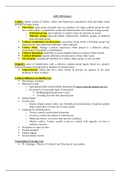
ADN 150 Exam 2 Culture: shared system of beliefs, values, and behavioral expectations while providing social structure for daily living • Subculture: large group of people who are members of a larger cultural group but who have certain ethnic, occupational, or physical characteristics not common to larger group o Dominant group: most authority to control values & sanctions of society o Minority group: physical/cultural characteristic identifies people as different from dominant group • Cultural assimilation (acculturation): minorities living within a dominant group lose characteristics that made them different; values replaced • Culture shock: feelings a person experiences when placed in a different culture; psychological discomfort or disturbances • Cultural imposition: belief that everyone should conform to majority belief system • Cultural blindness: ignores differences & proceeds as if they didn’t exist • Stereotyping: assuming all members of a culture, ethnic group, or race act alike Ethnicity: sense of identification with a collective cultural group largely based on a group’s common heritage; through birth or adoption of characteristics • Ethnocentrism: Belief that one’s ideas, beliefs & practice are superior or are most preferred to those of others Cultural Influences on Health Care • Physiologic variations • Reactions to pain o Each person holds various beliefs about pain & pain is what the patient says it is o Be sensitive to nonverbal signs of discomfort Holding/applying pressure to area Avoiding activities that intensify pain • Mental health • Gender roles o Islamic religion doesn’t allow use of health care professionals of opposite gender unless impossible to locate one of same gender • Language & communication o Always consult a professional interpreter o Avoid eye contact for clients of Arab descent o Malaysian clients: sit at more than one arm’s distance o Muslim culture: females usually avoid eye contact with opposite sex due to modesty concerns • Orientation to space & time • Food & nutrition • Family support • Socioeconomic factors Transcultural Nursing Care • Dr. Leininger: Theory of Cultural Care Diversity & Universality o Foundation for culturally respectful care for patients of all ages, groups, families, & communities Elements of Cultural Competence • Developing self-awareness • Demonstrating knowledge & understanding of a patient’s culture • Accepting & respecting cultural differences • Not assuming the health care provider’s beliefs & values are the same as client’s • Resisting judgmental attitudes • Being open & comfortable with cultural encounters • Accepting responsibility for one’s own cultural competency Guidelines for Providing Culturally Competent Nursing Care • Develop cultural self-awareness o Beliefs, values, traditions, & practices • Develop cultural knowledge • Accommodate cultural practices o Belief systems of etiology of illness & disease & those related to health & healing • Respect culturally based family roles • Avoid mandating change • Seek cultural assistance Spirituality: anything that pertains to the person’s relationship with a nonmaterial life force/higher power • Faith: a confident belief in something for which there is no proof • Religion: term used to describe cultural/institutional religion • Hope: ingredient in life responsible for a positive outlook Meeting Spiritual Needs • Offering a compassionate presence • Assisting in struggle to find meaning in face of suffering, illness, & death • Fostering relationships that nurture the spirit • Facilitating patient’s expression of religious/spiritual beliefs & practices Anandarajah & Hight’s (HOPE)- Assessing Spiritual Needs • H- Sources of hope, meaning, comfort, strength, peace, love, & connection • O- Organized religion • P- Personal spirituality & practice • E- Effects on medical care & end-of-life issue Patient Goals/Outcome: Spiritual Distress • Identify spiritual beliefs that meet needs for meaning & purpose, love & relatedness & forgiveness • Derive strength, hope, & comfort from these beliefs • Develop spiritual practice that nurture communion with inner self, God & the world • Express satisfaction with compatibility of spiritual beliefs & everyday living • Explore origin of spiritual beliefs & practices • Identify factors in life that challenge spiritual beliefs • Explore alternatives to challenges • Identify spiritual supports • Report/demonstrate decreased spiritual distress after intervention
Document information
- Uploaded on
- February 15, 2021
- Number of pages
- 36
- Written in
- 2020/2021
- Type
- Class notes
- Professor(s)
- Unknown
- Contains
- All classes


