EXAMINATION REPOSITORY:
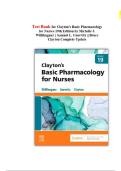
CLAYTON'S BASIC
PHARMACOLOGY FOR NURSES
(19TH EDITION)
SUBJECT: ADVANCED CLINICAL PHARMACOLOGY AND THERAPEUTICS
SOURCE MATERIAL: Clayton's Basic Pharmacology for Nurses, 19th Edition Authors:
Michelle J. Willihnganz, Samuel L. Gurevitz, Bruce D. Clayton
TARGET AUDIENCE: NURSING FACULTY, NCLEX-RN CANDIDATES, AND CLINICAL
EDUCATORS
DOCUMENT TYPE: COMPREHENSIVE TEST BANK WITH EXPERT RATIONALES
UNIT I: APPLYING PHARMACOLOGY TO
NURSING PRACTICE
Question 1: The Nursing Process and Pharmacologic Safety
Topic: The Nursing Process and Pharmacology Cognitive Level: Analysis (Analyzing) Client
Needs: Safe and Effective Care Environment / Management of Care
Question: A registered nurse is supervising a newly licensed nurse during the administration of
medications to a patient with complex comorbidities, including chronic renal failure and
congestive heart failure. The new nurse prepares to administer a prescribed dose of digoxin
(Lanoxin). Before the administration, the supervising nurse intervenes to verify that the
"Assessment" phase of the nursing process has been adequately completed. According to the
framework established in Clayton's Basic Pharmacology for Nurses, which specific assessment
finding is the most critical determinant for holding this medication to prevent life-threatening
toxicity?
A. The patient reports a lack of appetite and mild nausea over the past 24 hours. B. The
patient’s potassium level is 3.4 mEq/L and the apical pulse is 58 beats per minute. C. The
patient’s blood pressure is 110/70 mm Hg and they complain of fatigue. D. The patient has 2+
pitting edema in the lower extremities and crackles in the lung bases.
Correct Answer: B
Detailed Rationale: The nursing process—Assessment, Diagnosis, Planning, Implementation,
and Evaluation—is the bedrock of safe pharmacological practice. In the context of cardiac
glycosides like digoxin, the assessment phase is not merely procedural but diagnostic of the
patient’s immediate physiological capacity to handle the drug safely.
Option B is the correct answer because it presents a "perfect storm" of contraindications that
mandate holding the medication. Digoxin has a narrow therapeutic index, meaning the
difference between a therapeutic dose and a toxic dose is microscopic. Two critical factors are
present here: bradycardia and hypokalemia.
1. Apical Pulse: The standard of practice dictates that digoxin be withheld if the apical pulse
, is less than 60 beats per minute in an adult. A rate of 58 bpm indicates that the drug’s
negative chronotropic effect (slowing the heart rate) has already suppressed the sinoatrial
(SA) node significantly. Administering another dose could precipitate severe bradycardia
or heart block.
2. Hypokalemia: The potassium level of 3.4 mEq/L is below the normal range (3.5–5.0
mEq/L). Hypokalemia is the most significant risk factor for digoxin toxicity. Digoxin binds to
the sodium-potassium ATPase pump in cardiac cells; when potassium is low, digoxin
binding increases, leading to excessive intracellular calcium and toxicity.
Option A (Nausea/Anorexia): While nausea and anorexia are indeed early signs of digoxin
toxicity , they are non-specific and can be caused by many factors (e.g., uremia from renal
failure or other GI issues). While they warrant investigation (checking a digoxin level), the
physiological data in Option B (pulse and potassium) presents a more immediate, quantifiable
threat requiring a "hold" order.
Option C (BP and Fatigue): Fatigue is a vague symptom of heart failure or beta-blocker
therapy. A blood pressure of 110/70 is stable and acceptable for digoxin administration, as
digoxin is not primarily an antihypertensive.
Option D (Edema/Crackles): These are signs of exacerbation of heart failure. While they
indicate the need for treatment (perhaps a diuretic), they are not reasons to hold digoxin; in fact,
digoxin is given to improve contractility (positive inotropy) to resolve these very symptoms.
Clinical Insight: The interaction between diuretics (often prescribed for heart failure) and
digoxin is a classic NCLEX theme. Diuretics like furosemide waste potassium, creating the
hypokalemic environment that makes digoxin toxic. The nurse must view these lab values not in
isolation but as part of a connected physiological system.
Question 2: Pediatric Pharmacokinetics and Protein Binding
Topic: Drug Action Across the Life Span Cognitive Level: Analysis (Analyzing) Client Needs:
Physiological Integrity / Pharmacological Therapies
Question: A pediatric nurse is preparing to administer a highly protein-bound medication, such
as phenytoin or warfarin, to a 2-year-old child. The nurse understands that pediatric
pharmacokinetics differs significantly from adult pharmacokinetics. Which physiological
characteristic of the toddler places them at a higher risk for drug toxicity compared to an adult
receiving the same drug on a weight-adjusted basis?
A. Increased gastric pH, which enhances the absorption of basic drugs. B. Immature blood-brain
barrier allowing non-lipid soluble drugs to enter the CNS. C. Decreased concentration of serum
albumin and other plasma proteins. D. Accelerated glomerular filtration rate (GFR) leading to
rapid drug clearance.
Correct Answer: C
Detailed Rationale: The administration of medications to pediatric patients requires a nuanced
understanding of developmental pharmacokinetics. Children are not merely "small adults"; their
physiological maturity impacts how drugs are absorbed, distributed, metabolized, and excreted.
Option C is the correct answer. Distribution of drugs is heavily influenced by protein binding.
Many drugs circulate in the bloodstream bound to plasma proteins, primarily albumin. The
portion of the drug attached to protein is pharmacologically inactive; only the "free" or unbound
drug can cross membranes, bind to receptors, and exert a therapeutic effect (or toxicity). Infants
and young children often have lower levels of serum albumin and fewer protein-binding sites
compared to adults. Consequently, when a highly protein-bound drug is administered, a larger
percentage of the drug remains "free" and active in the circulation. This creates a higher
, effective concentration of the drug at the receptor sites, significantly elevating the risk of toxicity
even if the dose appears correct based on weight.
Option A (Gastric pH): While gastric pH is indeed higher (less acidic) in neonates and infants,
by age 2 (toddlerhood), gastric acid secretion approaches adult levels. Furthermore, altered pH
primarily affects absorption rates, not the distribution-related toxicity described here.
Option B (Blood-Brain Barrier): While the blood-brain barrier is immature in neonates, it is
generally more developed by toddlerhood. While this is a risk factor for CNS drugs in newborns,
the question specifically targets the mechanism of "highly protein-bound" drugs, pointing directly
to albumin levels.
Option D (GFR): The Glomerular Filtration Rate (GFR) and renal tubular function are immature
at birth but typically reach adult proficiency by 1 year of age. Even if GFR were accelerated
(which occurs in some children due to high metabolic rates), this would lead to decreased drug
levels and sub-therapeutic effects (rapid clearance), not the toxicity mentioned in the stem.
Clinical Insight: Nurses must be vigilant when administering combinations of protein-bound
drugs (e.g., sulfonamides and bilirubin in neonates). One drug can displace the other from
albumin binding sites, causing a sudden spike in free drug levels. This displacement
phenomenon is a critical concept in advanced pharmacology.
Question 3: The Seven Rights of Medication Administration
Topic: Principles of Medication Administration and Medication Safety Cognitive Level:
Application (Applying) Client Needs: Safe and Effective Care Environment / Safety and
Infection Control
Question: The 19th Edition of Clayton's Basic Pharmacology for Nurses expands the traditional
"Five Rights" to the "Seven Rights" of medication administration to enhance patient safety. A
nurse is preparing to administer a PRN pain medication. Which action best demonstrates the
nurse's adherence to the "Right Indication" (also referred to as Right Reason)?
A. The nurse verifies the patient's name and date of birth against the armband. B. The nurse
confirms that the medication is an opioid analgesic before administration. C. The nurse checks
the pain score and ensures the patient is requesting the medication for pain, rather than for
sedation or sleep. D. The nurse documents the administration time and the patient's response
30 minutes later.
Correct Answer: C
Detailed Rationale: Medication errors are often the result of system failures or lapses in
verifying the fundamental parameters of administration. The "Seven Rights" (Patient, Drug,
Dose, Route, Time, Indication, Documentation) serve as the final safety net before a drug enters
the patient's body.
Option C is the correct answer. The "Right Indication" ensures that the medication is being
given for the specific purpose for which it was ordered and for which it is FDA-approved. PRN
(pro re nata) medications are particularly susceptible to error here. For example, if an opioid like
morphine is ordered "PRN for Pain," administering it because the patient requests it "to help me
sleep" violates the Right Indication. The drug is an analgesic, not a sedative-hypnotic in this
context. Using it for sleep masks symptoms and exposes the patient to unnecessary risks
(respiratory depression) without addressing the root cause of the insomnia.
Option A (Identification): This confirms the Right Patient, a critical step but distinct from the
indication. Using two identifiers (Name and DOB) is the Joint Commission standard.
Option B (Drug Verification): This confirms the Right Drug. The nurse is verifying the
classification, but not necessarily the reason for giving it at this moment.
CLAYTON'S BASIC
PHARMACOLOGY FOR NURSES
(19TH EDITION)
SUBJECT: ADVANCED CLINICAL PHARMACOLOGY AND THERAPEUTICS
SOURCE MATERIAL: Clayton's Basic Pharmacology for Nurses, 19th Edition Authors:
Michelle J. Willihnganz, Samuel L. Gurevitz, Bruce D. Clayton
TARGET AUDIENCE: NURSING FACULTY, NCLEX-RN CANDIDATES, AND CLINICAL
EDUCATORS
DOCUMENT TYPE: COMPREHENSIVE TEST BANK WITH EXPERT RATIONALES
UNIT I: APPLYING PHARMACOLOGY TO
NURSING PRACTICE
Question 1: The Nursing Process and Pharmacologic Safety
Topic: The Nursing Process and Pharmacology Cognitive Level: Analysis (Analyzing) Client
Needs: Safe and Effective Care Environment / Management of Care
Question: A registered nurse is supervising a newly licensed nurse during the administration of
medications to a patient with complex comorbidities, including chronic renal failure and
congestive heart failure. The new nurse prepares to administer a prescribed dose of digoxin
(Lanoxin). Before the administration, the supervising nurse intervenes to verify that the
"Assessment" phase of the nursing process has been adequately completed. According to the
framework established in Clayton's Basic Pharmacology for Nurses, which specific assessment
finding is the most critical determinant for holding this medication to prevent life-threatening
toxicity?
A. The patient reports a lack of appetite and mild nausea over the past 24 hours. B. The
patient’s potassium level is 3.4 mEq/L and the apical pulse is 58 beats per minute. C. The
patient’s blood pressure is 110/70 mm Hg and they complain of fatigue. D. The patient has 2+
pitting edema in the lower extremities and crackles in the lung bases.
Correct Answer: B
Detailed Rationale: The nursing process—Assessment, Diagnosis, Planning, Implementation,
and Evaluation—is the bedrock of safe pharmacological practice. In the context of cardiac
glycosides like digoxin, the assessment phase is not merely procedural but diagnostic of the
patient’s immediate physiological capacity to handle the drug safely.
Option B is the correct answer because it presents a "perfect storm" of contraindications that
mandate holding the medication. Digoxin has a narrow therapeutic index, meaning the
difference between a therapeutic dose and a toxic dose is microscopic. Two critical factors are
present here: bradycardia and hypokalemia.
1. Apical Pulse: The standard of practice dictates that digoxin be withheld if the apical pulse
, is less than 60 beats per minute in an adult. A rate of 58 bpm indicates that the drug’s
negative chronotropic effect (slowing the heart rate) has already suppressed the sinoatrial
(SA) node significantly. Administering another dose could precipitate severe bradycardia
or heart block.
2. Hypokalemia: The potassium level of 3.4 mEq/L is below the normal range (3.5–5.0
mEq/L). Hypokalemia is the most significant risk factor for digoxin toxicity. Digoxin binds to
the sodium-potassium ATPase pump in cardiac cells; when potassium is low, digoxin
binding increases, leading to excessive intracellular calcium and toxicity.
Option A (Nausea/Anorexia): While nausea and anorexia are indeed early signs of digoxin
toxicity , they are non-specific and can be caused by many factors (e.g., uremia from renal
failure or other GI issues). While they warrant investigation (checking a digoxin level), the
physiological data in Option B (pulse and potassium) presents a more immediate, quantifiable
threat requiring a "hold" order.
Option C (BP and Fatigue): Fatigue is a vague symptom of heart failure or beta-blocker
therapy. A blood pressure of 110/70 is stable and acceptable for digoxin administration, as
digoxin is not primarily an antihypertensive.
Option D (Edema/Crackles): These are signs of exacerbation of heart failure. While they
indicate the need for treatment (perhaps a diuretic), they are not reasons to hold digoxin; in fact,
digoxin is given to improve contractility (positive inotropy) to resolve these very symptoms.
Clinical Insight: The interaction between diuretics (often prescribed for heart failure) and
digoxin is a classic NCLEX theme. Diuretics like furosemide waste potassium, creating the
hypokalemic environment that makes digoxin toxic. The nurse must view these lab values not in
isolation but as part of a connected physiological system.
Question 2: Pediatric Pharmacokinetics and Protein Binding
Topic: Drug Action Across the Life Span Cognitive Level: Analysis (Analyzing) Client Needs:
Physiological Integrity / Pharmacological Therapies
Question: A pediatric nurse is preparing to administer a highly protein-bound medication, such
as phenytoin or warfarin, to a 2-year-old child. The nurse understands that pediatric
pharmacokinetics differs significantly from adult pharmacokinetics. Which physiological
characteristic of the toddler places them at a higher risk for drug toxicity compared to an adult
receiving the same drug on a weight-adjusted basis?
A. Increased gastric pH, which enhances the absorption of basic drugs. B. Immature blood-brain
barrier allowing non-lipid soluble drugs to enter the CNS. C. Decreased concentration of serum
albumin and other plasma proteins. D. Accelerated glomerular filtration rate (GFR) leading to
rapid drug clearance.
Correct Answer: C
Detailed Rationale: The administration of medications to pediatric patients requires a nuanced
understanding of developmental pharmacokinetics. Children are not merely "small adults"; their
physiological maturity impacts how drugs are absorbed, distributed, metabolized, and excreted.
Option C is the correct answer. Distribution of drugs is heavily influenced by protein binding.
Many drugs circulate in the bloodstream bound to plasma proteins, primarily albumin. The
portion of the drug attached to protein is pharmacologically inactive; only the "free" or unbound
drug can cross membranes, bind to receptors, and exert a therapeutic effect (or toxicity). Infants
and young children often have lower levels of serum albumin and fewer protein-binding sites
compared to adults. Consequently, when a highly protein-bound drug is administered, a larger
percentage of the drug remains "free" and active in the circulation. This creates a higher
, effective concentration of the drug at the receptor sites, significantly elevating the risk of toxicity
even if the dose appears correct based on weight.
Option A (Gastric pH): While gastric pH is indeed higher (less acidic) in neonates and infants,
by age 2 (toddlerhood), gastric acid secretion approaches adult levels. Furthermore, altered pH
primarily affects absorption rates, not the distribution-related toxicity described here.
Option B (Blood-Brain Barrier): While the blood-brain barrier is immature in neonates, it is
generally more developed by toddlerhood. While this is a risk factor for CNS drugs in newborns,
the question specifically targets the mechanism of "highly protein-bound" drugs, pointing directly
to albumin levels.
Option D (GFR): The Glomerular Filtration Rate (GFR) and renal tubular function are immature
at birth but typically reach adult proficiency by 1 year of age. Even if GFR were accelerated
(which occurs in some children due to high metabolic rates), this would lead to decreased drug
levels and sub-therapeutic effects (rapid clearance), not the toxicity mentioned in the stem.
Clinical Insight: Nurses must be vigilant when administering combinations of protein-bound
drugs (e.g., sulfonamides and bilirubin in neonates). One drug can displace the other from
albumin binding sites, causing a sudden spike in free drug levels. This displacement
phenomenon is a critical concept in advanced pharmacology.
Question 3: The Seven Rights of Medication Administration
Topic: Principles of Medication Administration and Medication Safety Cognitive Level:
Application (Applying) Client Needs: Safe and Effective Care Environment / Safety and
Infection Control
Question: The 19th Edition of Clayton's Basic Pharmacology for Nurses expands the traditional
"Five Rights" to the "Seven Rights" of medication administration to enhance patient safety. A
nurse is preparing to administer a PRN pain medication. Which action best demonstrates the
nurse's adherence to the "Right Indication" (also referred to as Right Reason)?
A. The nurse verifies the patient's name and date of birth against the armband. B. The nurse
confirms that the medication is an opioid analgesic before administration. C. The nurse checks
the pain score and ensures the patient is requesting the medication for pain, rather than for
sedation or sleep. D. The nurse documents the administration time and the patient's response
30 minutes later.
Correct Answer: C
Detailed Rationale: Medication errors are often the result of system failures or lapses in
verifying the fundamental parameters of administration. The "Seven Rights" (Patient, Drug,
Dose, Route, Time, Indication, Documentation) serve as the final safety net before a drug enters
the patient's body.
Option C is the correct answer. The "Right Indication" ensures that the medication is being
given for the specific purpose for which it was ordered and for which it is FDA-approved. PRN
(pro re nata) medications are particularly susceptible to error here. For example, if an opioid like
morphine is ordered "PRN for Pain," administering it because the patient requests it "to help me
sleep" violates the Right Indication. The drug is an analgesic, not a sedative-hypnotic in this
context. Using it for sleep masks symptoms and exposes the patient to unnecessary risks
(respiratory depression) without addressing the root cause of the insomnia.
Option A (Identification): This confirms the Right Patient, a critical step but distinct from the
indication. Using two identifiers (Name and DOB) is the Joint Commission standard.
Option B (Drug Verification): This confirms the Right Drug. The nurse is verifying the
classification, but not necessarily the reason for giving it at this moment.