CIPP/E Exam with Verified Solutions
Save
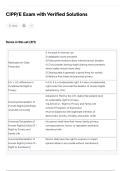
Terms in this set (371)
1) Increase in internet use
2) databanks more prevalent
3) Telecommunications allow internet across borders
Rationales for Data
4) Cross border sharing made sharing more prevalent
Protection
which makes misuse more likely
5) Sharing data is generally a good thing for society
6) Balance free trade and personal privacy
E.U. v U.S. difference in In E.U. it is a fundamental right. It is also a fundamental
Fundamental Right to right under the Universal Declaration of Human Rights
Privacy (adopted by U.N.)
Adopted in 1948 by the U.N. states that people have
an undeniable right to privacy.
Universal Declaration of
Via Article 12 - Right to Privacy and Family Life
Human Rights [Generally
Article 19 Freedom of Expression
what did it provide]
Must be balanced with legitimate interests of
democratic society, morality, and public order
Universal Declaration of No person shall have their home, family, privacy,
Human Rights [Article 12 - correspondence, honor, or reputation arbitrarily
Right to Privacy and interfered with
Family Life
Universal Declaration of Person shall have the right to express or impart
Human Rights [Article 19 - opinion/ideas in any media without interference
Right to Expression]
,Universal Declaration of Rights under 12 and 19 are not obsolete and instead
Human Rights [Article 29 - must be balanced with morality, democratic society,
Limit on Fundamental and public order
Rights]
Adopted in 1958 by the European Commission;
applied only to European member states;
European Declaration of
similar to Constitution of the U.S. fundamental rights +
Human Rights [Generally]
data privacy rights of the Universal Declaration of
Human Rights
Life
liberty
opinion
no torture
no slavery
marriage
European Declaration of
privacy in home and family (similar to article 12 of
Human Rights [Rights]
UDHR)
speech
association
religion
expression
fair trial
Originally it was the European Court of Human Rights,
European Declaration of
which was then changed to a single court dedicated
Human Rights
to human rights that can issue opinions on the EDHR
[Enforcement]
Court findings are binding on member states
1) Non-binding on the EU states
2) intended to provide guidance in order to create a
common set of principles to facilitate cross border
Organization of Economic data exchange while protecting privacy
Co-operation and 3) EU states are free to interpret and implement how
Development [Generally] they want
4) Does not discriminate based on technology or
sector (private or public)
5) 1980
, Accountability (will take accountability for compliance
with OECD)
Collection (fair and lawful and consent where
necessary)
Organization of Economic Openness (general transparency to data practices)
Co-operation and Individual Participation (data rights)
Development [8 Purpose (limited purpose and data collection based
Principles] on that purpose and use based on that purpose, state
the purpose)
Quality (relevant, accurate, up to date)
Use (use in accordance with purpose)
Security
1) the first worldwide, binding data privacy law where
Convention 108 any country could participate
[Generally] 2) Based off of earlier Council of Europe resolutions
73, 74 and 507
1) PI is processed lawfully and fairly
2) Limited collection to what is necessary (relevant
and non-excessive)
3) Not retained longer than necessary
Convention 108 [Chapter 4) Reasonable security as to prevent unauthorized
II Substantive Law - access, use, disclosure
Principles of 108] 5) Processing in line with purpose
6) Sensitive data is not automatically processed
7) Accurate and kept up to date
8) Right to communicate, rectify, and erase data (end
user data right)
Convention 108 [Chapter Where a measure is necessary for state security or
II Substantive Law - criminal investigation
Exceptions to Principles]
Save
Terms in this set (371)
1) Increase in internet use
2) databanks more prevalent
3) Telecommunications allow internet across borders
Rationales for Data
4) Cross border sharing made sharing more prevalent
Protection
which makes misuse more likely
5) Sharing data is generally a good thing for society
6) Balance free trade and personal privacy
E.U. v U.S. difference in In E.U. it is a fundamental right. It is also a fundamental
Fundamental Right to right under the Universal Declaration of Human Rights
Privacy (adopted by U.N.)
Adopted in 1948 by the U.N. states that people have
an undeniable right to privacy.
Universal Declaration of
Via Article 12 - Right to Privacy and Family Life
Human Rights [Generally
Article 19 Freedom of Expression
what did it provide]
Must be balanced with legitimate interests of
democratic society, morality, and public order
Universal Declaration of No person shall have their home, family, privacy,
Human Rights [Article 12 - correspondence, honor, or reputation arbitrarily
Right to Privacy and interfered with
Family Life
Universal Declaration of Person shall have the right to express or impart
Human Rights [Article 19 - opinion/ideas in any media without interference
Right to Expression]
,Universal Declaration of Rights under 12 and 19 are not obsolete and instead
Human Rights [Article 29 - must be balanced with morality, democratic society,
Limit on Fundamental and public order
Rights]
Adopted in 1958 by the European Commission;
applied only to European member states;
European Declaration of
similar to Constitution of the U.S. fundamental rights +
Human Rights [Generally]
data privacy rights of the Universal Declaration of
Human Rights
Life
liberty
opinion
no torture
no slavery
marriage
European Declaration of
privacy in home and family (similar to article 12 of
Human Rights [Rights]
UDHR)
speech
association
religion
expression
fair trial
Originally it was the European Court of Human Rights,
European Declaration of
which was then changed to a single court dedicated
Human Rights
to human rights that can issue opinions on the EDHR
[Enforcement]
Court findings are binding on member states
1) Non-binding on the EU states
2) intended to provide guidance in order to create a
common set of principles to facilitate cross border
Organization of Economic data exchange while protecting privacy
Co-operation and 3) EU states are free to interpret and implement how
Development [Generally] they want
4) Does not discriminate based on technology or
sector (private or public)
5) 1980
, Accountability (will take accountability for compliance
with OECD)
Collection (fair and lawful and consent where
necessary)
Organization of Economic Openness (general transparency to data practices)
Co-operation and Individual Participation (data rights)
Development [8 Purpose (limited purpose and data collection based
Principles] on that purpose and use based on that purpose, state
the purpose)
Quality (relevant, accurate, up to date)
Use (use in accordance with purpose)
Security
1) the first worldwide, binding data privacy law where
Convention 108 any country could participate
[Generally] 2) Based off of earlier Council of Europe resolutions
73, 74 and 507
1) PI is processed lawfully and fairly
2) Limited collection to what is necessary (relevant
and non-excessive)
3) Not retained longer than necessary
Convention 108 [Chapter 4) Reasonable security as to prevent unauthorized
II Substantive Law - access, use, disclosure
Principles of 108] 5) Processing in line with purpose
6) Sensitive data is not automatically processed
7) Accurate and kept up to date
8) Right to communicate, rectify, and erase data (end
user data right)
Convention 108 [Chapter Where a measure is necessary for state security or
II Substantive Law - criminal investigation
Exceptions to Principles]