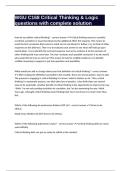
WGU C168 Critical Thinking & Logic
questions with complete solution
How do you define critical thinking? - correct answer ✔✔Critical thinking means to carefully
scrutinize a problem or issue that deserves the additional effort this requires. This means to
resist the first conclusion that comes to mind, but to not discard it. Rather, I try to think of other
responses to this dilemma. Then I try to evaluate each answer to see what will hold up upon
examination. I try to identify the one best response, but not to embrace it to the exclusion of
other thinking that may come later. The way I evaluate each possible conclusion is to ask myself,
why would this be true or not true? This means to look for credible evidence or to identify
credible reasoning to support or put into question each possibility.
What would you add or change about your first definition of critical thinking? - correct answer
✔✔After reading the definitions provided in this module, there are several points I want to add.
The purpose in engaging in critical thinking is to know "what to believe or do." Also, critical
thinking is a systematic process, one that takes lots of practice. I also think there are several
ways to be systematic. Another benefit of critical thinking is the opportunity to improve the way
I think. I'm not only seeking resolution to a problem, but I'm also examining the way I think.
Years ago, I thought critical thinking meant finding fault, but I now know it is much more than
this.
Which of the following do weak-sense thinkers NOT do? - correct answer ✔✔Strive to be
ethical.
Weak-sense thinkers do NOT strive to be ethical.
Which of the following statements is false? - correct answer ✔✔Critical thinking skills are never
used selfishly.
Critical thinking skills can just as easily be selfish as fair-minded.
, Fair-minded people feel no responsibility to represent viewpoints with which they disagree
fairly and accurately. True or false? - correct answer ✔✔False.
Intellectually unfair people feel no responsibility to represent viewpoints with which they
disagree fairly and accurately.
Intellectual humility is a character trait of critical thinkers. True or false? - correct answer
✔✔True.
Critical thinkers are intellectually humble, meaning they are conscious of the limitations of their
own knowledge and understanding.
Asking the question, "Did I try to impose my will on others?" is part of which tactic to improve
critical thinking? - correct answer ✔✔Deal with your ego.
It is an example of dealing with your ego.
Looking at the way your behavior is shaped by others is part of which tactic to improve critical
thinking? - correct answer ✔✔Analyze group influences on your life.
It is an example of analyzing group influences on one's life.
An argument that lacks specifics violates which of the following universal intellectual standards?
- correct answer ✔✔Precision.
The lack of specificity violates the standard of precision.
Wanting allocates energy into action. True or false? - correct answer ✔✔True.
Wanting continually tells us what is (or is not) worth seeking or getting.
Thinking, feeling, and wanting are unrelated processes in the mind. True or false? - correct
answer ✔✔False.
Thinking, feeling, and wanting interrelate closely and dynamically with one another.
questions with complete solution
How do you define critical thinking? - correct answer ✔✔Critical thinking means to carefully
scrutinize a problem or issue that deserves the additional effort this requires. This means to
resist the first conclusion that comes to mind, but to not discard it. Rather, I try to think of other
responses to this dilemma. Then I try to evaluate each answer to see what will hold up upon
examination. I try to identify the one best response, but not to embrace it to the exclusion of
other thinking that may come later. The way I evaluate each possible conclusion is to ask myself,
why would this be true or not true? This means to look for credible evidence or to identify
credible reasoning to support or put into question each possibility.
What would you add or change about your first definition of critical thinking? - correct answer
✔✔After reading the definitions provided in this module, there are several points I want to add.
The purpose in engaging in critical thinking is to know "what to believe or do." Also, critical
thinking is a systematic process, one that takes lots of practice. I also think there are several
ways to be systematic. Another benefit of critical thinking is the opportunity to improve the way
I think. I'm not only seeking resolution to a problem, but I'm also examining the way I think.
Years ago, I thought critical thinking meant finding fault, but I now know it is much more than
this.
Which of the following do weak-sense thinkers NOT do? - correct answer ✔✔Strive to be
ethical.
Weak-sense thinkers do NOT strive to be ethical.
Which of the following statements is false? - correct answer ✔✔Critical thinking skills are never
used selfishly.
Critical thinking skills can just as easily be selfish as fair-minded.
, Fair-minded people feel no responsibility to represent viewpoints with which they disagree
fairly and accurately. True or false? - correct answer ✔✔False.
Intellectually unfair people feel no responsibility to represent viewpoints with which they
disagree fairly and accurately.
Intellectual humility is a character trait of critical thinkers. True or false? - correct answer
✔✔True.
Critical thinkers are intellectually humble, meaning they are conscious of the limitations of their
own knowledge and understanding.
Asking the question, "Did I try to impose my will on others?" is part of which tactic to improve
critical thinking? - correct answer ✔✔Deal with your ego.
It is an example of dealing with your ego.
Looking at the way your behavior is shaped by others is part of which tactic to improve critical
thinking? - correct answer ✔✔Analyze group influences on your life.
It is an example of analyzing group influences on one's life.
An argument that lacks specifics violates which of the following universal intellectual standards?
- correct answer ✔✔Precision.
The lack of specificity violates the standard of precision.
Wanting allocates energy into action. True or false? - correct answer ✔✔True.
Wanting continually tells us what is (or is not) worth seeking or getting.
Thinking, feeling, and wanting are unrelated processes in the mind. True or false? - correct
answer ✔✔False.
Thinking, feeling, and wanting interrelate closely and dynamically with one another.