BMAL 590 BUSINESS ETHICS_MASTER.
EXAM QUESTIONS AND ANSWERS.
VERIFIED 2025/2026.
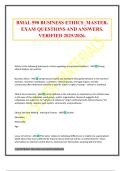
Which of the following statements is false regarding strong ethical leaders? - ANS Strong
ethical leaders are reactive
Business Ethics - ANS comprises principles and standards that guide behavior in the world of
business. Investors, employees, customers, interest groups, the legal system, and the
community often determine whether a specific action is right or wrong -- ethical or unethical
Ethical Issue Intensity - ANS can be defined as the relevance or importance of an ethical issue
in the eyes of the individual, work group, and/or organization. Research suggests that
individuals are subject to six "spheres of influence" when confronted with ethical choices: the
workplace, family, religion, legal system, community, and profession.
Ethical Decision Making - Individual Factors - ANS Gender
Education
Nationality
Age
Locus of Control - ANS This factor relates to individual differences in relation to a generalized
belief about how one is affected by internal versus external events or reinforcements. Those
who believe in external control (that is, externals) see themselves as going with the flow
1 @COPYRIGHT 2025/2026 ALLRIGHTS RESERVED.
, because that is all they can do. Conversely, those who believe in internal control (that is,
internals) believe that they control the events in their lives by their own effort and skill. These
individuals view themselves as masters of their destinies and trust in their capacity to influence
their environment.
Corporate Culture - ANS can be defined as a set of values, beliefs, goals, norms, and ways of
solving problems that members (employees) of an organization share
Opportunity Factors - ANS Opportunity describes the conditions in an organization that limit
or permit ethical or unethical behavior. Opportunity results from conditions that either provide
rewards, whether internal or external, or fail to erect barriers against unethical behavior.
Opportunity relates to individuals' immediate job context: where they work, with whom they
work, and the nature of the work
The Role of Leadership In Developing An Ethics Program - ANS 1. Conduct a rigorous self-
assessment of the firm's values and its existing ethics and compliance program.
2. Maintain commitment from top managers.
3. Publish, post, and make codes of ethics available and understandable.
4. Communicate ethical standards through multiple channels (for example, paper documents
and web pages).
5. Provide timely training to reinforce knowledge.
6. Provide confidential resources to whom employees can go for advice or to report their
concerns.
7. Ensure consistent implementation.
8. Respond and enforce consistently, promptly and fairly.
9. Monitor and assess using appropriate methods.
10. Revise and reform to ensure continuous improvement.
Coercive Leadership Style - ANS the coercive leader demands instantaneous obedience and
focuses on achievement, initiative, and self control.
2 @COPYRIGHT 2025/2026 ALLRIGHTS RESERVED.
EXAM QUESTIONS AND ANSWERS.
VERIFIED 2025/2026.
Which of the following statements is false regarding strong ethical leaders? - ANS Strong
ethical leaders are reactive
Business Ethics - ANS comprises principles and standards that guide behavior in the world of
business. Investors, employees, customers, interest groups, the legal system, and the
community often determine whether a specific action is right or wrong -- ethical or unethical
Ethical Issue Intensity - ANS can be defined as the relevance or importance of an ethical issue
in the eyes of the individual, work group, and/or organization. Research suggests that
individuals are subject to six "spheres of influence" when confronted with ethical choices: the
workplace, family, religion, legal system, community, and profession.
Ethical Decision Making - Individual Factors - ANS Gender
Education
Nationality
Age
Locus of Control - ANS This factor relates to individual differences in relation to a generalized
belief about how one is affected by internal versus external events or reinforcements. Those
who believe in external control (that is, externals) see themselves as going with the flow
1 @COPYRIGHT 2025/2026 ALLRIGHTS RESERVED.
, because that is all they can do. Conversely, those who believe in internal control (that is,
internals) believe that they control the events in their lives by their own effort and skill. These
individuals view themselves as masters of their destinies and trust in their capacity to influence
their environment.
Corporate Culture - ANS can be defined as a set of values, beliefs, goals, norms, and ways of
solving problems that members (employees) of an organization share
Opportunity Factors - ANS Opportunity describes the conditions in an organization that limit
or permit ethical or unethical behavior. Opportunity results from conditions that either provide
rewards, whether internal or external, or fail to erect barriers against unethical behavior.
Opportunity relates to individuals' immediate job context: where they work, with whom they
work, and the nature of the work
The Role of Leadership In Developing An Ethics Program - ANS 1. Conduct a rigorous self-
assessment of the firm's values and its existing ethics and compliance program.
2. Maintain commitment from top managers.
3. Publish, post, and make codes of ethics available and understandable.
4. Communicate ethical standards through multiple channels (for example, paper documents
and web pages).
5. Provide timely training to reinforce knowledge.
6. Provide confidential resources to whom employees can go for advice or to report their
concerns.
7. Ensure consistent implementation.
8. Respond and enforce consistently, promptly and fairly.
9. Monitor and assess using appropriate methods.
10. Revise and reform to ensure continuous improvement.
Coercive Leadership Style - ANS the coercive leader demands instantaneous obedience and
focuses on achievement, initiative, and self control.
2 @COPYRIGHT 2025/2026 ALLRIGHTS RESERVED.