
THE EAR
- The receptors that detect sound stimuli and movements of the head are known as
mechanoreceptors and are concentrated in the ear.
- The ear enables humans to hear and maintain their balance.
POSITION
- The two pinnae are positioned outside the skull on opposite sides of the head.
- The rest of the ear is embedded in the temporal bone on the skull.
STRUCTURE OF THE EAR
OUTER EAR
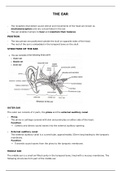
The outer ear consists of 2 parts, the pinna and the external auditory canal.
- Pinna
The pinna is cartilage covered with skin and protrudes on either side of the head.
Function
→ Collects and directs sound waves into the external auditory opening.
- External auditory canal
The external auditory canal is a curved tube, approximately 25mm long leading to the tympanic
membrane.
Function
→ Transmits sound waves from the pinna to the tympanic membrane.
MIDDLE EAR
The middle ear is a small air-filled cavity in the temporal bone, lined with a mucous membrane. The
following structures form part of the middle ear.
, - Tympanic membrane (Eardrum)
A thin membrane that covers the opening between the external auditory canal and the middle ear.
Function
Converts sound waves to vibrations that are transmitted to the hammer (malleus), the first ear
ossicle.
- Ossicles
The middle ear has 3 bony ossicles, i.e. the malleus (hammer), incus (anvil) and stapes
(stirrup).
Tiny ligaments join the 3 ossicles so they can articulate with each other freely.
The one end of the malleus is attached to the eardrum and the other end to the incus, which
articulates with the stapes.
The stapes is attached to the oval window.
Together, the three ossicles form a lever system that connects the outer and inner ear.
Function
Amplifies and transmits the vibrations to the membrane of the oval window.
- Oval window
→ The oval window is an opening covered by a thin membrane. It connects the middle ear to the
inner ear.
→ The area of the oval window is much smaller than that of the tympanic membrane.
Function
Transmits vibrations from the air-filled middle ear to the fluid-filled inner ear.
- Round window
→ The round window is another opening between the middle and inner ear and is situated directly
below the oval window.
→ Covered by a thin membrane.
- Opening to the Eustachian tube
This opening and the Eustachian tube connect the middle ear to the pharynx (throat cavity).
Function
The eustachian tube ensures that the pressure remains equal on both sides of the tympanic
membrane.
o The opening between the external auditory canal and the middle ear is covered by the tympanic
membrane.
o The oval window, covered by a thin membrane, connects the inner to the middle ear.
o The round window, covered by a thin membrane, connects the inner to the middle ear.
- The receptors that detect sound stimuli and movements of the head are known as
mechanoreceptors and are concentrated in the ear.
- The ear enables humans to hear and maintain their balance.
POSITION
- The two pinnae are positioned outside the skull on opposite sides of the head.
- The rest of the ear is embedded in the temporal bone on the skull.
STRUCTURE OF THE EAR
OUTER EAR
The outer ear consists of 2 parts, the pinna and the external auditory canal.
- Pinna
The pinna is cartilage covered with skin and protrudes on either side of the head.
Function
→ Collects and directs sound waves into the external auditory opening.
- External auditory canal
The external auditory canal is a curved tube, approximately 25mm long leading to the tympanic
membrane.
Function
→ Transmits sound waves from the pinna to the tympanic membrane.
MIDDLE EAR
The middle ear is a small air-filled cavity in the temporal bone, lined with a mucous membrane. The
following structures form part of the middle ear.
, - Tympanic membrane (Eardrum)
A thin membrane that covers the opening between the external auditory canal and the middle ear.
Function
Converts sound waves to vibrations that are transmitted to the hammer (malleus), the first ear
ossicle.
- Ossicles
The middle ear has 3 bony ossicles, i.e. the malleus (hammer), incus (anvil) and stapes
(stirrup).
Tiny ligaments join the 3 ossicles so they can articulate with each other freely.
The one end of the malleus is attached to the eardrum and the other end to the incus, which
articulates with the stapes.
The stapes is attached to the oval window.
Together, the three ossicles form a lever system that connects the outer and inner ear.
Function
Amplifies and transmits the vibrations to the membrane of the oval window.
- Oval window
→ The oval window is an opening covered by a thin membrane. It connects the middle ear to the
inner ear.
→ The area of the oval window is much smaller than that of the tympanic membrane.
Function
Transmits vibrations from the air-filled middle ear to the fluid-filled inner ear.
- Round window
→ The round window is another opening between the middle and inner ear and is situated directly
below the oval window.
→ Covered by a thin membrane.
- Opening to the Eustachian tube
This opening and the Eustachian tube connect the middle ear to the pharynx (throat cavity).
Function
The eustachian tube ensures that the pressure remains equal on both sides of the tympanic
membrane.
o The opening between the external auditory canal and the middle ear is covered by the tympanic
membrane.
o The oval window, covered by a thin membrane, connects the inner to the middle ear.
o The round window, covered by a thin membrane, connects the inner to the middle ear.


