

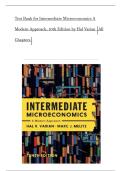
Test Bank for Intermediate Microeconomics A
Modern Approach, 10th Edition by Hal Varian [All
Chapters]
, Intermediate Microeconomics A Modern Approach, 10e by Hal Varian
(All Chapters) 978-1324034292
Table of contents
Chapter 1 The Market
Chapter 2 Budget Constraint
Chapter 3 Preferences
Chapter 4 Utility
Chapter 5 Choice
Chapter 6 Demand
Chapter 7 Revealed Preference
Chapter 8 Slutsky Equation
Chapter 9 Buying and Selling
Chapter 10 Intertemporal Choice
Chapter 11 Asset Markets
Chapter 12 Uncertainty
Chapter 13 Risky Assets
Chapter 14 Consumer’s Surplus
Chapter 15 Market Demand
Chapter 16 Equilibrium
Chapter 17 Measurement
Chapter 18 Auctions
Chapter 19 Technology
Chapter 20 Profit Maximization
Chapter 21 Cost Minimization
Chapter 22 Cost Curves
Chapter 23 Firm Supply
Chapter 24 Industry Supply
Chapter 25 Monopoly
Chapter 26 Monopoly Behavior
Chapter 27 Factor Markets
Chapter 28 Oligopoly
,Chapter 29 Game Theory
Chapter 30 Game Applications
Chapter 31 Behavioral Economics
Chapter 32 Exchange
Chapter 33 Production
Chapter 34 Welfare
Chapter 35 Externalities
Chapter 36 Information Technology
Chapter 37 Public Goods
Chapter 38 Information
, CHAPTER 2: Budget Constraint
TRUE/FALSE
1. If there are two goods with positive prices and the price of one good is reduced,
while income and other prices remain constant, then the size of the budget set is
reduced.
ANSWER: F DIF: 1
2. If good 1 is measured on the horizontal axis and good 2 is measured on the vertical
axis and if the price of good 1 is p1 and the price of good 2 is p2, then the slope of
the budget line is p2/p1.
ANSWER: F DIF: 1
3. If all prices are doubled and money income is left the same, the budget set does not
change because relative prices do not change.
ANSWER: F DIF: 1
4. If there are two goods and if one good has a negative price and the other has a
positive price, then the slope of the budget line will be positive.
ANSWER: T DIF: 1
5. If all prices double and income triples, then the budget line will
become steeper. ANSWER: F DIF: 1
6. If good 1 is on the horizontal axis and good 2 is on the vertical axis, then an increase
in the price of good 1 will not change the horizontal intercept of the budget line.
ANSWER: F DIF: 1
7. If there are two goods and the prices of both goods rise, then the budget line must
become steeper. ANSWER: F DIF: 1
Modern Approach, 10th Edition by Hal Varian [All
Chapters]
, Intermediate Microeconomics A Modern Approach, 10e by Hal Varian
(All Chapters) 978-1324034292
Table of contents
Chapter 1 The Market
Chapter 2 Budget Constraint
Chapter 3 Preferences
Chapter 4 Utility
Chapter 5 Choice
Chapter 6 Demand
Chapter 7 Revealed Preference
Chapter 8 Slutsky Equation
Chapter 9 Buying and Selling
Chapter 10 Intertemporal Choice
Chapter 11 Asset Markets
Chapter 12 Uncertainty
Chapter 13 Risky Assets
Chapter 14 Consumer’s Surplus
Chapter 15 Market Demand
Chapter 16 Equilibrium
Chapter 17 Measurement
Chapter 18 Auctions
Chapter 19 Technology
Chapter 20 Profit Maximization
Chapter 21 Cost Minimization
Chapter 22 Cost Curves
Chapter 23 Firm Supply
Chapter 24 Industry Supply
Chapter 25 Monopoly
Chapter 26 Monopoly Behavior
Chapter 27 Factor Markets
Chapter 28 Oligopoly
,Chapter 29 Game Theory
Chapter 30 Game Applications
Chapter 31 Behavioral Economics
Chapter 32 Exchange
Chapter 33 Production
Chapter 34 Welfare
Chapter 35 Externalities
Chapter 36 Information Technology
Chapter 37 Public Goods
Chapter 38 Information
, CHAPTER 2: Budget Constraint
TRUE/FALSE
1. If there are two goods with positive prices and the price of one good is reduced,
while income and other prices remain constant, then the size of the budget set is
reduced.
ANSWER: F DIF: 1
2. If good 1 is measured on the horizontal axis and good 2 is measured on the vertical
axis and if the price of good 1 is p1 and the price of good 2 is p2, then the slope of
the budget line is p2/p1.
ANSWER: F DIF: 1
3. If all prices are doubled and money income is left the same, the budget set does not
change because relative prices do not change.
ANSWER: F DIF: 1
4. If there are two goods and if one good has a negative price and the other has a
positive price, then the slope of the budget line will be positive.
ANSWER: T DIF: 1
5. If all prices double and income triples, then the budget line will
become steeper. ANSWER: F DIF: 1
6. If good 1 is on the horizontal axis and good 2 is on the vertical axis, then an increase
in the price of good 1 will not change the horizontal intercept of the budget line.
ANSWER: F DIF: 1
7. If there are two goods and the prices of both goods rise, then the budget line must
become steeper. ANSWER: F DIF: 1


