BLP WS2
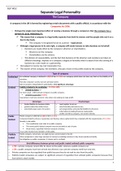
Separate Legal Personality
The Company
A company in the UK is formed by registering certain documents with a public official, in accordance with the
Companies Act 2006.
Perhaps the single most important effect of running a business through a company is that the company has a
SEPARATE LEGAL PERSONALITY.
This means that a company is a legal entity separate from both its owners and the people who run it on a
day-to-day basis.
The company is recognized by law as a person – legal person.
Although a legal person in its own right, a company still needs humans to take decisions on its behalf.
o Decisions are made either by the company’s directors or shareholders.
Directors run the company.
Shareholders are the owners.
o This division of responsibility, and the fact that decisions of the directors and members are taken at
different meetings, imposes on a company a degree of formality which is absent from the running of a
business by a sole trader or a partnership.
Not subject to income tax, but Corporation Tax.
The owners of the company, the members, who get a share in the profits made by the company.
Type of company
Unlimited An unlimited company is defined in s3(4) of the CA 2006 as a company which does not have any limit on the liability of its
members.
Not only company’s assets, but own personal assets.
Rare in practice, being limited is potentially a very significant advantage.
Limited Liability is limited to its constitution – CA 2006, s3(1).
Limited by shares; or
Far more usual – either private company or public company.
Limited by guarantee (s 3(1)).
Guarantee is much less common: only where not seeking to make profit.
Advantages Disadvantages
o limited liability for business debts; o must register to set up;
o greater status than other forms; o extra formality and costs to run;
o potentially larger pool of investors. o extra-legal duties and potential liability for directors;
o information (including finances) made public;
o profits earned by company, not owners directly.
Public Public company is defined by s3(4) of the CA 2006.
Company limited by shares or guarantee and having a share capital which has complied with the requirements of CA 2006.
limited
Broadly, to be public:
The constitution must state it is public company.
The words public limited company must be included at end of name
Must invest a specified minimum amount of money.
It can raise money from members of the public.
Publicly Public company, not private, can apply to join a stock market in the UK.
Allow companies to raise large amounts of money by enabling investors to buy shares quickly and easily.
traded
No obligation on public companies. If choose not to, unlisted.
Brief differences between private and (public traded/unlisted) public companies
o s 755: a private company cannot offer its shares to the public, whereas a public company can.
o s 154: a public company must have at least two directors, but a private company need have only one.
o Private companies are less regulated than public because they do not seek to raise from the public.
o Publicly traded companies are subject to significant amount of regulation than unlisted public companies because they
have joined a stock market.
1
Separate Legal Personality
The Company
A company in the UK is formed by registering certain documents with a public official, in accordance with the
Companies Act 2006.
Perhaps the single most important effect of running a business through a company is that the company has a
SEPARATE LEGAL PERSONALITY.
This means that a company is a legal entity separate from both its owners and the people who run it on a
day-to-day basis.
The company is recognized by law as a person – legal person.
Although a legal person in its own right, a company still needs humans to take decisions on its behalf.
o Decisions are made either by the company’s directors or shareholders.
Directors run the company.
Shareholders are the owners.
o This division of responsibility, and the fact that decisions of the directors and members are taken at
different meetings, imposes on a company a degree of formality which is absent from the running of a
business by a sole trader or a partnership.
Not subject to income tax, but Corporation Tax.
The owners of the company, the members, who get a share in the profits made by the company.
Type of company
Unlimited An unlimited company is defined in s3(4) of the CA 2006 as a company which does not have any limit on the liability of its
members.
Not only company’s assets, but own personal assets.
Rare in practice, being limited is potentially a very significant advantage.
Limited Liability is limited to its constitution – CA 2006, s3(1).
Limited by shares; or
Far more usual – either private company or public company.
Limited by guarantee (s 3(1)).
Guarantee is much less common: only where not seeking to make profit.
Advantages Disadvantages
o limited liability for business debts; o must register to set up;
o greater status than other forms; o extra formality and costs to run;
o potentially larger pool of investors. o extra-legal duties and potential liability for directors;
o information (including finances) made public;
o profits earned by company, not owners directly.
Public Public company is defined by s3(4) of the CA 2006.
Company limited by shares or guarantee and having a share capital which has complied with the requirements of CA 2006.
limited
Broadly, to be public:
The constitution must state it is public company.
The words public limited company must be included at end of name
Must invest a specified minimum amount of money.
It can raise money from members of the public.
Publicly Public company, not private, can apply to join a stock market in the UK.
Allow companies to raise large amounts of money by enabling investors to buy shares quickly and easily.
traded
No obligation on public companies. If choose not to, unlisted.
Brief differences between private and (public traded/unlisted) public companies
o s 755: a private company cannot offer its shares to the public, whereas a public company can.
o s 154: a public company must have at least two directors, but a private company need have only one.
o Private companies are less regulated than public because they do not seek to raise from the public.
o Publicly traded companies are subject to significant amount of regulation than unlisted public companies because they
have joined a stock market.
1