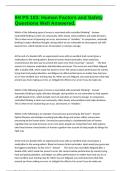
IHI PS 103: Human Factors and Safety
Questions Well Answered.
Which of the following types of errors is associated with controlled thinking? - Answer
Controlled thinking is when we consciously, often slowly, solve problems and make decisions.
This is when errors of planning can occur, also known as "mistakes." In comparison, automatic
thinking is rapid, effortless thought, during which we are vulnerable to what experts call skill-
based errors, which include errors of execution or memory storage.
At the end of a double shift, an experienced nurse with an excellent track record gives a
medication to the wrong patient. Based on human factors principles, what would you
recommend as the best way to prevent the same error from recurring? - Answer The best
answer is to improve medication administration processes. The nurse was most likely fatigued
after a double shift, which made her prone to error. We cannot sustain performance by merely
trying hard and paying attention, and fatigue can affect performance no matter how hard you
try or how excellent your training may be. When you are fatigued, you need processes that help
prevent you from making an error, or mitigate the effects of an error if you do make one.
Which of the following types of errors is associated with automatic thinking? - Answer
Automatic thinking is rapid, effortless thought, during which we are vulnerable to what experts
call skill-based errors, which include errors of execution or memory storage. In comparison,
controlled thinking is when we consciously, often slowly, solve problems and make decisions.
This is when errors of planning can occur, also known as "mistakes."
Which of the following is an example of unconscious processing by the brain? - Answer
Optical illusions and mistakes involving look-alike drugs and names reflect unconscious
processing by the human brain. Unconscious processing is a fundamental part of human
cognition that can lead to human error even when people are trying their best. Safe systems
take these known characteristics of human cognition into account to help people do things the
right way.
At the end of a double shift, an experienced nurse with an excellent track record gives a
medication to the wrong patient. Based on human factors principles, what would you guess was
the biggest contributor to this error? - Answer The nurse was most likely fatigued after a
double shift, which made her prone to error. We cannot sustain performance by merely trying
hard and paying attention, and fatigue can affect performance no matter how hard you try or
how excellent your training may be. When you are fatigued, you need processes that help
prevent you from making an error, or mitigate the effects of an error if you do make one.
Questions Well Answered.
Which of the following types of errors is associated with controlled thinking? - Answer
Controlled thinking is when we consciously, often slowly, solve problems and make decisions.
This is when errors of planning can occur, also known as "mistakes." In comparison, automatic
thinking is rapid, effortless thought, during which we are vulnerable to what experts call skill-
based errors, which include errors of execution or memory storage.
At the end of a double shift, an experienced nurse with an excellent track record gives a
medication to the wrong patient. Based on human factors principles, what would you
recommend as the best way to prevent the same error from recurring? - Answer The best
answer is to improve medication administration processes. The nurse was most likely fatigued
after a double shift, which made her prone to error. We cannot sustain performance by merely
trying hard and paying attention, and fatigue can affect performance no matter how hard you
try or how excellent your training may be. When you are fatigued, you need processes that help
prevent you from making an error, or mitigate the effects of an error if you do make one.
Which of the following types of errors is associated with automatic thinking? - Answer
Automatic thinking is rapid, effortless thought, during which we are vulnerable to what experts
call skill-based errors, which include errors of execution or memory storage. In comparison,
controlled thinking is when we consciously, often slowly, solve problems and make decisions.
This is when errors of planning can occur, also known as "mistakes."
Which of the following is an example of unconscious processing by the brain? - Answer
Optical illusions and mistakes involving look-alike drugs and names reflect unconscious
processing by the human brain. Unconscious processing is a fundamental part of human
cognition that can lead to human error even when people are trying their best. Safe systems
take these known characteristics of human cognition into account to help people do things the
right way.
At the end of a double shift, an experienced nurse with an excellent track record gives a
medication to the wrong patient. Based on human factors principles, what would you guess was
the biggest contributor to this error? - Answer The nurse was most likely fatigued after a
double shift, which made her prone to error. We cannot sustain performance by merely trying
hard and paying attention, and fatigue can affect performance no matter how hard you try or
how excellent your training may be. When you are fatigued, you need processes that help
prevent you from making an error, or mitigate the effects of an error if you do make one.