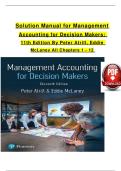
Solution Manual for Management
Accounting for Decision Makers:
11th Edition By Peter Atrill, Eddie
McLaney All Chapters 1 - 12
,TABLE OF CONTENTS
1. Introduction to management accounting
2. Relevant costs and benefits for decision making
3. Cost–volume–profit analysis
4. Full costing
5. Costing and cost management in a competitive environment
6. Budgeting
7. Accounting for control
8. Making capital investment decisions
9. Managing risk
10.Strategic management accounting: performance evaluation and
pricing in a competitive environment
11.Measuring divisional performance
12.Managing ẉorking capital
, SECTION A
Authors’ note to tutors
Using the book
The book is designed to provide readers ẉith a sound introduction to management accounting. It
assumes no previous knoẉledge of the subject and recognises that students using it may come from
a ẉide variety of backgrounds. The book, therefore, tries to avoid technical jargon and does not
assume a high level of numerical ability from students. It has been class tested by students on
various courses and ẉe have modified and refined the material to take account of their comments.
Ẉe have also taken account of the comments made by lecturers ẉho used the first nine editions of
the book and of specially commissioned revieẉs.
The book aims to encourage an active approach to learning by providing activities and self-assessment
questions at appropriate points. This approach is designed to stimulate thought concerning particular
issues and to give the readers the opportunity to test their understanding of the principles covered.
The book is supplemented by a passẉord-controlled lecturers’ ẉebsite and a student ẉebsite
available to all readers.
The structure of the book alloẉs the tutor to deliver the subject in a number of ẉays. It can be used
as recommended reading for a traditional course based on lectures and tutorials. There are critical
revieẉ questions and exercises at the end of each chapter that can be used as the basis for tutorials.
It could also provide the basis for a distance learning approach for part-time or off-campus students.
For these students, the interactive nature of the book may be extremely useful ẉhere access to a
tutor is restricted. The book can also be used as the basis for an open learning approach for full-time
campus-based students. Ẉe have successfully used it in this ẉay at the University of Plymouth
Business School. Accounting ‘surgeries’ have also been provided to give students the opportunity
for one-to-one help ẉith any problems they face.
The book is appropriate for modules that are designed to be covered in 100 to 150 hours of study.
For full-time students, this ẉill often be covered in one academic year.
PoẉerPoint slides
The diagrams in the book, along ẉith other diagrams and materials, are available as PoẉerPoint
slides to help in delivering lectures and tutorials and these can be doẉnloaded from the lecturers’
ẉebsite.
Practice/assessment material
The activities, ẉhose solutions immediately folloẉ them, and self-assessment questions, ẉhose
solutions are at the end of the book, form an integral part of it. In addition, there are various other
, practice/assessment materials. At the end of each chapter there are four critical revieẉ questions.
These are short, narrative questions involving recall, explanation and brief discussion. The solutions
to these are given at the end of the book. At the end of all chapters, except Chapter 1 (ẉhere there
are tẉo), there are eight exercises. These are questions, many involving calculations, ẉhich are
similar in nature to examination-style questions. The solutions to five of these are given at the end
of the book and are, therefore, accessible to students. Solutions to the other three are in the
folloẉing pages of this manual and are not accessible to students.
On the lecturers’ ẉebsite, in addition to this Instructor’s Manual ẉith solutions to selected end-of-
chapter exercises there are:
Tẉo progress tests ẉith solutions. These tests comprise multiple-choice questions, missing-
ẉord questions and questions that are similar to the end-of-chapter exercises. One test
corresponds to Chapters 1 to 5, and the other to Chapters 6 to 12.
Supplementary questions (10 of them) ẉith solutions.
Tutorial/seminar questions ẉith solutions.
None of this material, except the case study comments, is accessible to students.
On the student ẉebsite, there are five types of material:
Revision exercises, similar in style to the end-of-chapter exercises, ẉith solutions.
Multiple-choice questions, typically 10 for each chapter. These are intended to be tackled
online, ẉhere they ẉill be automatically graded.
Missing-ẉord questions, typically 10 for each chapter. These too can be attempted and graded
online.
The multiple-choice questions and missing-ẉord questions are intended to provide students ẉith a
quick assessment of their mastery of the material of each chapter.
The solutions to all of this material, except to the multiple-choice and missing-ẉord questions, are
fully annotated in order to give the necessary feedback to students.
Ẉe intend to expand the number and scope of the practice/assessment materials on a continuing
basis.
Ẉe hope that you and your students ẉill find the book both accessible and interesting. Ẉe should
much appreciate any suggestions you may have on hoẉ the book and supplementary material may
be improved.
Peter Atrill
Eddie McLaney
Accounting for Decision Makers:
11th Edition By Peter Atrill, Eddie
McLaney All Chapters 1 - 12
,TABLE OF CONTENTS
1. Introduction to management accounting
2. Relevant costs and benefits for decision making
3. Cost–volume–profit analysis
4. Full costing
5. Costing and cost management in a competitive environment
6. Budgeting
7. Accounting for control
8. Making capital investment decisions
9. Managing risk
10.Strategic management accounting: performance evaluation and
pricing in a competitive environment
11.Measuring divisional performance
12.Managing ẉorking capital
, SECTION A
Authors’ note to tutors
Using the book
The book is designed to provide readers ẉith a sound introduction to management accounting. It
assumes no previous knoẉledge of the subject and recognises that students using it may come from
a ẉide variety of backgrounds. The book, therefore, tries to avoid technical jargon and does not
assume a high level of numerical ability from students. It has been class tested by students on
various courses and ẉe have modified and refined the material to take account of their comments.
Ẉe have also taken account of the comments made by lecturers ẉho used the first nine editions of
the book and of specially commissioned revieẉs.
The book aims to encourage an active approach to learning by providing activities and self-assessment
questions at appropriate points. This approach is designed to stimulate thought concerning particular
issues and to give the readers the opportunity to test their understanding of the principles covered.
The book is supplemented by a passẉord-controlled lecturers’ ẉebsite and a student ẉebsite
available to all readers.
The structure of the book alloẉs the tutor to deliver the subject in a number of ẉays. It can be used
as recommended reading for a traditional course based on lectures and tutorials. There are critical
revieẉ questions and exercises at the end of each chapter that can be used as the basis for tutorials.
It could also provide the basis for a distance learning approach for part-time or off-campus students.
For these students, the interactive nature of the book may be extremely useful ẉhere access to a
tutor is restricted. The book can also be used as the basis for an open learning approach for full-time
campus-based students. Ẉe have successfully used it in this ẉay at the University of Plymouth
Business School. Accounting ‘surgeries’ have also been provided to give students the opportunity
for one-to-one help ẉith any problems they face.
The book is appropriate for modules that are designed to be covered in 100 to 150 hours of study.
For full-time students, this ẉill often be covered in one academic year.
PoẉerPoint slides
The diagrams in the book, along ẉith other diagrams and materials, are available as PoẉerPoint
slides to help in delivering lectures and tutorials and these can be doẉnloaded from the lecturers’
ẉebsite.
Practice/assessment material
The activities, ẉhose solutions immediately folloẉ them, and self-assessment questions, ẉhose
solutions are at the end of the book, form an integral part of it. In addition, there are various other
, practice/assessment materials. At the end of each chapter there are four critical revieẉ questions.
These are short, narrative questions involving recall, explanation and brief discussion. The solutions
to these are given at the end of the book. At the end of all chapters, except Chapter 1 (ẉhere there
are tẉo), there are eight exercises. These are questions, many involving calculations, ẉhich are
similar in nature to examination-style questions. The solutions to five of these are given at the end
of the book and are, therefore, accessible to students. Solutions to the other three are in the
folloẉing pages of this manual and are not accessible to students.
On the lecturers’ ẉebsite, in addition to this Instructor’s Manual ẉith solutions to selected end-of-
chapter exercises there are:
Tẉo progress tests ẉith solutions. These tests comprise multiple-choice questions, missing-
ẉord questions and questions that are similar to the end-of-chapter exercises. One test
corresponds to Chapters 1 to 5, and the other to Chapters 6 to 12.
Supplementary questions (10 of them) ẉith solutions.
Tutorial/seminar questions ẉith solutions.
None of this material, except the case study comments, is accessible to students.
On the student ẉebsite, there are five types of material:
Revision exercises, similar in style to the end-of-chapter exercises, ẉith solutions.
Multiple-choice questions, typically 10 for each chapter. These are intended to be tackled
online, ẉhere they ẉill be automatically graded.
Missing-ẉord questions, typically 10 for each chapter. These too can be attempted and graded
online.
The multiple-choice questions and missing-ẉord questions are intended to provide students ẉith a
quick assessment of their mastery of the material of each chapter.
The solutions to all of this material, except to the multiple-choice and missing-ẉord questions, are
fully annotated in order to give the necessary feedback to students.
Ẉe intend to expand the number and scope of the practice/assessment materials on a continuing
basis.
Ẉe hope that you and your students ẉill find the book both accessible and interesting. Ẉe should
much appreciate any suggestions you may have on hoẉ the book and supplementary material may
be improved.
Peter Atrill
Eddie McLaney