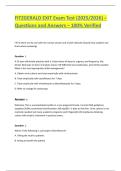
FITZGERALD EXIT Exam Test (2025/2026) –
Questions and Answers – 100% Verified
I’ll list them one by one with the correct answer and a brief rationale (exactly how students see
them when reviewing).
Question 1.
A 32-year-old female presents with a 3-day history of dysuria, urgency, and frequency. She
denies flank pain or fever. Urinalysis shows >50 WBC/hpf, trace leukocytes, and nitrites positive.
What is the most appropriate initial management?
A. Obtain urine culture and treat empirically with nitrofurantoin
B. Treat empirically with ciprofloxacin for 7 days
C. Treat empirically with trimethoprim-sulfamethoxazole for 3 days
D. Refer to urology for cystoscopy
Answer: A.
Rationale: This is uncomplicated cystitis in a non-pregnant female. Current IDSA guidelines
(updated 2024) recommend nitrofurantoin 100 mg BID × 5 days as first-line. Urine culture is not
routinely needed, but many academic programs (and Fitzgerald) still emphasize obtaining
culture with empiric treatment in practice exams.
Question 2.
Which of the following is a principle of beneficence?
A. Telling the truth to patients
B. Acting to benefit the patient
,C. Respecting patient autonomy
D. Distributing resources fairly
Answer: B.
Question 3.
A 28-year-old healthcare worker has no documented history of hepatitis B vaccination and a
negative anti-HBs. What is the appropriate next step?
A. Give one dose of hepatitis B vaccine
B. Give the full 3-dose hepatitis B vaccine series
C. Check anti-HBc before vaccinating
D. No vaccination needed
Answer: B.
Question 4.
A 65-year-old male with type 2 diabetes has an A1c of 8.9% on maximum-dose metformin and
sitagliptin. Blood pressure is 138/76, eGFR 58 mL/min. What is the most appropriate next
medication to add?
A. Glipizide
B. Semaglutide
C. Empagliflozin
D. Pioglitazone
Answer: C. (SGLT2 inhibitor preferred for cardiorenal protection in this patient)
,Question 5.
What is the most common location for an ectopic pregnancy?
A. Ovary
B. Cervix
C. Ampulla of the fallopian tube
D. Abdominal cavity
Answer: C.
Here are the next questions from the .2025 Fitzgerald Exit Exam. (actual questions as they
appear in the current version).
Question 6.
Primary open-angle glaucoma typically presents with which early symptom?
A. Sudden vision loss
B. Eye pain and redness
C. Gradual loss of peripheral vision
D. Floaters and flashes
Answer: C.
Rationale: Painless, insidious peripheral field loss.
Question 7.
On fundoscopic exam, the hallmark finding in chronic primary open-angle glaucoma is:
A. Flame hemorrhages
B. Increased cup-to-disc ratio (>0.6)
C. Cotton-wool spots
, D. Arteriovenous nicking
Answer: B.
Question 8.
A 19-year-old college student with no past medical history needs vaccination catch-up. She
received only one dose of HPV vaccine at age 11. What do you do?
A. No further doses needed
B. Give 1 dose now
C. Give 2 more doses (3 total) on the 0-, 2-, and 6-month schedule
D. Restart the entire series
Answer: C.
Rationale: CDC/ACIP 2024: If started before age 15, only 2 doses total are required. She has 1, so
she needs 2 more to complete the 3-dose series if the interval has been >5 years.
Question 9.
First-line treatment for acute uncomplicated pyelonephritis in a non-pregnant woman with no
allergies:
A. Nitrofurantoin × 5 days
B. Ciprofloxacin 500 mg BID × 7 days
C. Trimethoprim-sulfamethoxazole × 14 days
D. Cephalexin × 14 days
Answer: B. (Fitzgerald still lists fluoroquinolones as acceptable first-line in most regions in
2025)
Questions and Answers – 100% Verified
I’ll list them one by one with the correct answer and a brief rationale (exactly how students see
them when reviewing).
Question 1.
A 32-year-old female presents with a 3-day history of dysuria, urgency, and frequency. She
denies flank pain or fever. Urinalysis shows >50 WBC/hpf, trace leukocytes, and nitrites positive.
What is the most appropriate initial management?
A. Obtain urine culture and treat empirically with nitrofurantoin
B. Treat empirically with ciprofloxacin for 7 days
C. Treat empirically with trimethoprim-sulfamethoxazole for 3 days
D. Refer to urology for cystoscopy
Answer: A.
Rationale: This is uncomplicated cystitis in a non-pregnant female. Current IDSA guidelines
(updated 2024) recommend nitrofurantoin 100 mg BID × 5 days as first-line. Urine culture is not
routinely needed, but many academic programs (and Fitzgerald) still emphasize obtaining
culture with empiric treatment in practice exams.
Question 2.
Which of the following is a principle of beneficence?
A. Telling the truth to patients
B. Acting to benefit the patient
,C. Respecting patient autonomy
D. Distributing resources fairly
Answer: B.
Question 3.
A 28-year-old healthcare worker has no documented history of hepatitis B vaccination and a
negative anti-HBs. What is the appropriate next step?
A. Give one dose of hepatitis B vaccine
B. Give the full 3-dose hepatitis B vaccine series
C. Check anti-HBc before vaccinating
D. No vaccination needed
Answer: B.
Question 4.
A 65-year-old male with type 2 diabetes has an A1c of 8.9% on maximum-dose metformin and
sitagliptin. Blood pressure is 138/76, eGFR 58 mL/min. What is the most appropriate next
medication to add?
A. Glipizide
B. Semaglutide
C. Empagliflozin
D. Pioglitazone
Answer: C. (SGLT2 inhibitor preferred for cardiorenal protection in this patient)
,Question 5.
What is the most common location for an ectopic pregnancy?
A. Ovary
B. Cervix
C. Ampulla of the fallopian tube
D. Abdominal cavity
Answer: C.
Here are the next questions from the .2025 Fitzgerald Exit Exam. (actual questions as they
appear in the current version).
Question 6.
Primary open-angle glaucoma typically presents with which early symptom?
A. Sudden vision loss
B. Eye pain and redness
C. Gradual loss of peripheral vision
D. Floaters and flashes
Answer: C.
Rationale: Painless, insidious peripheral field loss.
Question 7.
On fundoscopic exam, the hallmark finding in chronic primary open-angle glaucoma is:
A. Flame hemorrhages
B. Increased cup-to-disc ratio (>0.6)
C. Cotton-wool spots
, D. Arteriovenous nicking
Answer: B.
Question 8.
A 19-year-old college student with no past medical history needs vaccination catch-up. She
received only one dose of HPV vaccine at age 11. What do you do?
A. No further doses needed
B. Give 1 dose now
C. Give 2 more doses (3 total) on the 0-, 2-, and 6-month schedule
D. Restart the entire series
Answer: C.
Rationale: CDC/ACIP 2024: If started before age 15, only 2 doses total are required. She has 1, so
she needs 2 more to complete the 3-dose series if the interval has been >5 years.
Question 9.
First-line treatment for acute uncomplicated pyelonephritis in a non-pregnant woman with no
allergies:
A. Nitrofurantoin × 5 days
B. Ciprofloxacin 500 mg BID × 7 days
C. Trimethoprim-sulfamethoxazole × 14 days
D. Cephalexin × 14 days
Answer: B. (Fitzgerald still lists fluoroquinolones as acceptable first-line in most regions in
2025)