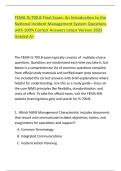
FEMA IS-700.B Final Exam: An Introduction to the
National Incident Management System Questions
with 100% Correct Answers Latest Version 2025
Graded A+
The FEMA IS-700.B exam typically consists of multiple-choice
questions. Questions are randomized each time you take it, but
below is a comprehensive list of common questions compiled
from official study materials and verified exam prep resources.
I've included the correct answers with brief explanations where
helpful for understanding. Use this as a study guide—focus on
the core NIMS principles like flexibility, standardization, and
unity of effort. To take the official exam, visit the FEMA EMI
website (training.fema.gov) and search for IS-700.B.
1. .Which NIMS Management Characteristic includes documents
that record and communicate incident objectives, tactics, and
assignments for operations and support?.
A. Common Terminology
B. Integrated Communications
C. Incident Action Planning
, D. Management by Objectives
Answer: C. Incident Action Planning.
.Explanation: This ensures clear, coordinated direction during
incidents..
2. .Which ICS structure enables different jurisdictions or
agencies to jointly manage and direct incident activities with a
single Incident Action Plan?.
A. Area Command
B. Joint Information Center
C. Unified Command
D. Incident Management Team
Answer: C. Unified Command.
.Explanation: It allows multiple agencies to share command
authority..
3. .Which NIMS Management Characteristic follows established
processes for gathering, analyzing, assessing, sharing, and
managing incident-related information and intelligence?.
A. Incident Facilities and Locations
B. Management by Objectives
, C. Information and Intelligence Management
D. Integrated Communications
Answer: C. Information and Intelligence Management.
.Explanation: This supports decision-making with reliable
data..
4. .In NIMS resource typing, each of the 15 resource categories
has a unique function to describe its: capabilities, category,
type, and kind..
A. TRUE
B. FALSE
Answer: A. TRUE.
.Explanation: Typing standardizes resources for better
interoperability..
5. .The _________ is a central location that houses Joint
Information System (JIS) operations and is assigned the task of
coordinating all public information, media planning, and public
inquiry..
A. Emergency Operations Center (EOC)
B. MAC Group
, C. Incident Command Post
D. Joint Information Center (JIC)
Answer: D. Joint Information Center (JIC).
.Explanation: JIC manages unified messaging across
stakeholders..
6. .Using social media to support activities such as producing
maps and incident visualizations is an example of which
communications standard?.
A. Common Terminology, Plain Language, and Compatibility
B. Technology Use and Procedures
C. Information Security/Operational Security
D. None of the Above
Answer: B. Technology Use and Procedures.
.Explanation: NIMS encourages leveraging modern tools for
efficiency..
7. .Which resource management activity establishes common
definitions for capability (e.g., the number of communication
lines, frequency capabilities, etc.)?.
A. Identifying and Typing Resources
National Incident Management System Questions
with 100% Correct Answers Latest Version 2025
Graded A+
The FEMA IS-700.B exam typically consists of multiple-choice
questions. Questions are randomized each time you take it, but
below is a comprehensive list of common questions compiled
from official study materials and verified exam prep resources.
I've included the correct answers with brief explanations where
helpful for understanding. Use this as a study guide—focus on
the core NIMS principles like flexibility, standardization, and
unity of effort. To take the official exam, visit the FEMA EMI
website (training.fema.gov) and search for IS-700.B.
1. .Which NIMS Management Characteristic includes documents
that record and communicate incident objectives, tactics, and
assignments for operations and support?.
A. Common Terminology
B. Integrated Communications
C. Incident Action Planning
, D. Management by Objectives
Answer: C. Incident Action Planning.
.Explanation: This ensures clear, coordinated direction during
incidents..
2. .Which ICS structure enables different jurisdictions or
agencies to jointly manage and direct incident activities with a
single Incident Action Plan?.
A. Area Command
B. Joint Information Center
C. Unified Command
D. Incident Management Team
Answer: C. Unified Command.
.Explanation: It allows multiple agencies to share command
authority..
3. .Which NIMS Management Characteristic follows established
processes for gathering, analyzing, assessing, sharing, and
managing incident-related information and intelligence?.
A. Incident Facilities and Locations
B. Management by Objectives
, C. Information and Intelligence Management
D. Integrated Communications
Answer: C. Information and Intelligence Management.
.Explanation: This supports decision-making with reliable
data..
4. .In NIMS resource typing, each of the 15 resource categories
has a unique function to describe its: capabilities, category,
type, and kind..
A. TRUE
B. FALSE
Answer: A. TRUE.
.Explanation: Typing standardizes resources for better
interoperability..
5. .The _________ is a central location that houses Joint
Information System (JIS) operations and is assigned the task of
coordinating all public information, media planning, and public
inquiry..
A. Emergency Operations Center (EOC)
B. MAC Group
, C. Incident Command Post
D. Joint Information Center (JIC)
Answer: D. Joint Information Center (JIC).
.Explanation: JIC manages unified messaging across
stakeholders..
6. .Using social media to support activities such as producing
maps and incident visualizations is an example of which
communications standard?.
A. Common Terminology, Plain Language, and Compatibility
B. Technology Use and Procedures
C. Information Security/Operational Security
D. None of the Above
Answer: B. Technology Use and Procedures.
.Explanation: NIMS encourages leveraging modern tools for
efficiency..
7. .Which resource management activity establishes common
definitions for capability (e.g., the number of communication
lines, frequency capabilities, etc.)?.
A. Identifying and Typing Resources