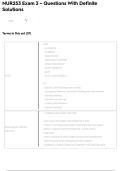
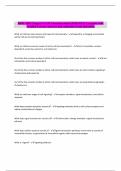
NUR253 Exam 3 – Questions With Definite
Solutions
Save
Terms in this set (37)
SXS:
- avoidance
- irritability
- detachment
- depression (suicide)
- sleep disturbance
- hypervigillance
- guilt
PTSD - poor concentration
NI:
- assure client feelings are normal
- recognize behavior between feeling and from trauma
- express feeling
- monitor suicide risk
- coping mechanisms
- support groups
- multiple personality disorder
•One sub-personality manifested at a time
•"Host" or primary personality dominant assumes given
Dissociative Identity
name, is passive and self-blaming, usually seeks
Disorder
treatment
•Host unaware of other states during their dominance
•Switching process changing of personalities
•Unable to connect aspects of identity with past/present
, Inability to recall information
SXS:
- inability to recall important info
- memory impairment can be partial- complete
Dissociative Amnesia
- may identify as different identity in a new environment,
drift from place to place, develop few relationships,
then return home and not be able to remember the
amnesia
•Depersonalization—focus on self
•Derealization—focus on outside world
•Persistent and recurrent experience of feeling
detached from mental processes or body without
disorientation
depersonalization/derealiz
SXS:
ation disorder
•Unsure of personal identity or information
•Derealization perceive external environment as unreal
or changing (mechanical)
•Unable to recognize illogical nature of feelings
•Anxiety, depression, somatic complaints
•Report feeling like a robot or outside observer
- feeling of detachment
- intact reality testing
- orient the client
- trusting relationship
- encourage verbal expression of painful experiences
- coping strategies
NI for Dissociative - identify source of conflict
Disorders - focus on strength and skill
- non demanding simple routines
- progress at own pace
- stress relief
- therapy
, worry associated with maladaptive response regarding
physical illness without physical illness findings.
NI:
-explore needs being met by physical sxs
- alternative ways to meet needs
Somatic Symptom disorder - use pain scale
- explore source of anxiety
- assist with recognizing own feelings (client)
- relaxation techniques
- diversional activities
- positive feedback
- anti anxiety meds
Characterized by extreme worry & fear about the
possibility of having a disease. Which leads to frequent
illness anxiety disorder scanning of body for signs of illness
*hypochondriac*
(previously known as Munchausen syndrome)
consciously pretend to be ill to get emotional needs
met & attain the status of patient. Pt. w/ this disorder
artificially, deliberately, & dramatically fabricate
Factitous disorder
symptoms or self inflict injury with the goal of assuming
the sick role.
*do have actual sxs*
*unexplained fever/bleeding*
ACUTE, often EMERGENT, caused by and UNDERLYING
AND USUALLY REVERSIBLE CAUSE.
•Acute onset
•Emergent
•LOC fluctuates
Delirium •Cognitive impairment
•Disoriented
•Agitated/fear/panic
•Delusions, hallucinations, illusions
•Common in hospitalized patients (elderly)
•Very common post op
•NEED TO KNOW PATIENT'S BASELINE COGNITION
Solutions
Save
Terms in this set (37)
SXS:
- avoidance
- irritability
- detachment
- depression (suicide)
- sleep disturbance
- hypervigillance
- guilt
PTSD - poor concentration
NI:
- assure client feelings are normal
- recognize behavior between feeling and from trauma
- express feeling
- monitor suicide risk
- coping mechanisms
- support groups
- multiple personality disorder
•One sub-personality manifested at a time
•"Host" or primary personality dominant assumes given
Dissociative Identity
name, is passive and self-blaming, usually seeks
Disorder
treatment
•Host unaware of other states during their dominance
•Switching process changing of personalities
•Unable to connect aspects of identity with past/present
, Inability to recall information
SXS:
- inability to recall important info
- memory impairment can be partial- complete
Dissociative Amnesia
- may identify as different identity in a new environment,
drift from place to place, develop few relationships,
then return home and not be able to remember the
amnesia
•Depersonalization—focus on self
•Derealization—focus on outside world
•Persistent and recurrent experience of feeling
detached from mental processes or body without
disorientation
depersonalization/derealiz
SXS:
ation disorder
•Unsure of personal identity or information
•Derealization perceive external environment as unreal
or changing (mechanical)
•Unable to recognize illogical nature of feelings
•Anxiety, depression, somatic complaints
•Report feeling like a robot or outside observer
- feeling of detachment
- intact reality testing
- orient the client
- trusting relationship
- encourage verbal expression of painful experiences
- coping strategies
NI for Dissociative - identify source of conflict
Disorders - focus on strength and skill
- non demanding simple routines
- progress at own pace
- stress relief
- therapy
, worry associated with maladaptive response regarding
physical illness without physical illness findings.
NI:
-explore needs being met by physical sxs
- alternative ways to meet needs
Somatic Symptom disorder - use pain scale
- explore source of anxiety
- assist with recognizing own feelings (client)
- relaxation techniques
- diversional activities
- positive feedback
- anti anxiety meds
Characterized by extreme worry & fear about the
possibility of having a disease. Which leads to frequent
illness anxiety disorder scanning of body for signs of illness
*hypochondriac*
(previously known as Munchausen syndrome)
consciously pretend to be ill to get emotional needs
met & attain the status of patient. Pt. w/ this disorder
artificially, deliberately, & dramatically fabricate
Factitous disorder
symptoms or self inflict injury with the goal of assuming
the sick role.
*do have actual sxs*
*unexplained fever/bleeding*
ACUTE, often EMERGENT, caused by and UNDERLYING
AND USUALLY REVERSIBLE CAUSE.
•Acute onset
•Emergent
•LOC fluctuates
Delirium •Cognitive impairment
•Disoriented
•Agitated/fear/panic
•Delusions, hallucinations, illusions
•Common in hospitalized patients (elderly)
•Very common post op
•NEED TO KNOW PATIENT'S BASELINE COGNITION