Chapter 12: Families and Aging - Detailed Notes
This chapter explores two fundamental social institutions: the Family (the
primary intimate group) and the societal trends and issues surrounding
Aging.
Key Terms: Family, Marriage, Incest taboo, Life expectancy, Ageism.
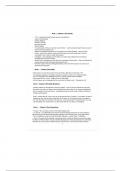
I. The Family: Structure, Functions, and Forms
A. Defining and Functioning of the Family
● Family: An intimate group in which two or more people have a
committed relationship, care for one another and any children, share
activities, and have close emotional ties.
● Marriage: A socially approved mating relationship that people expect
to be stable and enduring.
● Incest taboo: Cultural norms and laws that forbid sexual intercourse
between close blood relatives. (Universal function across cultures).
● Worldwide Functions of Family: Sexual activity regulation,
procreation and socialization, economic security, emotional support,
and social class placement.
B. Types of Families and Kinship
Concept Definition
Nuclear A married couple and their biological or adopted children.
family
Extended Two or more generations of people who live with or near
family each other (e.g., parents, children, grandparents).
Fictive kin Non-relatives who are accepted as part of the family
because they have strong emotional ties.
C. Marriage and Residence Patterns
, Concept Definition
Endogamy Cultural practice of marrying within one's own group
(e.g., religion, race, social class).
Exogamy Cultural practice of marrying outside one's own group.
Monogamy One person is married exclusively to one other person.
Serial Marrying several people over a lifetime, but only one at
monogamy a time.
Polygamy A system where a person has two or more spouses (e.g.,
polygyny, polyandry).
Marriage A term used by exchange theorists to describe how
market courtship and marriage mimic economic behaviors
(supply, demand, cost-benefit analysis).
Arranged Parents or relatives select the spouse for their children.
marriage
Patrilocal Newly married couple lives with the husband’s family.
residence
pattern
Matrilocal Newly married couple lives with the wife’s family.
residence
pattern
This chapter explores two fundamental social institutions: the Family (the
primary intimate group) and the societal trends and issues surrounding
Aging.
Key Terms: Family, Marriage, Incest taboo, Life expectancy, Ageism.
I. The Family: Structure, Functions, and Forms
A. Defining and Functioning of the Family
● Family: An intimate group in which two or more people have a
committed relationship, care for one another and any children, share
activities, and have close emotional ties.
● Marriage: A socially approved mating relationship that people expect
to be stable and enduring.
● Incest taboo: Cultural norms and laws that forbid sexual intercourse
between close blood relatives. (Universal function across cultures).
● Worldwide Functions of Family: Sexual activity regulation,
procreation and socialization, economic security, emotional support,
and social class placement.
B. Types of Families and Kinship
Concept Definition
Nuclear A married couple and their biological or adopted children.
family
Extended Two or more generations of people who live with or near
family each other (e.g., parents, children, grandparents).
Fictive kin Non-relatives who are accepted as part of the family
because they have strong emotional ties.
C. Marriage and Residence Patterns
, Concept Definition
Endogamy Cultural practice of marrying within one's own group
(e.g., religion, race, social class).
Exogamy Cultural practice of marrying outside one's own group.
Monogamy One person is married exclusively to one other person.
Serial Marrying several people over a lifetime, but only one at
monogamy a time.
Polygamy A system where a person has two or more spouses (e.g.,
polygyny, polyandry).
Marriage A term used by exchange theorists to describe how
market courtship and marriage mimic economic behaviors
(supply, demand, cost-benefit analysis).
Arranged Parents or relatives select the spouse for their children.
marriage
Patrilocal Newly married couple lives with the husband’s family.
residence
pattern
Matrilocal Newly married couple lives with the wife’s family.
residence
pattern