

Chapter 11: The Economy and Politics - Detailed Notes
The chapter explores the two highly interconnected social institutions that
organize the production and distribution of resources and the acquisition and
exercise of power.
Key Terms: Economy, Politics, Government, Power, Authority.
I. The Economy: Systems and Structures
A. Global Economic Systems
The Economy is the social institution that determines how a society
produces, distributes, and consumes goods and services.
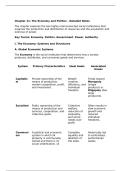
System Primary Characteristics Ideal Goals Associated
Issues
Capitalis Private ownership of the Wealth Tends toward
m means of production, creation, Monopoly
market competition, profit, efficiency, and (single
and investment. individual producer) or
freedom. Oligopoly (few
large
producers).
Socialism Public ownership of the Collective Often results in
means of production and welfare, slow economic
services, cooperation, and reduction of growth and
collective goals. inequality, reduced
and social individual
needs over freedoms.
profit.
Communi A political and economic Complete Historically led
sm system in which all equality and to centralized,
property is communally abolition of authoritarian
owned and there is no the state. states.
social stratification. (A
, theoretical ideal, not fully
realized in practice.)
Welfare A mixed system. Combines Balances Can lead to high
Capitalis private ownership with market taxes and
m government regulation freedom with complex
(subsidies, tax policies) and social safety bureaucracy.
social programs (e.g., nets.
healthcare, education).
B. Corporations and Power
A Corporation is a legal organization with rights, privileges, and liabilities
separate from its members.
● Conglomerate: A giant corporation that owns a collection of separate
companies in different industries.
● Transnational Corporation (TNC): A company that controls
production or services in multiple countries.
● Transnational Conglomerate: A corporation composed of
companies that own businesses across different industries and
countries.
Interwoven Corporate and Political Power:
● Interlocking directorate: Members of the board of directors of one
corporation also sit on the boards of others, often including
competitors, which concentrates economic power.
● Corporations wield immense influence through lobbying and campaign
financing.
II. The Changing U.S. Economy and Work
A. Shifts in the U.S. Economy
Macro-level changes have fundamentally reshaped U.S. labor:
1. Deindustrialization: The decline of manufacturing (factory) jobs and
the corresponding rise of service sector jobs (e.g., retail, healthcare,
finance).
The chapter explores the two highly interconnected social institutions that
organize the production and distribution of resources and the acquisition and
exercise of power.
Key Terms: Economy, Politics, Government, Power, Authority.
I. The Economy: Systems and Structures
A. Global Economic Systems
The Economy is the social institution that determines how a society
produces, distributes, and consumes goods and services.
System Primary Characteristics Ideal Goals Associated
Issues
Capitalis Private ownership of the Wealth Tends toward
m means of production, creation, Monopoly
market competition, profit, efficiency, and (single
and investment. individual producer) or
freedom. Oligopoly (few
large
producers).
Socialism Public ownership of the Collective Often results in
means of production and welfare, slow economic
services, cooperation, and reduction of growth and
collective goals. inequality, reduced
and social individual
needs over freedoms.
profit.
Communi A political and economic Complete Historically led
sm system in which all equality and to centralized,
property is communally abolition of authoritarian
owned and there is no the state. states.
social stratification. (A
, theoretical ideal, not fully
realized in practice.)
Welfare A mixed system. Combines Balances Can lead to high
Capitalis private ownership with market taxes and
m government regulation freedom with complex
(subsidies, tax policies) and social safety bureaucracy.
social programs (e.g., nets.
healthcare, education).
B. Corporations and Power
A Corporation is a legal organization with rights, privileges, and liabilities
separate from its members.
● Conglomerate: A giant corporation that owns a collection of separate
companies in different industries.
● Transnational Corporation (TNC): A company that controls
production or services in multiple countries.
● Transnational Conglomerate: A corporation composed of
companies that own businesses across different industries and
countries.
Interwoven Corporate and Political Power:
● Interlocking directorate: Members of the board of directors of one
corporation also sit on the boards of others, often including
competitors, which concentrates economic power.
● Corporations wield immense influence through lobbying and campaign
financing.
II. The Changing U.S. Economy and Work
A. Shifts in the U.S. Economy
Macro-level changes have fundamentally reshaped U.S. labor:
1. Deindustrialization: The decline of manufacturing (factory) jobs and
the corresponding rise of service sector jobs (e.g., retail, healthcare,
finance).


