
Electrical circuits and mathematical relationships Summary GR 10 – 12 IEB
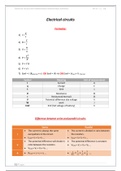
Electrical circuits
Formulae:
𝑞
1) I =
𝑡
𝑉
2) R =
𝐼
𝑤
3) V =
𝑞
𝑉2
4) P =
𝑅
5) P = I2 R
6) P = V I
7) Emf = I (Rexternal + r) OR Emf = IR +Ir OR Emf = Vload + V internal.
Symbol Meaning Unit of measurement
I Current A
q Charge C
t time s
R Resistance
r Resistance(internal)
V Potential difference aka voltage V
W work J
Emf Emf (full voltage of battery) V
Difference between series and parallel circuits:
Series Parallel
The current is always the same The current is divided in ratio between
I everywhere in the circuit. the resistors.
Itotal = I1 = I2 = I3 … Itotal = I1 + I2 + I3 …
The potential difference will divide in The potential difference is constant.
V ratio between the resistors. Vtotal = V1 = V2 = V3 …
Vtotal = V1 + V2 + V3 …
1 1 1 1
R Rtotal = r1 + r2 + r3 … = + + …
𝑅// r1 r2 r3
1|Page
, Electrical circuits and mathematical relationships Summary GR 10 – 12 IEB
Example: V2
6
6 In the circuit, there is
A X internal resistance. V2 is
4
3.6 V and the voltmeter
8V across the battery is 8v.
2) Calculate the resistance of the resistors in parallel.
1 1 1
𝑅//
= +
r1 r2
1 1 1
𝑅//
= +
4 6
R// = 2,4
1) Determine the reading on the ammeter.
V//
R// = - this formula is only used for parallel branches.
Itotal
3,6
2,4 =
I
I = 1,5 A
3) Determine the current through the 6 resistor.
Itotal = 1,5 A.
6 + 4 =10. We need to divide the total current in ratio.
Although the question asks for the current
1,5 10 = 0,15
through the 6 resistor, you need to multiply by
0,15 × 4 = 0,6 A the 4 resistor. This is because the greater
resistor, gets the least amount of current.
Always remember to divide in ratio and then
multiply by the opposite resistor that the
question is asking for!
2|Page
Electrical circuits
Formulae:
𝑞
1) I =
𝑡
𝑉
2) R =
𝐼
𝑤
3) V =
𝑞
𝑉2
4) P =
𝑅
5) P = I2 R
6) P = V I
7) Emf = I (Rexternal + r) OR Emf = IR +Ir OR Emf = Vload + V internal.
Symbol Meaning Unit of measurement
I Current A
q Charge C
t time s
R Resistance
r Resistance(internal)
V Potential difference aka voltage V
W work J
Emf Emf (full voltage of battery) V
Difference between series and parallel circuits:
Series Parallel
The current is always the same The current is divided in ratio between
I everywhere in the circuit. the resistors.
Itotal = I1 = I2 = I3 … Itotal = I1 + I2 + I3 …
The potential difference will divide in The potential difference is constant.
V ratio between the resistors. Vtotal = V1 = V2 = V3 …
Vtotal = V1 + V2 + V3 …
1 1 1 1
R Rtotal = r1 + r2 + r3 … = + + …
𝑅// r1 r2 r3
1|Page
, Electrical circuits and mathematical relationships Summary GR 10 – 12 IEB
Example: V2
6
6 In the circuit, there is
A X internal resistance. V2 is
4
3.6 V and the voltmeter
8V across the battery is 8v.
2) Calculate the resistance of the resistors in parallel.
1 1 1
𝑅//
= +
r1 r2
1 1 1
𝑅//
= +
4 6
R// = 2,4
1) Determine the reading on the ammeter.
V//
R// = - this formula is only used for parallel branches.
Itotal
3,6
2,4 =
I
I = 1,5 A
3) Determine the current through the 6 resistor.
Itotal = 1,5 A.
6 + 4 =10. We need to divide the total current in ratio.
Although the question asks for the current
1,5 10 = 0,15
through the 6 resistor, you need to multiply by
0,15 × 4 = 0,6 A the 4 resistor. This is because the greater
resistor, gets the least amount of current.
Always remember to divide in ratio and then
multiply by the opposite resistor that the
question is asking for!
2|Page


