

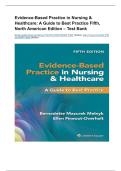
Evidence-Based Practice in Nursing &
Healthcare: A Guide to Best Practice Fifth,
North American Edition – Test Bank
by Bernadette Mazurek Melnyk PhD RN CPNP/PMHNP FNAP (Author), Ellen Fineout-Overholt PhD
RN FNAP FAAN (Author)
,TABLE OF CONTENTS
Chapter 1 Making the Case for Evidence-Based Practice and Cultivating a Spirit of
Inquiry
Chapter 2 Asking Compelling Clinical Questions
Chapter 3 Finding Relevant Evidence to Answer Clinical Questions
Chapter 4 Critically Appraising Knowledge for Clinical Decision Making
Chapter 5 Clinician Expertise and Patient-Valued Preferences as Context for
Critical Appraisal for Evidence-Based Decision Making
Chapter 6 Critically Appraising Quantitative Evidence for Clinical Decision
Making
Chapter 7 Critically Appraising Qualitative and Mixed Methods Evidence for
Clinical Decision Making
Chapter 8 Advancing Optimal Care With Robust Clinical Practice Guidelines
Chapter 9 Key Strategies for Implementing Evidence in Real-World Clinical
Settings
Chapter 10 The Role of Quality Improvement and Evidence-based Quality
Improvement in Practice Changes
Chapter 11 Implementing the Evidence-Based Practice Competencies in Clinical and
Academic Settings to Ensure Healthcare Quality, Safety, and Improved Patient Outcomes
Chapter 12 Leadership Strategies for Creating and Sustaining Evidence-Based
Practice Organizations
Chapter 13 Innovation and Evidence: A Partnership in Advancing Best Practice and
High-Quality Care
Chapter 14 Models to Guide Implementation and Sustainability of Evidence-Based
Practice
Chapter 15 Implementation Science to Clinical Practice Settings: Accelerating the
Uptake of Evidence into Practice for Best Outcomes
Chapter 16 Evidence-Based Practice Mentors: The Key to Sustaining Evidence-
Based Practice in Clinical and Educational Settings
Chapter 17 Creating a Vision and Motivating a Change to Evidence-Based Practice
in Individuals, Teams, and Organizations
Chapter 18 Teaching Evidence-Based Practice in Academic Settings
Chapter 19 Teaching Evidence-Based Practice in Clinical Settings
Chapter 20 Using Evidence to Influence Health and Organizational Policy
Chapter 21 Disseminating Evidence Through Presentations, Publications, Health
Policy Briefs and the Media
Chapter 22 Generating Evidence through Quantitative and Qualitative Research
Chapter 23 Writing a Successful Grant Proposal to Fund Research and Evidence-
,Based Practice Implementation Projects
Chapter 24 Ethical Considerations for Evidence Implementation and Evidence
Generation
, Understanding Pathophysiology, 5th Edition
Chapter 01: Cellular Biology
MULTIPLE CHOICE
Huether & McCance: Understanding Pathophysiology, 5th Edition MULTIPLE CHOICE
1. A student is observing a cell under the microscope. It is observed to have supercoiled
DNA with histones. Which of the following would also be observed by the student?
a. A single circular chromosome
b. A nucleus
c. Free-floating nuclear material
d. No organelles ANSWER; B
The cell described is a eukaryotic cell, so it has histones and a supercoiled DNA within its
nucleus; thus, the nucleus should be observed. A single circular chromosome called a
prokaryote contains free-floating nuclear material but has no organelles.
REF: p. 2
2. A nurse is instructing the staff about cellular functions. Which cellular function is the
nurse describing when an isolated cell absorbs oxygen and uses it to transform nutrients to
energy?
a. Metabolic absorption
b. Communication
c. Secretion
d. Respiration
Healthcare: A Guide to Best Practice Fifth,
North American Edition – Test Bank
by Bernadette Mazurek Melnyk PhD RN CPNP/PMHNP FNAP (Author), Ellen Fineout-Overholt PhD
RN FNAP FAAN (Author)
,TABLE OF CONTENTS
Chapter 1 Making the Case for Evidence-Based Practice and Cultivating a Spirit of
Inquiry
Chapter 2 Asking Compelling Clinical Questions
Chapter 3 Finding Relevant Evidence to Answer Clinical Questions
Chapter 4 Critically Appraising Knowledge for Clinical Decision Making
Chapter 5 Clinician Expertise and Patient-Valued Preferences as Context for
Critical Appraisal for Evidence-Based Decision Making
Chapter 6 Critically Appraising Quantitative Evidence for Clinical Decision
Making
Chapter 7 Critically Appraising Qualitative and Mixed Methods Evidence for
Clinical Decision Making
Chapter 8 Advancing Optimal Care With Robust Clinical Practice Guidelines
Chapter 9 Key Strategies for Implementing Evidence in Real-World Clinical
Settings
Chapter 10 The Role of Quality Improvement and Evidence-based Quality
Improvement in Practice Changes
Chapter 11 Implementing the Evidence-Based Practice Competencies in Clinical and
Academic Settings to Ensure Healthcare Quality, Safety, and Improved Patient Outcomes
Chapter 12 Leadership Strategies for Creating and Sustaining Evidence-Based
Practice Organizations
Chapter 13 Innovation and Evidence: A Partnership in Advancing Best Practice and
High-Quality Care
Chapter 14 Models to Guide Implementation and Sustainability of Evidence-Based
Practice
Chapter 15 Implementation Science to Clinical Practice Settings: Accelerating the
Uptake of Evidence into Practice for Best Outcomes
Chapter 16 Evidence-Based Practice Mentors: The Key to Sustaining Evidence-
Based Practice in Clinical and Educational Settings
Chapter 17 Creating a Vision and Motivating a Change to Evidence-Based Practice
in Individuals, Teams, and Organizations
Chapter 18 Teaching Evidence-Based Practice in Academic Settings
Chapter 19 Teaching Evidence-Based Practice in Clinical Settings
Chapter 20 Using Evidence to Influence Health and Organizational Policy
Chapter 21 Disseminating Evidence Through Presentations, Publications, Health
Policy Briefs and the Media
Chapter 22 Generating Evidence through Quantitative and Qualitative Research
Chapter 23 Writing a Successful Grant Proposal to Fund Research and Evidence-
,Based Practice Implementation Projects
Chapter 24 Ethical Considerations for Evidence Implementation and Evidence
Generation
, Understanding Pathophysiology, 5th Edition
Chapter 01: Cellular Biology
MULTIPLE CHOICE
Huether & McCance: Understanding Pathophysiology, 5th Edition MULTIPLE CHOICE
1. A student is observing a cell under the microscope. It is observed to have supercoiled
DNA with histones. Which of the following would also be observed by the student?
a. A single circular chromosome
b. A nucleus
c. Free-floating nuclear material
d. No organelles ANSWER; B
The cell described is a eukaryotic cell, so it has histones and a supercoiled DNA within its
nucleus; thus, the nucleus should be observed. A single circular chromosome called a
prokaryote contains free-floating nuclear material but has no organelles.
REF: p. 2
2. A nurse is instructing the staff about cellular functions. Which cellular function is the
nurse describing when an isolated cell absorbs oxygen and uses it to transform nutrients to
energy?
a. Metabolic absorption
b. Communication
c. Secretion
d. Respiration


