NURS 480 Neurological Disorders – Questions
With Precise Solutions
Save
Practice questions for this set
Learn 1 /7 Study with Learn
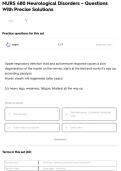
Upper respiratory infection start and autoimmune response causes a slow
degeneration of the myelin on the nerves; starts at the feet and works it's way up;
ascending paralysis
Myelin sheath will regenerate (after years)
S/s heavy legs, weakness, fatigue, bilateral all the way up
Choose an answer
Wernikes area- L posteriori temporal
1 Frontal lobe 2
lobe
3 Gillian-Barré syndrome 4 brain stem
Don't know?
Terms in this set (60)
Frontal lobe thinking, memory, behavior and movement
Parietal lobe language-- aphasias
, Temporal lobe hearing, HR, and temp
Occipital lobe sight
brain stem non voluntary action: breathing, HR, and temperature
balance and coordination
Cerebellum
focus on muscle tone
Function: regulates
parasympathetic and sympathetic
nervous system, sleep,
temperature, related to hormone
regulation
Hypothalmus
Brain structure that acts as a
control center for recognition
and analysis of hunger, thirst,
fatigue, anger and body
temperature
A hindbrain structure that connects the medulla to the
Pons two sides of the cerebellum; helps coordinate and
integrate movements on each side of the body
Medulla Base of brainstem; controls heartbeat and breathing
Midbrain coordination
Various visual deficits. Cortical blindness. Modifications:
avoid diagrams, written materials, and reading.
environmental modifications required
occipital lobe lesion
Occipital lobe: blindness, seizures, hallucinations, HA,
N/V
Disinhibition and deficits in concentration, orientation,
and judgement. Reemergence of primitive reflexes
Frontal lobe lesion
Frontal Lobe: Dementia, depression, emotional lability,
inability to concentrate, impaired memory, flat affect,
speech impairment, bowel and bladder incontinence
Wernikes area- L posteriori speech
temporal lobe
With Precise Solutions
Save
Practice questions for this set
Learn 1 /7 Study with Learn
Upper respiratory infection start and autoimmune response causes a slow
degeneration of the myelin on the nerves; starts at the feet and works it's way up;
ascending paralysis
Myelin sheath will regenerate (after years)
S/s heavy legs, weakness, fatigue, bilateral all the way up
Choose an answer
Wernikes area- L posteriori temporal
1 Frontal lobe 2
lobe
3 Gillian-Barré syndrome 4 brain stem
Don't know?
Terms in this set (60)
Frontal lobe thinking, memory, behavior and movement
Parietal lobe language-- aphasias
, Temporal lobe hearing, HR, and temp
Occipital lobe sight
brain stem non voluntary action: breathing, HR, and temperature
balance and coordination
Cerebellum
focus on muscle tone
Function: regulates
parasympathetic and sympathetic
nervous system, sleep,
temperature, related to hormone
regulation
Hypothalmus
Brain structure that acts as a
control center for recognition
and analysis of hunger, thirst,
fatigue, anger and body
temperature
A hindbrain structure that connects the medulla to the
Pons two sides of the cerebellum; helps coordinate and
integrate movements on each side of the body
Medulla Base of brainstem; controls heartbeat and breathing
Midbrain coordination
Various visual deficits. Cortical blindness. Modifications:
avoid diagrams, written materials, and reading.
environmental modifications required
occipital lobe lesion
Occipital lobe: blindness, seizures, hallucinations, HA,
N/V
Disinhibition and deficits in concentration, orientation,
and judgement. Reemergence of primitive reflexes
Frontal lobe lesion
Frontal Lobe: Dementia, depression, emotional lability,
inability to concentrate, impaired memory, flat affect,
speech impairment, bowel and bladder incontinence
Wernikes area- L posteriori speech
temporal lobe