PPG mid-term summary
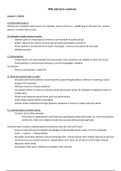
Lecture 1: 28/10
A: Why public policy?
Policies are needed to solve issues. For example, issues such as A.I., wealth gap in the west, etc. require
policies to tackle these issues.
B: Examples: public policy in action
- Obama’s plan on reducing co2 emissions (an example of public policy)
- Brexit: status of EU citizens living in the UK (what will happen to them?)
- Police (policies connected to the state’s monopoly - what can the police do and not)
- Welfare benefits
C: Policymaking:
- Governments not only involved, but also private actors (policies are needed to have this occur)
- Policymaking is a slow process because a lot of knowledge is needed
Conclusion:
- Policy is everywhere in daily life
D: What do policies help us with?
- Set goals and invent solutions (work towards a goal through policies. Policies in creating a space
program for example)
- Allocate means to achieve solutions
- Coordinate efforts to work on solutions (with the private sector for example to regularise them or
collaborate)
- Divide tasks between government and non-government
- Policy makes governments predictable
- Policies induce behavioral change (policies needed as a means to make everyone abide.
E: 2 perspectives on public policy:
Context: food safety example
EFSA (lots of requirements with how the supermarket deals with food, etc. there are policies
within this. Rules are needed to take into account when producing food)
Positivist take on policy making (what do positivists look at): Knill and Tosun
- Focus on fact and proof (scientific knowledge to tell whether food is safe or not for example)
- Facts ---> proof ---> policymaking
- Bounded rationality (Herbert Samuel developed this. Human beings have limited capacity to process
and they focus on certain elements. Policymakers can’t focus on all info, but still make rational
decisions within that)
- Assumption that actors behave according to their interest
, - Assume that there are institutional constraints (formal and informal rules in the system, how rules
determine how actors behave)
- Importance of resources → amount of resources time and effort to be put in
- Technocratic aspects prevail: this idea that knowledge in technology play a large role, less about
politics. If we’re rational → rational decisions → optimal result
- Assumes that policies are made by civil servants, politics less
- Rely on scientific expertise (food control)
- Interested in causality (smtg early in the food chain goes wrong → tracks what caused it for example)
Constructivist take on policy making: Stone
- Norm is a construction → scientists abide, some contest. Knowledge is multi-interpretative and used to
get their interests.
- All aspects of policies = subject to debate
- Weary when politicians talk about norms
- Information is never complete: guesses, expectations, there’s alternative ways always. Example:
Banking crisis and how they wanted to solve in 2 days which led them to taking guesses, etc. in order to
establish some form of policymaking asap.
- Strategy: manipulation of information.
Example:
- One political party advocates for diminishing poverty, the other does not. One will manipulate
information in order to have their gains for their political party.
- Deeply political
- In communities, self-interest and altruism can coexist
- Interpretations more powerful than fact. Example: different interpretations → influence policy making.
Lecture 2: 31/10
A: The public element
- Physical: roads, hospitals, schools
- Social: social movements (e.g. black lives matter)
public events (e.g. Martin Luther King day)
- A concern: an event or common interest of those who live in the same polity (rape in cologne and
attitude towards refugees/immigrants)
- An opinion: (e.g. surveys) also media, sharing information on certain issues and forming opinions on
that (collective belief)
- Public as a collective that fathers to deal with public concern
- Dewey: all those affected by the indirect consequences of transactions to such an extent that is
deemed necessary to have consequences systematically cared for
- Examples of publics:
- social movements
, - NGO’s
- Citizen initiatives
- Stone: public = concern and therefore public concern = public interest in politics never agreed as
communities struggle over public interest
- Common problems
- Public and private interests conflict
- E.g. coal power plants: power for families and pollute
- Self interest and public interest coming together (most policies are common problems
due to unintended effects)
- Does the government produce common problems?
- If 2 public interests collide then they do
- Climate goals from Paris accord and harming local economy (offshore wind
farms)
- Complexity of public interest
- Common problems are power struggles
- Government closing coal fueled plants
- Relocating families (invading rights/ privacy)
- Windmills built in sight
- Levers of power: influence, cooperation etc.
B: Policy element
- Policy, polity + politics
- Polity: institutional elements
- Politics: who gets what, when, why and how?
- Competition over resources (what)
- At others expense? (who)
- Nature of political power (how)
- Definitions beyond government
- Broad in what counts as politics
- Birland: what is public policy?
- Orientated to a problem
- Made on the public’s belief
- Orientated towards a goal or desired state
- Ultimately made by governments
- Implementation by other public actors (elaborate in L9)
- What the government chooses to do
- Birkland vs. Knill and Tosun
- B: focuses on statements
- K+T: misses public element and focuses on actions
Lecture 1: 28/10
A: Why public policy?
Policies are needed to solve issues. For example, issues such as A.I., wealth gap in the west, etc. require
policies to tackle these issues.
B: Examples: public policy in action
- Obama’s plan on reducing co2 emissions (an example of public policy)
- Brexit: status of EU citizens living in the UK (what will happen to them?)
- Police (policies connected to the state’s monopoly - what can the police do and not)
- Welfare benefits
C: Policymaking:
- Governments not only involved, but also private actors (policies are needed to have this occur)
- Policymaking is a slow process because a lot of knowledge is needed
Conclusion:
- Policy is everywhere in daily life
D: What do policies help us with?
- Set goals and invent solutions (work towards a goal through policies. Policies in creating a space
program for example)
- Allocate means to achieve solutions
- Coordinate efforts to work on solutions (with the private sector for example to regularise them or
collaborate)
- Divide tasks between government and non-government
- Policy makes governments predictable
- Policies induce behavioral change (policies needed as a means to make everyone abide.
E: 2 perspectives on public policy:
Context: food safety example
EFSA (lots of requirements with how the supermarket deals with food, etc. there are policies
within this. Rules are needed to take into account when producing food)
Positivist take on policy making (what do positivists look at): Knill and Tosun
- Focus on fact and proof (scientific knowledge to tell whether food is safe or not for example)
- Facts ---> proof ---> policymaking
- Bounded rationality (Herbert Samuel developed this. Human beings have limited capacity to process
and they focus on certain elements. Policymakers can’t focus on all info, but still make rational
decisions within that)
- Assumption that actors behave according to their interest
, - Assume that there are institutional constraints (formal and informal rules in the system, how rules
determine how actors behave)
- Importance of resources → amount of resources time and effort to be put in
- Technocratic aspects prevail: this idea that knowledge in technology play a large role, less about
politics. If we’re rational → rational decisions → optimal result
- Assumes that policies are made by civil servants, politics less
- Rely on scientific expertise (food control)
- Interested in causality (smtg early in the food chain goes wrong → tracks what caused it for example)
Constructivist take on policy making: Stone
- Norm is a construction → scientists abide, some contest. Knowledge is multi-interpretative and used to
get their interests.
- All aspects of policies = subject to debate
- Weary when politicians talk about norms
- Information is never complete: guesses, expectations, there’s alternative ways always. Example:
Banking crisis and how they wanted to solve in 2 days which led them to taking guesses, etc. in order to
establish some form of policymaking asap.
- Strategy: manipulation of information.
Example:
- One political party advocates for diminishing poverty, the other does not. One will manipulate
information in order to have their gains for their political party.
- Deeply political
- In communities, self-interest and altruism can coexist
- Interpretations more powerful than fact. Example: different interpretations → influence policy making.
Lecture 2: 31/10
A: The public element
- Physical: roads, hospitals, schools
- Social: social movements (e.g. black lives matter)
public events (e.g. Martin Luther King day)
- A concern: an event or common interest of those who live in the same polity (rape in cologne and
attitude towards refugees/immigrants)
- An opinion: (e.g. surveys) also media, sharing information on certain issues and forming opinions on
that (collective belief)
- Public as a collective that fathers to deal with public concern
- Dewey: all those affected by the indirect consequences of transactions to such an extent that is
deemed necessary to have consequences systematically cared for
- Examples of publics:
- social movements
, - NGO’s
- Citizen initiatives
- Stone: public = concern and therefore public concern = public interest in politics never agreed as
communities struggle over public interest
- Common problems
- Public and private interests conflict
- E.g. coal power plants: power for families and pollute
- Self interest and public interest coming together (most policies are common problems
due to unintended effects)
- Does the government produce common problems?
- If 2 public interests collide then they do
- Climate goals from Paris accord and harming local economy (offshore wind
farms)
- Complexity of public interest
- Common problems are power struggles
- Government closing coal fueled plants
- Relocating families (invading rights/ privacy)
- Windmills built in sight
- Levers of power: influence, cooperation etc.
B: Policy element
- Policy, polity + politics
- Polity: institutional elements
- Politics: who gets what, when, why and how?
- Competition over resources (what)
- At others expense? (who)
- Nature of political power (how)
- Definitions beyond government
- Broad in what counts as politics
- Birland: what is public policy?
- Orientated to a problem
- Made on the public’s belief
- Orientated towards a goal or desired state
- Ultimately made by governments
- Implementation by other public actors (elaborate in L9)
- What the government chooses to do
- Birkland vs. Knill and Tosun
- B: focuses on statements
- K+T: misses public element and focuses on actions